Your Bag Is Empty
Explore timeless jewelry that carries love and inspires lasting change
Every purchase gives one person access to clean, life-changing water.
Explore timeless jewelry that carries love and inspires lasting change
Diamond grading is an independent evaluation of a stone’s carat weight, color, clarity, cut when applicable, finish, measurements, fluorescence, and detected treatments. The report records that evaluation so you can compare grades, confirm the stone’s identity, and understand what you’re buying.
The 4Cs describe the main factors experts use to evaluate diamond quality. They are cut, color, clarity, and carat weight. Cut describes how well the stone’s facets and proportions work together to return light. Color describes how little body color a D-to-Z diamond shows. Clarity describes inclusions and blemishes. Carat weight measures how heavy the diamond is.
For many engagement-ring shoppers, cut deserves top priority because it has the strongest effect on sparkle. Your ideal balance may be different. Decide how you value visible size, color, clarity, and budget, then compare stones with those priorities in mind.
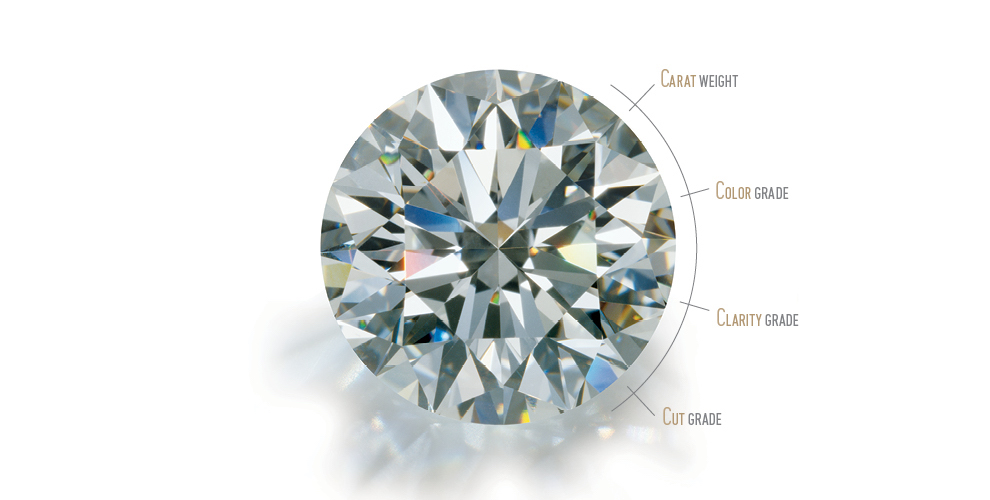
How are diamonds graded? A professional lab follows a controlled, anonymous process so the stone, not the seller, determines the result. GIA’s published grading process and IGI’s process differ in some details, but the core sequence is similar.
The laboratory assigns a unique tracking number and hides owner information from graders. The stone is then screened to identify natural, laboratory-grown, treated, or non-diamond material before quality grading begins.
A calibrated balance records carat weight. An optical scanner captures dimensions, proportions, and facet angles. These measurements separate weight from face-up size, which is why two diamonds with the same carat weight can look different.
Graders compare D-to-Z color under controlled lighting, usually with the stone viewed face down against master stones. Fluorescence is assessed separately and recorded on the report.
At 10x magnification, graders assess inclusions, blemishes, polish, symmetry, and signs of treatment. Clarity depends on the size, nature, number, position, and relief of the characteristics, not simply whether an inclusion exists.
For standard round brilliants in the D-to-Z range, GIA combines measurements with brightness, fire, scintillation, weight ratio, girdle thickness, durability, polish, and symmetry. Other laboratories and report types may handle fancy-shape cut differently.
Multiple graders provide independent opinions, and a final grade is issued only after sufficient agreement and quality control. The completed report receives a unique number that you can verify through the laboratory’s official report-check tool.
Think of a diamond grading scale as four related scales, not one overall score. This compact diamond grading chart shows what each diamond grade records and what you should compare.
| C | Scale or unit | How it is assessed | What to check |
| Cut | Excellent to Poor where an overall cut grade applies | Proportions and finish. For GIA rounds, brightness, fire, scintillation, weight ratio, girdle thickness, and durability | Confirm the lab, shape, and whether an overall cut grade applies |
| Color | D to Z | Compared face down with master stones under controlled lighting | Compare stones from the same lab, then view face up with the setting metal |
| Clarity | FL to I3 | Characteristics assessed at 10x by size, nature, number, position, and relief | Check eye cleanliness, transparency, durability concerns, and report notes |
| Carat weight | Carats and points | Weighed on a calibrated balance. Dimensions measured separately | Compare millimeter measurements because carat is not face-up size |
The report records the report number, shape, measurements, fluorescence, polish, symmetry, proportions, and treatment comments when relevant. Some report formats include a clarity plotting diagram and some do not. Use the laboratory’s online report-check tool to confirm the number and make sure the report details match the diamond.
Use the report number and grading fields to confirm that two listings describe the same diamond before comparing prices. Match the lab, report type, carat weight, measurements, color, clarity, and applicable cut details. A lower price means little if the listing covers a different stone or report format. Do Amore uses this same like-for-like check for eligible diamond price matches, with the report number serving as the fastest identity check. That turns the report from paperwork into a practical way to protect your budget.
Natural and laboratory-grown diamonds are both assessed for quality, but report language and formats differ. IGI reports the 4Cs and identifies laboratory-grown origin. For colorless to near-colorless laboratory-grown stones, GIA now assigns an overall Premium or Standard assessment rather than the natural-diamond 4Cs nomenclature. When comparing lab-grown and natural diamonds, read the origin designation, grading fields, treatment or growth comments, and verification details. Do not assume every report uses the same format.

A well-cut diamond returns light through the top as brightness, fire, and scintillation. Misaligned facets can send light through the sides or bottom, which creates dull or dark areas. Balanced proportions and precise facet placement help the stone look lively.
If you mean shape, a well-cut Round has the greatest potential for light return. If you mean cut grade, GIA’s top grade is Excellent. An Excellent grade indicates that, in the opinion of independent gem lab GIA, the standard round brilliant meets the lab’s top cut-quality range. GIA assigns an overall cut grade only to standard round brilliant diamonds in the D-to-Z color range. Fancy shapes still receive polish and symmetry assessments, but not a GIA overall cut grade.
An “ideal” cut diamond is a trade description, not one universal laboratory grade. Different sellers may use the term for different proportion ranges or light-performance standards. Treat “ideal” as a prompt to examine the grading criteria, proportions, symmetry, polish, and the stone’s actual appearance.
Screen a stone’s cut quality in three steps:
The “ideal proportions” of a diamond are useful as a screening tool, not a universal recipe for maximum sparkle. The ranges depend on shape and on how measurements interact. For a Round diamond, table and depth measurements can be useful starting points, but those numbers alone do not determine cut quality. GIA’s overall cut grade for standard round brilliants considers brightness, fire, scintillation, weight ratio, girdle thickness, durability, polish, and symmetry.
These measurements matter because they affect how light enters the diamond and returns to your eye.
Each shape has different cut features. For example, Round diamonds require specific crown angles and pavilion angles. Emerald cuts look best with evenly spaced steps. Princess cuts need balanced contrast. Open our resource section in another tab, choose your shape, and compare the details as you shop.
After checking the proportions, study the stone while it stays still. Start with obvious problems, then compare the small differences among the strongest candidates. Focus on symmetry, light return, the culet, and contrast.
Look at the diamond’s outline and imagine a line through its center. The left and right sides should feel balanced, with no bulges, flat spots, or odd angles. Strong symmetry makes the shape look intentional from every direction.
Blue marks contrast (shadow). Red marks extra weight (shape irregularity).
The pear on the left carries extra weight along its lower-right edge and upper-left shoulder. The red markings show where the outline loses balance. From a distance, that uneven shape can make the stone look less graceful.
The left pear has uneven dark areas. The right pear shows a more balanced pattern of contrast. Compare how evenly the darker reflections appear across each stone, then imagine how that pattern will change as the diamond moves.
With the stone still, look for even light return across its face. A dark center can create a nailhead effect, and a pale ring near the center can create a fisheye. Well-cut stones avoid these distracting patterns.
Nailheads and fisheyes can appear in any shape. The examples below show a fisheye in a cushion and a nailhead in a round.
Left, a cushion with a fisheye. Right, a round with a nailhead.
The culet is the small point or facet at the bottom of a diamond’s pavilion. View it through the table and check whether it sits on the stone’s center line. Its position is one clue to the overall symmetry, especially in shapes with a large, open table.
Use the same imaginary center line. A centered culet supports a balanced pattern, but an off-center culet can make the shape look uneven or distracting. Compare the heart below with a more symmetrical stone.
Heart with off-center culet
Rocking the diamond reveals how its contrast pattern changes with movement. View each stone under the same lighting and compare how bright and dark areas shift before judging sparkle.
Contrast describes how the diamond’s dark and bright reflections work together. You want some dark areas because they give the light pattern definition and help the stone look lively.
A stone with no meaningful contrast pattern can look flat, even when it appears bright. Balanced dark reflections give the bright areas structure and make the pattern feel livelier as the diamond moves.
“Dead” stones, without contrast.
Once the stone shows a healthy mix of light and dark, check whether the contrast looks balanced. Watch for distracting dark boxes, a strong bowtie, or uneven patches that interrupt the pattern. Compare several stones under the same lighting before deciding.
Left, a black box. Right, a bowtie and uneven patterns.
You can now screen a diamond for promising cut traits before a gemologist makes the final call. Look for balanced proportions, even light return, lively contrast, and a shape that feels symmetrical to your eye.
You can judge a diamond’s visible beauty without a loupe by comparing normal-size videos under the same lighting. Watch for even brightness, balanced contrast, a symmetrical outline, and inclusions you can see at everyday viewing distance. The grading report still matters, but it describes quality rather than choosing the most pleasing stone for you. Do Amore’s GIA gemologist, Corinne, helps shoppers compare those visible details with the report. That expert review is useful when two diamonds carry similar grades but look different on screen.
Carat weight is easy to notice, but it does not outrank every other C for every buyer. Treat it as one part of the balance among visible size, cut quality, color, clarity, and budget.
Carat measures weight, not size. One carat equals 0.2 grams, or 200 milligrams, and divides into 100 points. A 0.50 ct diamond weighs 50 points. Compare millimeter measurements to understand how large a stone will look from the top.
Carat weight does not guarantee a particular face-up size. Two diamonds with the same weight can have different lengths, widths, and depths because their proportions differ. The variation can be even more noticeable among non-round shapes.
“gem scales” measure diamonds by weight. “calipers” and “millimeter gauges” measure length and width.
There is no universally good carat weight for an engagement ring. The better question is how much finger coverage you want, because two diamonds with the same weight can face up at different sizes. Compare the stone’s millimeter measurements, shape, and proportions instead of shopping by carat alone.
Think about the finger the ring will sit on and the overall balance you want. A diamond’s length and width tell you more about face-up presence than carat weight alone, so compare measurements and try a scale image or sizing tool when possible.
Elongated shapes such as an Oval, Radiant, or Rectangular Cushion create different face-up outlines than Round or Princess at the same carat weight. A squarer outline or an east-west setting creates a different balance, so compare shapes on a scale image when possible.
Your setting changes how much space the ring covers on the finger, so compare the complete design rather than the center stone alone.
For a closer look at diamond carat weight, see how “light” carat weights can help you compare near-milestone weights and value.
Color matters because subtle warmth may be more visible in some shapes, sizes, and settings. Judge the report grade and the face-up appearance together.
Diamond color describes how little body color a D-to-Z diamond shows. The GIA scale has five ranges. D-F is Colorless, G-J is Near Colorless, K-M is Faint, N-R is Very Light, and S-Z is Light. These distinctions can be subtle. A diamond’s shape, cut, size, and setting metal affect how color appears face up.
Laboratories grade D-to-Z color with the diamond face down so sparkle does not distract from body color. Graders use controlled lighting, neutral backgrounds, and master stones to compare the unknown diamond with known grades. This process is why a casual face-up look cannot reproduce an official color grade.
What the diamond looks like face up may matter more to you than a one-grade difference on paper. Compare it with your setting metal and any side stones, then decide whether the warmth feels right. Yellow and rose gold can make warmth less noticeable. White metals and colorless side stones can make contrast easier to see.
D is the highest color grade, but it is not automatically the best value for every ring. G or H can be a smart range for some well-cut diamonds. Other shapes, larger stones, white-metal settings, or personal preferences may make a higher or warmer grade the better choice. Compare the stone face up and choose the look you prefer.
For more detail, read my full guide to diamond color here.
Diamond clarity describes the size, nature, number, position, and relief of internal inclusions and surface blemishes. Almost all diamonds have some clarity characteristics, and each pattern is unique.
On the GIA scale, FL means no inclusions or blemishes are visible at 10x magnification. IF means no inclusions are visible at 10x, though blemishes may be present. VVS and VS grades contain progressively easier-to-find inclusions. SI and I grades contain noticeable or obvious characteristics that may affect appearance, transparency, brilliance, or durability.
Official clarity grading belongs to a trained laboratory. Gemologists use a jeweler’s loupe and microscope at 10x magnification under controlled conditions, then judge characteristics by size, nature, number, position, and relief. Online magnified views are useful, but they cannot reliably tell you whether a stone is SI, VS, VVS, IF, or FL.
Use video to judge whether the diamond appears eye clean at normal size, whether inclusions reduce transparency, and whether an obvious feature sits near a vulnerable edge. This visual check helps you compare stones with the same report grade, but it cannot replace the report.
Left, visible inclusions in a magnified SI1 diamond. Right, the same stone appears eye clean without major magnification.
Two diamonds with the same clarity grade can still look different because the type, location, relief, and size of their inclusions differ. Use the grading report for classification, then use magnified media and normal-size viewing for a practical eye-cleanliness check.
The highest clarity grade is Flawless, but the best value depends on the individual stone. A VS2 may be eye clean and offer excellent value, yet inclusion visibility can change with stone size, faceting, location, and relief. In brilliant shapes such as round, princess, oval, cushion, radiant, pear, heart, and marquise, facets can sometimes help disguise inclusions, but there is no blanket guarantee.
Step cuts such as emerald and asscher use broad, open facets that can make inclusions easier to see. Some buyers prefer a higher clarity grade for that reason, but many stones below VVS can still look beautiful. Judge the report and the actual diamond together.
For more detail, read my full guide to diamond clarity here.
Before you buy, use this checklist to turn the grading report into a practical decision:
When you’re ready, browse engagement rings at your own pace. Every ring helps fund clean water for someone in need, and a gemologist can review your shortlist before you choose.
Your grading report should narrow the field, not leave you second-guessing every letter and number. Do Amore’s GIA gemologist can compare the details that affect appearance and value, then help you build a shortlist around your priorities. Every Do Amore purchase gives one person access to clean water, so your ring can carry meaning beyond the proposal.
Still unsure which grading details matter for your ring? I’m Corinne, Do Amore’s gemologist. I’m happy to help you compare color, clarity, cut, and grading reports without pressure, so ask away.