





Your bag is empty
Explore timeless jewelry that carries love and inspires lasting impact.
We promise that every purchase you make gives one person access to clean, life-changing water.
Explore timeless jewelry that carries love and inspires lasting impact.

Carat measures a diamond’s weight, not how large it looks on your finger. Shape, cut proportions, millimeter measurements, finger width, band width, and setting all change its visible size, so two diamonds with the same carat weight can look surprisingly different on the hand.
Use this guide to see how diamond carat size sits on a finger, then compare real stones without getting hung up on one number from a grading report. No size wins for everyone. The right proportion suits your style, feels comfortable, and stays inside the budget you set before the sparkle started talking.
When comparing round cut engagement rings, remember that a metric carat is a unit of weight equal to 200 milligrams, and each carat is divided into 100 points. That means a 0.75 carat diamond weighs 150 milligrams and may also be called a 75-pointer. The Gemological Institute of America’s diamond carat weight guide confirms those definitions. Carat tells you weight, not diameter.
Visible size is the length and width you see when the diamond faces up. A cutter can distribute more of a stone’s weight through its depth, pavilion, or girdle, leaving less of that weight visible from above. Another diamond of equal weight may have a wider face-up spread.
Millimeters give you a clearer picture. They show the outline your eye will actually see. But spread is only part of the story. A stone cut too shallow or with unbalanced proportions may look wide on paper while losing the brightness, fire, or pattern that caught your eye in the first place.
The chart below uses approximate face-up diameters for well-proportioned round diamonds to compare visible scale. Think of it as a visual starting point, not a promise. Every individual diamond has its own measurements, and fancy shapes need length-by-width comparisons rather than one diameter. Comparing radiant versus cushion cuts can help narrow two shapes before evaluating individual stones.
| Carat weight | Approx. round diameter | Neutral visual description |
| 0.50 ct | About 5.1 mm | Delicate center-stone presence |
| 0.75 ct | About 5.8 mm | Defined without dominating the hand |
| 1.00 ct | About 6.4 to 6.5 mm | Familiar, classic center-stone scale |
| 1.50 ct | About 7.3 to 7.4 mm | More visible finger coverage |
| 2.00 ct | About 8.1 to 8.2 mm | Strong visual impact |
| 3.00 ct | About 9.3 to 9.4 mm | Statement-scale coverage |
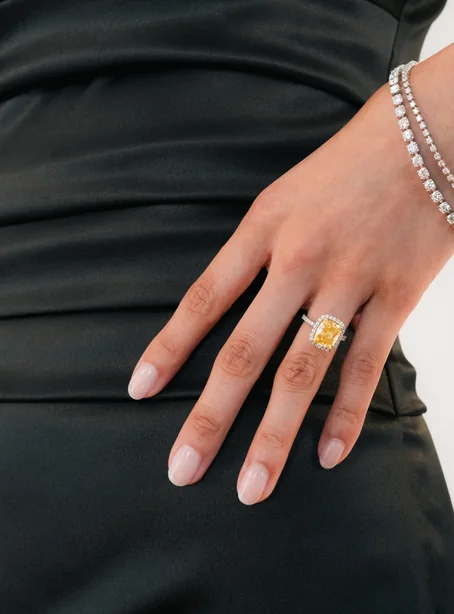
Viewed on a finger, a carat size chart makes the pattern clear: the jump in visual width is steady, but it is not proportional to weight. A 2 carat round weighs twice as much as a 1 carat round, yet it is only about 1.7 millimeters wider. Much of the added volume sits across three dimensions.
For a useful on-hand comparison, keep the camera distance, viewing angle, band style, and image scale consistent. Then view the same measured stones on at least two finger sizes. Otherwise, you may be comparing photography more than diamond size.
Round diamonds near 0.5, 0.75, and 1 carat generally move from delicate definition to a familiar classic presence. On a narrower finger, each may occupy more of the visible width. On a wider finger, the same diamond can feel more restrained without being less beautiful.
A slim band can place more visual emphasis on the center stone. A halo, bezel, or side stones can expand the ring’s total footprint, but they do not change the center diamond’s carat weight. Keep those two ideas separate while comparing rings.
This range is also a good reminder to look beyond milestone numbers. A well-cut diamond just under 1 carat may have measurements close to another stone at or over 1 carat. Compare the full combination of cut, color, clarity, dimensions, and grading details before deciding which offers the look you want.
Between 1.5 and 2 carats, the increase in face-up diamond size becomes easier to notice on most hands. The difference is still measured in millimeters, not in a doubling of visible width. Exact measurements will tell you more than the label alone.
Larger center stones also make the whole ring design more important. Check the setting height, prong security, comfort between neighboring fingers, and how a wedding band will sit beside the engagement ring. A low-profile design may feel easier for daily wear, while a higher setting may allow more band styles to sit flush.
Protect cut quality as you compare. More weight does not automatically produce more beauty or even more visible spread. A lively, well-proportioned diamond can command attention without reaching the largest carat number in your search.
At 3 carats and above, a center diamond creates statement-scale coverage. Elongated ovals, emerald cuts, pears, and marquises may extend even farther along the finger, while round or squarer outlines concentrate the visual area differently.
At this scale, a try-on or accurate mockup earns its keep. Check the profile height, snag risk, prongs, band width, and how the ring feels during an ordinary day. A beautiful ring should work with your hands, not make you handle them differently.
A 3 carat diamond ring creates a bold design, and that look will not suit everyone. Some people love a commanding center stone. Others prefer a quieter proportion or put more of the budget toward cut quality, the setting, or a future wedding band.
Your finger acts as the frame around the diamond. The same measured stone usually looks more prominent on a narrower finger and more restrained on a wider one because the amount of visible space around it changes.
When judging how a ring’s carat size looks on a finger, remember that ring size helps, but circumference is only one clue. From above, the picture also changes with finger width, finger shape, knuckle width, and overall hand proportions. Two people can wear the same ring size and see the same diamond quite differently.
Start by confirming the correct ring size. If you are unsure, Do Amore’s guide to getting an accurate ring size explains several practical approaches. Next, place an accurately scaled stone silhouette on the actual finger or compare on-hand images taken from the same distance and angle.
On a smaller ring size, a modest carat weight may take up plenty of visible finger width. A slim band or elongated outline can push that effect further. Treat both as options, never rules for petite hands.
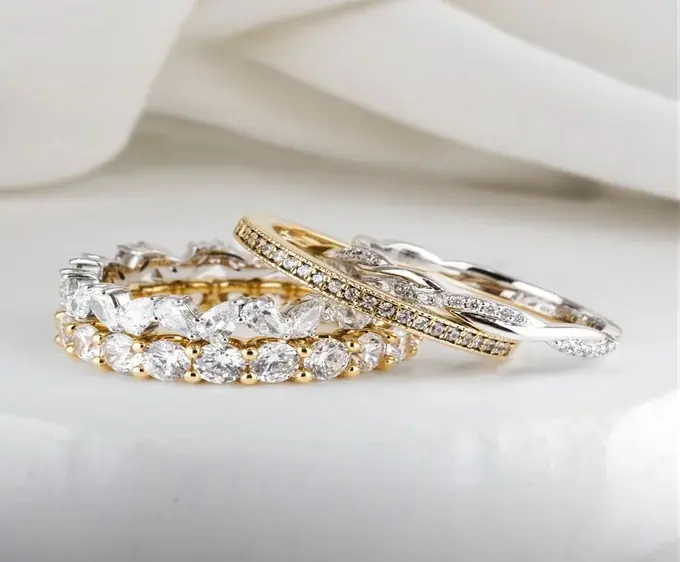
Look at the complete stack. If a wedding band will sit beside the engagement ring, include it in your mockup or try-on. The extra width can change the balance, comfort, and amount of finger space the design occupies.
On a size 5 finger, judge a round diamond by measured diameter and the presence you want, not by a prescribed carat weight. There is no correct number. Use the chart’s approximate diameters to print or draw true-scale circles, then compare 5.8, 6.4 to 6.5, and 7.3 to 7.4 millimeters directly on the finger. Engagement ring buying statistics offer context, while your own budget and preferences should set the limits for the ring.
Do Amore’s round engagement ring collection includes solitaire, halo, bezel, and side-stone settings, so equal-diameter center stones can create very different total footprints. Pick the center outline first, then judge it with the actual band width and future wedding band. That keeps a size 5 recommendation personal instead of turning it into a rule. When comparing stone options, weigh moissanite versus cubic zirconia separately from the shape and setting you prefer.
On an average-to-larger ring size, start with the presence you want instead of a carat target someone else picked. Quiet, balanced, bold, all can look right. Exact measurements turn those loose descriptions into a real outline.
The setting can add coverage without adding center-stone weight. Side stones and halos widen the overall composition, a bezel creates a defined rim, and a wider band brings more metal into view. An east-west setting turns an elongated shape across the finger, changing the ring’s footprint again.
Step back and look at the whole ring. The center stone, band, prongs, profile, and future wedding band need to make sense together.
Shape changes where a diamond places its visible area. At the same carat weight, elongated outlines often create more length along the finger, while squarer or deeper shapes may hold more volume below the face-up view.
That does not make one outline universally better. Shape also changes the style of the ring, the facet pattern you see, and the setting needed to protect vulnerable points. Do Amore’s diamond shapes guide can help you compare the personality and practical trade-offs of each silhouette.
Oval, emerald, marquise, and pear diamonds can look longer on the hand because their length-to-width ratios stretch the outline. Two 1 carat ovals may still look quite different if one is short and broad while the other is narrow and elongated.
When comparing how an oval’s carat size looks on a finger, exact length and width matter alongside weight. When comparing oval cut engagement rings, check those measurements alongside the outline and length-to-width ratio. A 1.5 carat label alone cannot tell you whether the outline is slender, broad, softly shouldered, or sharply defined.
Review videos as well as measurements. Ovals and some other elongated brilliant shapes can show a bow-tie pattern across the center. Pear and marquise points need thoughtful protection. Emerald cuts reveal broad flashes and open facets, so their visual character comes from more than coverage alone.
Round diamonds are a familiar benchmark because diameter makes their face-up size easy to compare. Cushion, princess, and Asscher diamonds often look more compact at equal weight when more volume sits in depth, though the proportions of the individual stone always matter.
Facet style changes visual impression too. Round, princess, cushion, and radiant cuts generally create busy patterns of sparkle, while emerald and Asscher cuts show broader, hall-of-mirrors flashes. Neither effect is automatically more beautiful. Your eye gets the deciding vote.
Compare each shape at a consistent scale, then ask two questions. Do I like the outline on the hand? Do I still like the facet pattern when the stone moves? A larger-looking silhouette cannot answer that second question.
To compare face-up coverage across diamond shapes, match carat weight and quality, then check each stone’s length and width at the same scale. Elongated oval, marquise, pear, and emerald outlines often extend farther along the finger than a round of equal weight. Deeper square shapes can look more compact because more volume sits below the top view.
Do Amore offers round, oval, emerald, pear, radiant, marquise, cushion, princess, Asscher, and heart-shaped engagement rings, so you can keep the comparison within one jeweler’s settings and scale. Narrow the field to two shapes, print each outline at its listed measurements, and view both on the finger. Choose the one whose outline and light pattern you love, not the one that wins a size contest.
Millimeter measurements show how a diamond’s carat size will look on a finger. On a grading report or product listing, look for length, width, and depth. Round diamonds usually use diameter measurements, while fancy shapes are best compared by length and width together.
For an emerald-cut diamond, carat size on the finger depends heavily on exact length and width, not weight alone. Suppose two round diamonds both weigh 1 carat. One measures about 6.3 millimeters across and the other about 6.5 millimeters. The second has a wider face-up spread, but that alone does not prove it has the better cut or light performance. Compare proportions, cut information, images, and video before choosing.
Do Amore’s guide to carat size versus diamond size goes deeper into visible spread and hidden weight. The GIA’s guidance on perceived diamond size also explains why shape, girdle, pavilion, and cut proportions can hide weight or make a wider stone less appealing when light leaks through it.
Use a ruler or an accurately printed silhouette to make the numbers real. Scale the shape to the stated dimensions, place it on the finger, and view it from a normal distance. A millimeter sounds tiny, but even a fraction of one can be visible in a center stone.
The setting changes the entire frame around a center diamond. To see how carat size looks on the finger with an emerald cut, compare the setting as closely as the stone. For emerald cut engagement rings, check corner protection and how much of the rectangular outline remains visible. A solitaire leaves the outline easy to see. A halo adds a border of smaller stones, while a three-stone or side-stone ring carries sparkle farther across the finger. A bezel creates a clean metal rim and can add edge protection.
Band width changes the contrast. A thin band can make the center look more prominent. A wider one can soften that contrast, bring a large stone into better balance, or simply feel more like the wearer. Neither choice changes the diamond’s measurements.
Prongs have a small footprint and a big job. They must hold the stone securely without covering more of its face than necessary. Pear, marquise, and princess diamonds also need settings that protect their points during daily wear.
If you are considering a personalized design, look at the complete proportions before production. Do Amore’s custom ring process requires a deposit before the CAD render. You can then review the design before production. Judge the center diamond, band, setting height, and wedding-band fit together.
Skip formulas that assign a carat weight to a ring size. A repeatable comparison process keeps your own priorities in charge.
Diamonds just below popular weight milestones deserve a look, but never count on an automatic bargain or an identical appearance. Inventory, quality, measurements, and pricing vary. Let the actual stones make the case.
Natural and lab-grown diamonds can both be meaningful choices. If future resale is one of your priorities, review lab-grown diamond value before deciding how much of your budget goes toward the center stone. Compare them according to the priorities that matter to you, without treating either origin as the default. Do Amore offers responsibly sourced, conflict-free natural and lab-grown diamonds, and its online team can help you review the measurements and proportions of a specific stone without pressure.
Once you know the presence you want, browse engagement ring settings to see how different bands, halos, bezels, and side stones change the complete composition. Save your favorites and compare them at a consistent scale.
A well-proportioned 1 carat round diamond is often about 6.4 to 6.5 millimeters across, though the individual stone’s measurements may differ. It usually looks more prominent on a narrower finger and more restrained on a wider one.
To judge carat size on a finger for an oval, pear, emerald cut, or marquise diamond, compare the exact outline because fancy shapes create different coverage at the same weight. Ovals, pears, emerald cuts, and marquises use length-by-width measurements, so compare their outlines directly rather than treating the round diameter as universal. Consider diamond shapes and sparkle alongside measurements when comparing the overall look of individual stones.
There is no single best carat size for a size 7 finger. Shape, setting, band width, desired presence, comfort, and budget matter more than the ring-size number alone.
Use true-scale examples to compare subtle, balanced, and statement-making proportions on the actual hand. An accurately scaled mockup is more useful than a rule that assigns everyone with the same ring size one carat weight.
A well-proportioned 2 carat round diamond is often approximately 8.1 to 8.2 millimeters across. Fancy shapes should be judged by their exact length and width, and the same 2 carat stone will look different across finger sizes and band widths.
At this scale, also review setting height, prong security, comfort, and wedding-band fit. The ring needs to work in daily life as beautifully as it works in a close-up photo.
The right carat size on finger feels considered from every angle, from shape and visible spread to comfort, quality, and cost. Check the measurements. Compare at true scale. Then choose what you love, even if a milestone number points somewhere else.
When you are ready, compare Do Amore’s responsibly sourced, conflict-free natural and lab-grown diamonds by shape, carat weight, and millimeter measurements. Save two or three combinations, then ask the online team to review their proportions with you. Every Do Amore ring helps give one person access to clean water, so your choice can mark your love and deepen the well of love in the world.