


Your Bag Is Empty
Explore timeless jewelry that carries love and inspires lasting change
Every purchase gives one person access to clean, life-changing water.
Explore timeless jewelry that carries love and inspires lasting change
When someone refers to a “diamond tester”, most people mean a handheld “pen” tester that measures a gemstone’s thermal conductivity. In other worse, how a gem handles heat. These testers use a small metal point which, when put on a gem’s surface, measure how quickly heat travels through the stone. People use these to test diamonds because diamonds have super high conductivity.
Diamond testers can be a helpful tool as part of a multi-stage test, but should not be solely relied upon. These little pens are a helpful way to separate out CZ from diamond. But that should be the beginning and end of their use. Why? Because other gems also have high conductivity (such as moissanite) and because the testers themselves notoriously malfunction. Reasons I have seen these testers fail include user error (stones will not test correctly if the point touches metal), low battery, or age/abuse of the pen.
Yes, some diamond simulants can pass a diamond tester. For example, moissanite, a man made gem, may pass as a diamond on a standard tester pen. This is because moissanite also has very high thermal conductivity! That result does not make moissanite a diamond; moissanite engagement rings use a distinct gemstone with unusually high thermal conductivity. Care, residue, and stone quality all matter when evaluating whether moissanite gets cloudy or simply needs a thorough cleaning.
Other diamond simulants, such as CZ, will not pass the tester. So, it’s important to use multiple tests to confirm your stone!
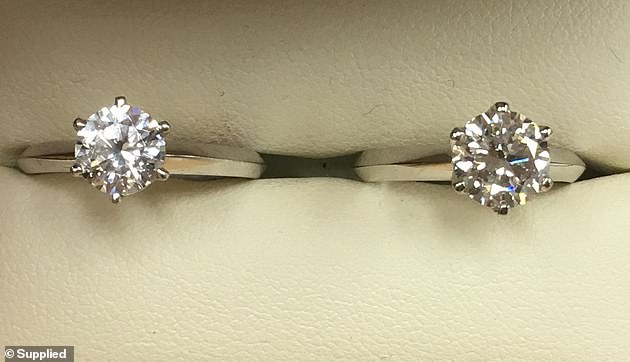
Note the CZ’s (left) lack of depth and “plasticky” reflection vs the Diamond’s (right) multi-tonal shades and crisp reflection?
The major tests jewelers use to tell real diamonds from other white stones are confirming they are singly refractive, have 10/10 hardness, and super high conductivity. Moissanite is doubly refractive under magnification, which easily separates it from diamond. CZ, white sapphire, and white topaz do not have high conductivity using a pen tester. Finally, lesser known diamond simulants do not have high hardness, which can be seen through magnification.
Yes! Rainbow sparkle in a diamond is called “fire”. There is some misinformation out there that diamonds do not show colored light – however this is false. In fact, a diamond’s ability to show a rainbow of color is one of its most prized features, and one of the reasons it is preferred by many over other white stones like white sapphire or white topaz. Moreover, diamonds show a balanced display of rainbow and white sparkle. This should be compared against moissanite and CZ’s major colored sparkle, which outshines its white sparkle.
Typically a lab diamond will test as diamond on a pen tester because they are pure carbon just like mined diamonds. Testing a lab diamond is a little more complicated than testing a natural diamond, however. That is because lab diamonds are grown using differing methods and over differing courses of time. This results in different crystal densities (and thermal conductivity levels). As a result, some lab diamonds (HPHT especially) may test as Moissanite on a diamond tester and require further testing.
Ironically, just like Moissanite can test as diamond, diamond can also test like Moissanite. This is because diamonds have a range of thermal conductivity, depending upon crystal density. This is especially true for HPHT lab diamonds. So, if this happens to you, don’t immediately assume the worst. Again, these pen testers are not foolproof. Here’s what to do:
Lab diamonds can be separated from natural diamonds by reviewing the diamond’s certificate inscription underneath a scope. Lab diamonds will be marked “lab grown” or “LG”, whereas naturals will not have these prefixes. Gem scientists are also be able to tell lab diamonds from natural diamonds using advanced magnification, fluorescence, and laser techniques.
Natural diamonds, lab diamonds, and non-diamond moissanite! This is because a handheld pen “diamond tester” actually only tests the ability of a gem to conduct heat. It does not test for whether or not the stone is, for example, pure carbon (like diamonds are). So, while the pen tester is helpful – it’s only one piece of the puzzle!
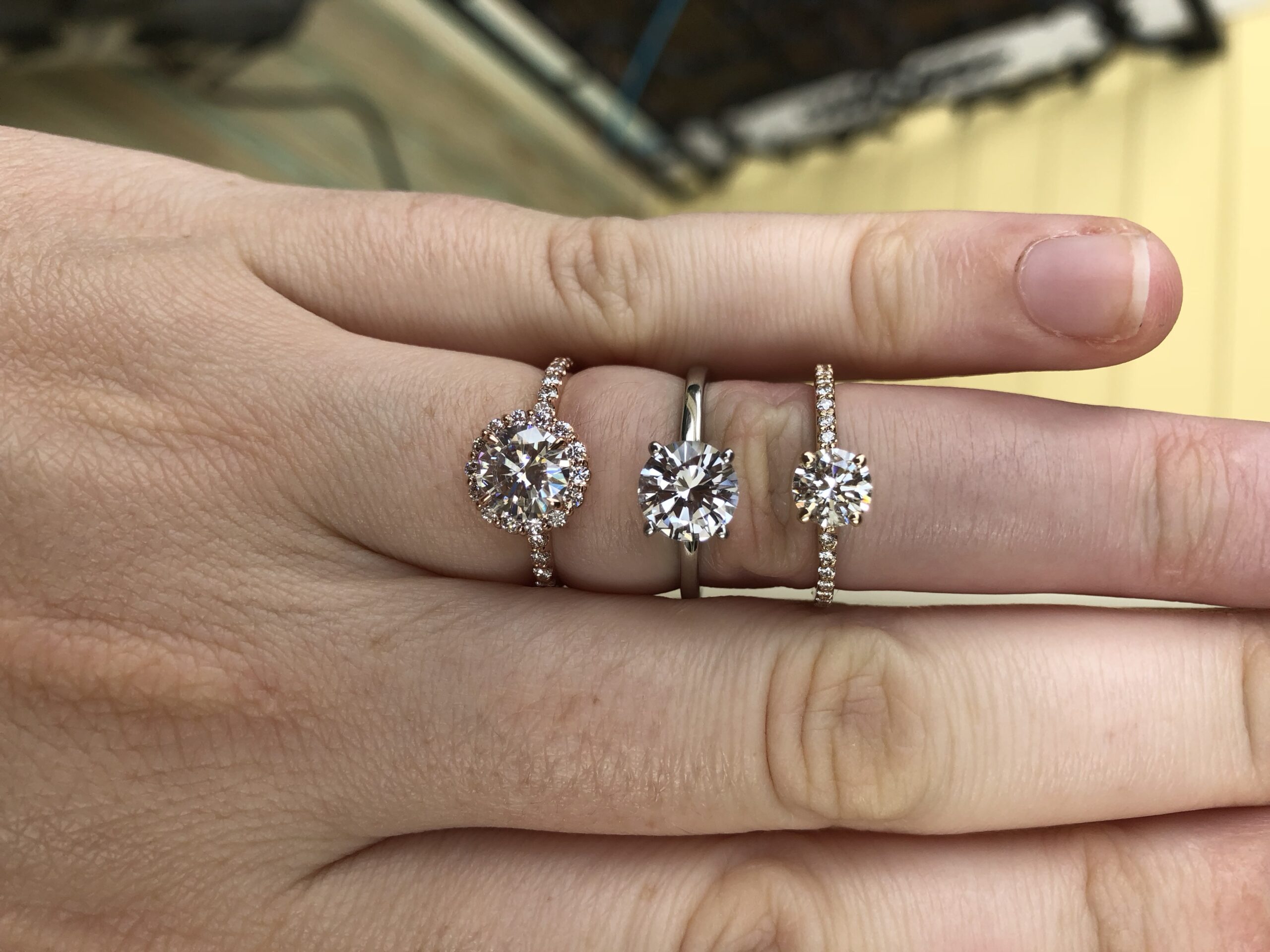
Moissanite (left) vs White Sapphire vs Diamond (right)
Some testers show a moissanite result whereas others test moissanite as diamond. It all depends upon the model of the tester. However, because of the varying levels of diamond thermal conductivity (discussed above) a test as “diamond” or “moissanite” on one of these pens only gives so much information. Once a stone tests as diamond or moissanite on a pen tester, confirming magnification tests should be performed via microscope!
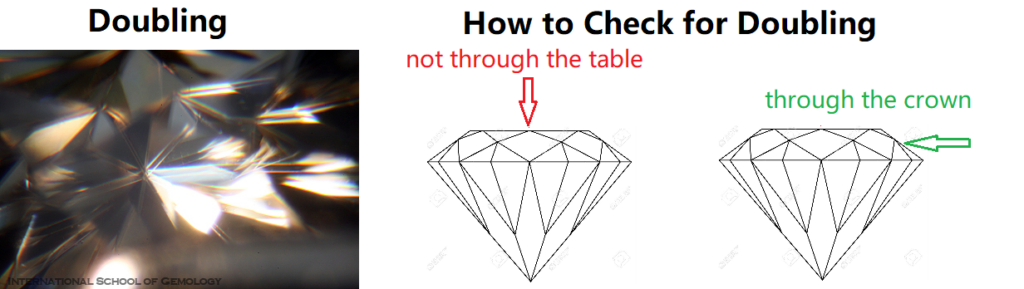
There are pen testers that provide a certain result for moissanite, however, moissanite is best confirmed through viewing “doubling” under magnification. Why? Especially with the growing popularity of HPHT diamonds, which may test as moissanite on a pen tester, viewing doubling under magnification is the easiest way to conclusively separate the two. And it’s easy! Just look through the “crown” facets of the stone under a scope.
There are a few options! If you’re using a pen tester, start there to rule out diamond simulants other than moissanite. Then check for certificate or doubling! Here’s how:
No. Cubic Zirconia (or CZ) does not have high enough thermal conductivity to pass. So, when you test a CZ with a diamond tester, it will not show as diamond. In fact, distinguishing CZ from diamond is one of the most important uses of thermal conductivity pen testers.
Real diamonds test as diamond on thermal conductivity testers and most have microscopic laser inscriptions. Those are the two easiest ways to test between diamond and CZ. More nuanced tests include “pavilion flash” and “heft” – both of these require the stone to be loose. To test for pavilion flash, put your stone point side up and flash a penlight over it. If the stone flashes blue, the stone is likely CZ. And, to test for heft, weigh the stone in your hand. If it feels “too heavy” for its size, it is likely CZ (CZ weighs about twice as much as diamond).
No. White Sapphire does not have high enough thermal conductivity to pass. And, white sapphire looks quite different than diamond, moissanite, and CZ, so using a pen tester is not common. Whereas the high conductivity gems show rainbow sparkle, white sapphire shows white and silver sparkle. It also tends to have a silvery undertone. So, these are often easier ways to spot sapphire from diamond.
Whereas diamond will pass a pen test and have rainbow sparkle, white sapphire will not pass and has white and silver sparkle. Sapphire is usually faceted differently than diamond, as well, with rectangular facets on the bottom of the stone. Finally, more nuanced tests include finding the “refractive index” of the gem. Notably, white sapphire’s refractive index also helps to distinguish white sapphire from white topaz!
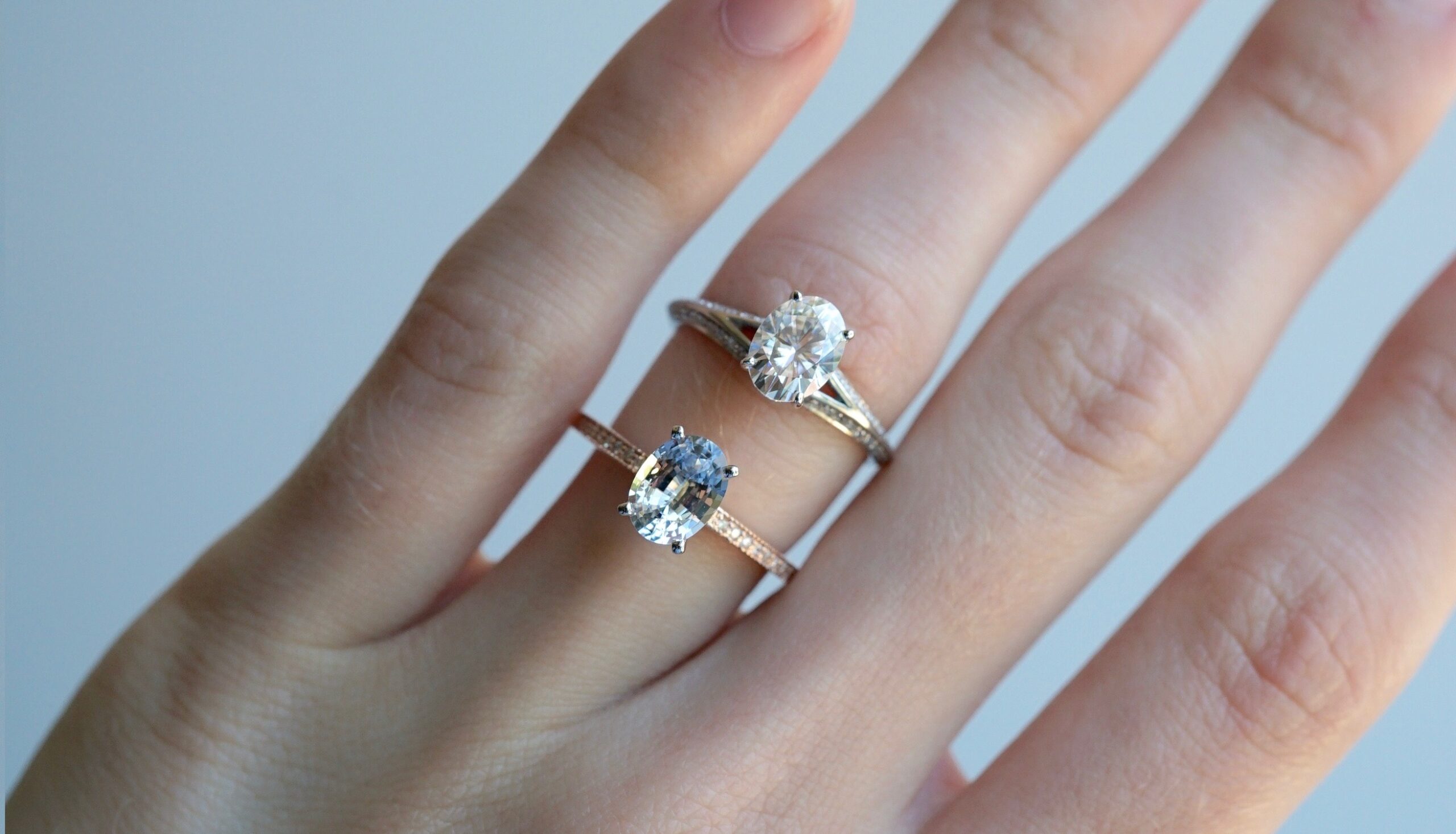
Moissanite (top) vs White Sapphire (bottom) ovals
Sure! While we do not offer appraisal services or gem testing services, if you have questions about why your stone is testing the way it is, I’d be happy to answer them! And, as always, the best way to protect yourself in this once in a lifetime purchase is to choose a reputable jeweler to buy your diamond or moissanite from (hint hint: check out our reviews on Facebook, The Knot and Wedding Wire)!
No. Moissanite and diamond are two different gemstones! While they look similar, there are ways to tell them apart. The biggest differences between moissanite vs diamond are amount of sparkle, cost, and reflection. Care, residue, and stone quality all matter when evaluating whether moissanite gets cloudy or simply needs a thorough cleaning.
Moissanite is actually more brilliant than a diamond! That higher dispersion is why moissanite engagement rings can show more rainbow fire than comparable diamond rings.
Brilliance, which refers to a stone’s ability to reflect white light, is a good measure for how much a gemstone will ‘sparkle’. Moissanite’s brilliance is higher than diamond’s due to its higher “refractive index” (Diamond’s is 2.42, whereas Moissanite’s is 2.65). This is a technical term for how much a gemstone bends light. Moissanite bends light a lot, meaning light bounces around more, giving it max sparkle! In addition, moissanite has a higher dispersion than a diamond, too. So, in addition to your moissanite giving off more white sparkle, it will actually reflect more colored sparkle (“fire”), too. In fact, your moissanite will look like a firework next to a diamond.
Bonus! Because moissanite contains some silicon, it is also less likely to attract grease or dirt than a diamond. That means a moissanite will sparkle more in between cleanings, too.
Diamond (left) vs Moissanite (right) sparkle (credit: Lauren B)
No! Moissanite stays super sparkly for its whole life. Because of its superior hardness and great refractive index, Moissanite stands the test of time. Unlike a CZ (a less beautiful diamond simulant), you never have to worry about Moissanite becoming dull, losing its brilliance, or getting foggy. It will be beautiful and bright forever!
Yes, if you look closely. Moissanite’s extra bling and extra reflection can separate it from diamond. While diamonds have equal amounts of white and rainbow sparkle, Moissanite’s rainbow sparkle exceeds its white brilliance. Moissanite’s unique double refraction can also separate it from diamond, if you know what to look for:
Diamond is singly refractive, whereas Moissanite is doubly refractive. This means that if you look through the side of a Moissanite, you may see double! In Forever One, this feature is not noticeable unless you know to look for it, and look very closely. Other doubly refractive gems include sapphire, alexandrite, and tanzanite.
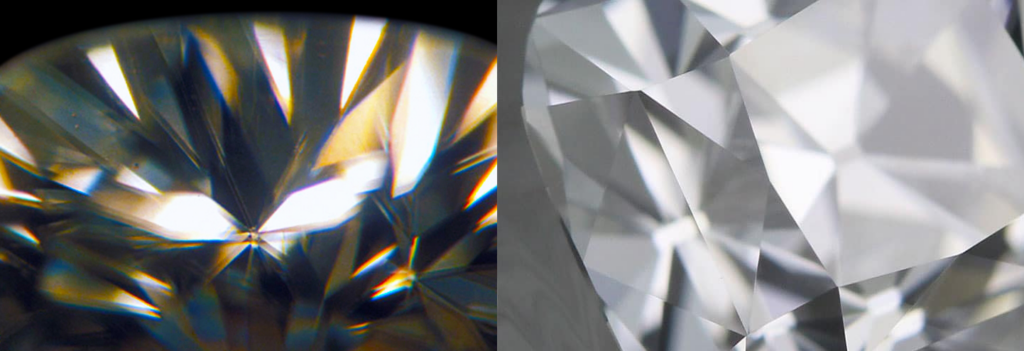
Moissanite vs Diamond Under Magnification
Both moissanite and diamond can be colorless or near-colorless. The amount of color a moissanite has depends upon the type of moissanite. Classic moissanite, the first moissanite that man created, is a greenish-yellow hue. It’s not very pretty, and Do Amore does not sell it. In fact, many feel that classic moissanite’s color is similar to a GIA-certified K-color diamond (quite yellow). On the other hand, Forever One Moissanite can be colorless or near colorless! Forever One Colorless has the color of a GIA-certified E-color diamond. Forever One Near Colorless has the color of a GIA-certified I-color diamond. Both of these gems are gorgeous, come in a variety of sizes, and make perfect engagement stones.
No. Forever Brilliant was near colorless, Forever One can be colorless! Have you been looking around and seeing “Forever Brilliant” Moissanite mentioned? Wondering what is Forever Brilliant Moissanite is? Forever Brilliant was Charles & Colvard’s first attempt at a colorless-looking Moissanite. However, because the technology wasn’t as great back then, it turned out near colorless. As a result, when Charles & Colvard developed Colorless Moissanite (what everyone really wanted to begin with), they called it Forever One.
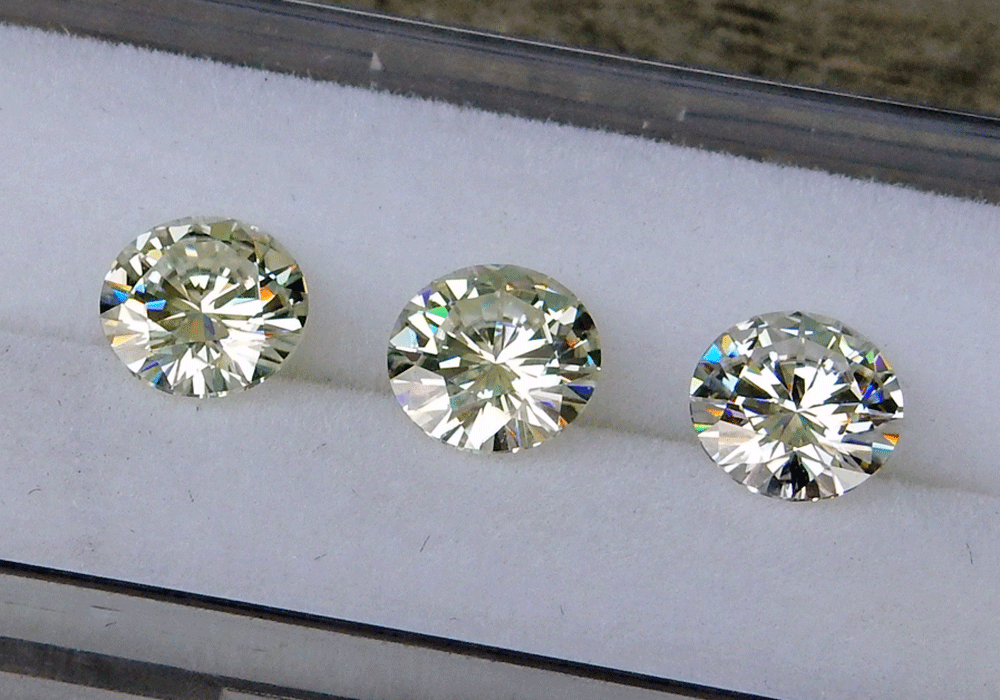
Classic Moissanite (left) vs Near Colorless Moissanite (center) vs Forever One Colorless Moissanite (right)
Colorless Forever One Moissanite is widely thought to be more beautiful than near colorless Forever Brilliant was. So, we highly recommend choosing a crisp and icy Forever One colorless for your engagement ring! However, if you’re looking for the warmth of a near colorless, Do Amore can special order a Forever One Near Colorless for you, too!
Hot Tip: Classic & Near-colorless moissanite is still sold by numerous jewelers. So, to make sure you don’t get stuck with a yellow-green classic moissanite or only a near-colorless stone, demand Forever One Colorless!
VIEW OUR FOREVER ONE MOISSANITE COLLECTION>
Forever One Colorless Hearts & Arrows looks most like a diamond as it’s cut to show even white and rainbow sparkle! Non Hearts & Arrows Moissanite will show more rainbow sparkle than white. Hearts & Arrows Moissanite is only faceted in round and cushion shapes, currently. Other shapes that look more similar to diamond include emerald and asscher, as these shapes do not truly sparkle, and instead have more of a sheen emerald cut engagement rings.
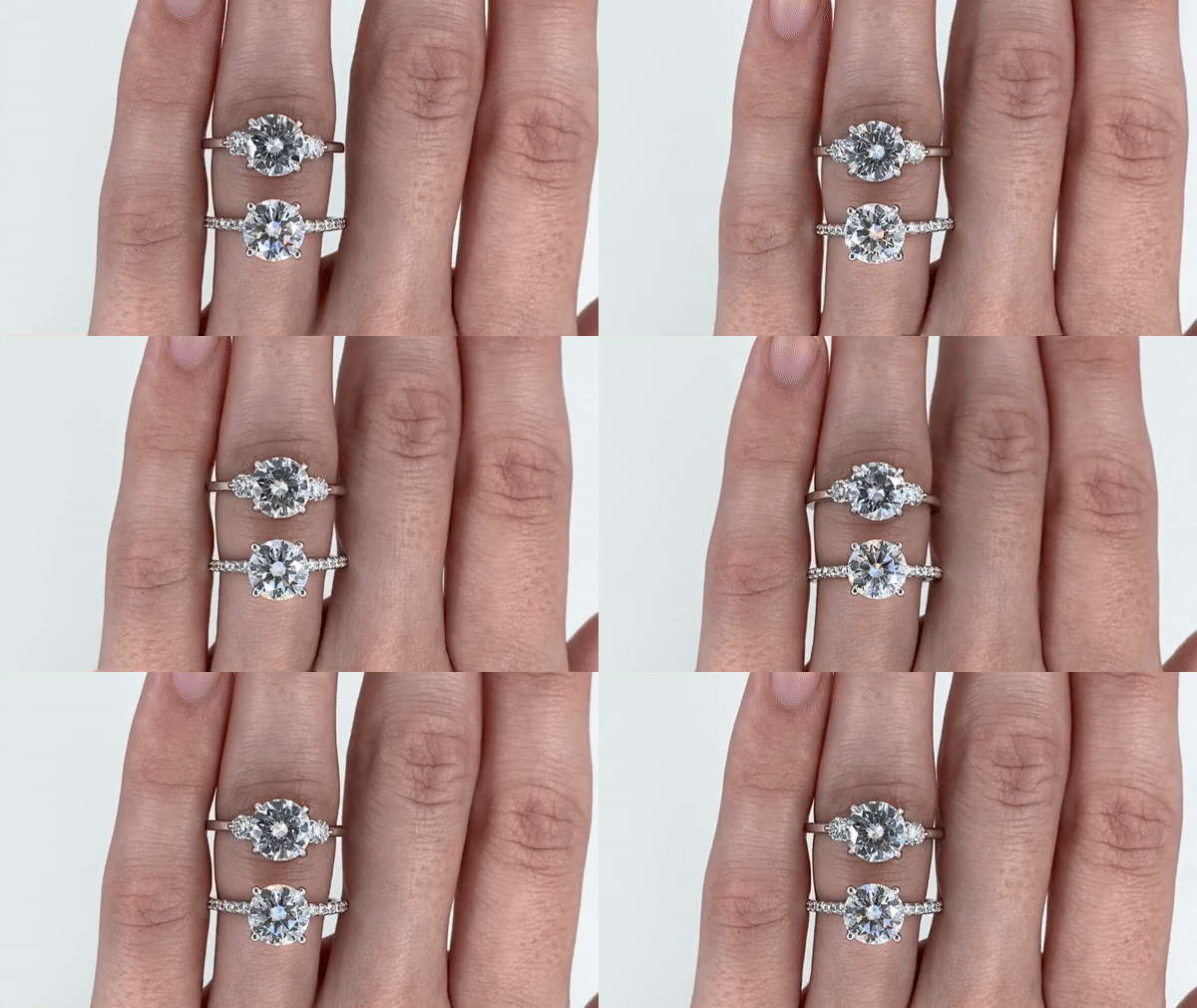
Forever One Moissanite (top) VS Hearts & Arrows Forever One Moissanite (bottom)
Moissanite is a very hard gem, but not quite as hard as diamond. The harder a material, the more difficult it is to scratch. And, on the Mohs Scale of Hardness, moissanite is rated as a 9.25. This is a great score, and higher than any gemstone used in jewelry besides diamonds! Diamonds, which are the hardest known mineral, score a 10.
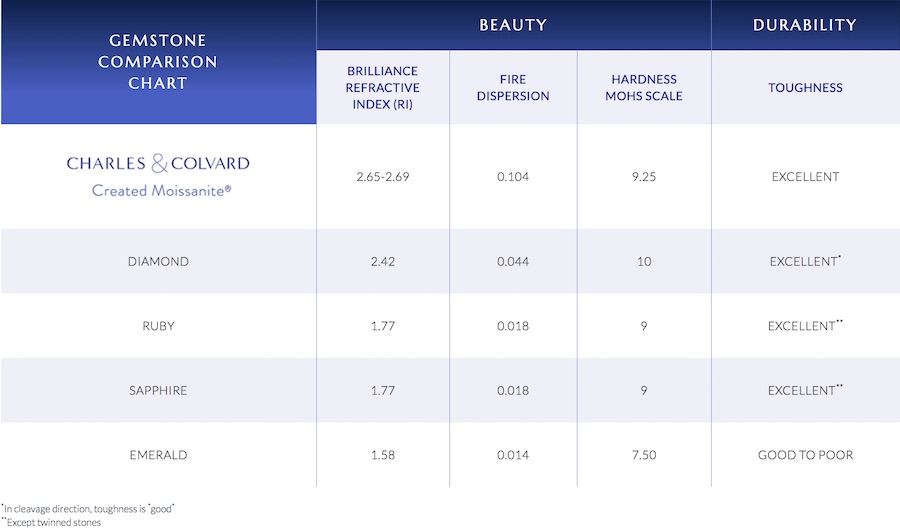
Yes! Moissanite’s great hardness makes it an ideal ring to wear everyday! At a 9.25 hardness, it stands up to wear and tear extremely well, making it a great engagement ring choice. Also, Moissanite’s mineral makeup means that it resists oil and dirt better than a diamond.
Moissanite resists chipping and breaking better than diamond. Diamond, when struck against something hard, can sheer off in the direction of its crystal growth (this is called “cleaving”). Moissanite, on the other hand, does not break in its crystal direction, as its cleavage in “indistinct”. This means that while a Moissanite can still be chipped, it is less prone to large breaks than diamond is.
Yes, but only by the rare things harder than it, like diamonds and certain abrasive cleaners. However, that’s about all that can scratch a moissanite! Most other gems and surfaces, such as sapphire or granite, are softer than Moissanite and cannot cause scratches. Because Moissanite is a 9.25 on the hardness scale, and diamond is a 10, diamond can scratch moissanite.
Overall, moissanite is a fraction of the cost of a diamond. Also, while a diamond’s price varies based on cut, clarity, and other individual characteristics, moissanite varies only with type and size. Below is a table comparing our pricing for a GIA-certified round diamond (with I-color and VS2 clarity), a classic moissanite stone (not colorless), a near-colorless moissanite stone, and Forever One colorless moissanite stone.
| Carat Size | GIA Certified Diamond (Round, I-color, VS2) | Classic Moissanite | Near Colorless Moissanite | Forever One Colorless Moissanite |
| .5 | $1,100+ | $89 | $243 | $269 |
| 1.0 | $4,000+ | $269 | $539 | $599 |
| 1.5 | $10,000+ | $449 | $945 | $1,049 |
For those who want a big blingy look for a reasonable price, yes! Many of our customers choose Moissanite over diamond when they want a great ring look, but also want to buy a house. Moissanite is a great option for couples on a budget, those looking for a man-made option for sustainable reasons, or those who simply do not feel the need to spend a lot on a ring. We have thousands of very happy moissanite customers!
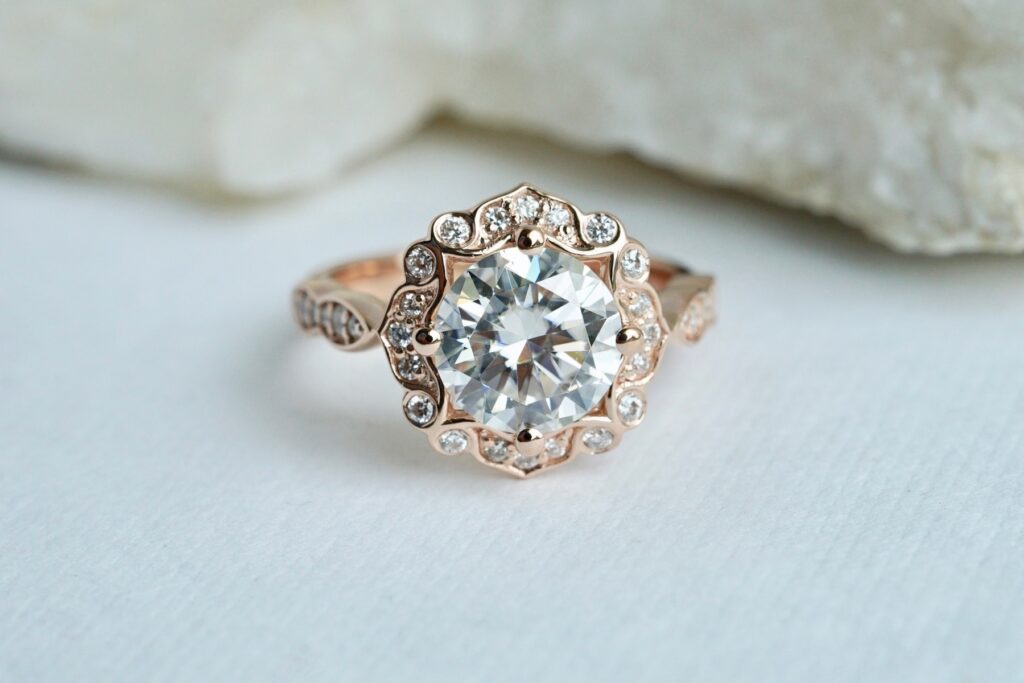
Moissanite engagement ring
While moissanite does not replicate the look of a diamond exactly, it is a beautiful, durable, white stone! So, it’s a viable option for those not wanting to purchase a diamond. Colored stones, like sapphires (which also come in white!), are beautiful options as well. As a result, there are many ways we can help couples create a stunning ring without paying for the higher cost of a diamond.
To pair an engagement ring with a moissanite, find your favorite engagement ring here, then choose “Pair with Moissanite.”
Of course! Do Amore is proud to be knowledgeable in conflict-free diamonds, moissanite, and other stone options so please feel free to contact us with any questions. Feel free to ask for me personally (my name is Krish)!
Choosing between white sapphire and diamond gets easier when you focus on what you can see and how each stone wears. The biggest differences are sparkle, scratch resistance, upkeep, and price. Both stones come in natural and lab-created options, and each has a distinct look. Use these differences to choose the stone that fits your ring and priorities.
For most couples, the choice comes down to sparkle, upkeep, and budget. In a white sapphire vs diamond comparison, diamond offers stronger brilliance, colorful fire, and greater scratch resistance. White sapphire has a softer, silvery look and usually costs less, but it often needs more frequent cleaning to stay bright. Both can look beautiful, whether you choose a white sapphire ring or a diamond.
| White Sapphire vs Diamond | White Sapphire | Diamond |
| Composition | Corundum (Al₂O₃) | Crystallized carbon |
| Appearance | Softer, silvery glow; can look slightly gray | Stronger brilliance and rainbow fire |
| Refractive index | 1.762 to 1.770 | 2.417 |
| Dispersion | 0.018 | 0.044 |
| Mohs hardness | 9 | 10 (the scale is not linear) |
| Toughness | Excellent; no cleavage | Somewhat tough; can chip along cleavage directions |
| Cleaning cadence | Often needs more frequent cleaning to stay bright | Clean regularly; residue still dulls sparkle |
| Natural or lab availability | Natural and lab-created | Natural and lab-grown |
| Price direction | Usually lower | Usually higher; varies by origin and the 4Cs |
| Best fit | Softer look, larger-size potential, lower budget | Maximum brilliance, fire, and scratch resistance |
Is white sapphire a diamond? No. According to GIA, sapphire is corundum, an aluminum oxide (Al₂O₃). Diamond is crystallized carbon. That material difference between white sapphire and diamond drives their light performance, hardness, and price. White sapphire can resemble a colorless diamond at a glance, but it is a separate gemstone.
Yes, especially side by side. If you are wondering whether white sapphire looks like diamond, both can appear colorless, but their sparkle gives them away. Diamond usually shows brighter white brilliance and more rainbow fire. White sapphire returns a softer, silvery glow and may look slightly gray in some lighting. Each has a distinct kind of beauty.
No. Compare white sapphire and diamond sparkle side by side: white sapphire looks softer and more silvery. Diamond combines strong white brilliance with colored fire. Its higher refractive index and dispersion bend and separate light more dramatically, much like a prism. White sapphire catches light with a quieter effect.
Residue can dull any gemstone. Oil, lotion, and soap film often become noticeable sooner on white sapphire because its light return starts softer. Diamond may hide minor buildup better, but dirt still reduces its sparkle. Clean either ring gently with warm water, mild soap, and a soft brush. Follow any treatment-specific care instructions.
You can often distinguish white sapphire from diamond, cubic zirconia, and moissanite by its muted, silvery sparkle. White sapphire is denser than diamond, so stones with the same carat weight can face up at different sizes. Crisp facet edges may help separate it from softer white gemstones such as topaz, quartz, or glass. Ask a gemologist to confirm the stone’s identity.
Comparing white sapphire and diamond hardness starts with the Mohs scale: sapphire rates 9, and diamond rates 10. The scale measures scratch resistance, but its values are nonlinear, so the gap between 9 and 10 is larger than one step sounds. Sapphire has excellent toughness and no cleavage. Diamond resists scratches better, but a sharp impact can chip a vulnerable edge.
Side by side, white sapphire looks less brilliant than diamond. Diamond’s sparkle appears more colorful.
Yes. Comparing white sapphire and diamond in the same setting shows how each stone will look and wear as a complete ring. Do Amore can help you place both options against the same metal, setting style, and budget, so the difference you see comes from the stone rather than a different design. Ask to compare similar dimensions, not carat weight alone, since sapphire and diamond have different densities.
Start with the look you love, then weigh how the ring will fit your routine and budget.
Use these six questions to narrow the choice.
White sapphire offers a soft, elegant look, excellent toughness, and strong resistance to everyday scratches. Its lower typical price can make a larger center stone possible within a set budget. Natural and lab-created options are available, so confirm the stone’s origin and any treatments before you choose.
Diamond delivers stronger brilliance, more fire, and greater scratch resistance than white sapphire. It suits someone who wants a lively look and less frequent cleaning. Oil and residue can still dull its sparkle. Natural and lab-grown diamonds offer different origin and budget paths.
White sapphire has less brilliance and fire than diamond, and buildup can make it look hazy sooner. It may need more frequent cleaning to keep its softer sparkle visible. In exchange, it usually offers more size for the budget.
Price is the main tradeoff. Diamonds usually cost more than white sapphire, especially as carat weight and quality rise. Hardness protects against scratches, but diamond can still chip. Setting and daily care still matter.
The cost of white sapphire vs diamond is usually lower for sapphire because the two stones follow different markets and pricing systems. Diamonds are priced by origin, carat, cut, color, clarity, rarity, and other factors. A useful white sapphire vs diamond price comparison should match similar dimensions and settings instead of carat weight alone because the stones have different densities.
Diamond prices span a wide range. Natural or lab-grown origin can change the result substantially, so compare live stones and the complete ring when weighing sapphire vs diamond price.
White sapphire follows a different market and pricing structure from diamond, so it usually costs less. The lower price can leave more room in the budget for size or setting details.
No. A white sapphire can fit a lower budget and still carry the same personal meaning as a diamond. At Do Amore, every jewelry purchase provides clean water access for one person, regardless of the stone or price point. Couples receive the GPS coordinates and a photo of the well their purchase helped fund. That lets you choose the stone for its look and daily fit, not to prove what the ring means.
Another common question is whether white sapphire or moissanite is the better diamond alternative. Both are durable, colorless options that cost less than many diamonds, but they have distinct looks. Browse our moissanite engagement rings if you want to compare settings while you read.
The better choice depends on the look and origin you prefer. White sapphire can be natural or lab-created. Moissanite used in jewelry is typically lab-created. If natural origin matters to you, confirm the sapphire’s origin and any treatments before deciding. White sapphire is naturally colorless in some cases, unlike most blue sapphire, but you should never assume that a specific stone is untreated.
If strong sparkle and colorful fire are your priority, moissanite is the closer match to diamond. White sapphire has a subtler, silvery glint. Moissanite’s higher refractive index and dispersion create a livelier display. Choose the stone that matches your preference for a quieter glow or more visible fire.
Side by side, white sapphire may look light gray rather than bright white. Moissanite produces more colorful flashes and a livelier sparkle. If you are comparing several center-stone options, moissanite vs lab diamond adds another useful view of sparkle and budget.
White sapphire is the stronger choice for everyday durability. Cubic zirconia is a common diamond alternative, but it is less durable than white sapphire or moissanite. We focus on fine-jewelry gemstones rather than cubic zirconia, so this comparison stays brief. If you want a fine-jewelry alternative with stronger everyday durability, compare white sapphire and moissanite instead.
These answers cover common questions about clarity, testing, and origin.
White sapphire stays clear through normal wear, but oil, lotion, soap, and dirt can coat the surface and make its sparkle look hazy. Its softer light return makes buildup more noticeable than on diamond. Gentle cleaning usually restores brightness, though treatment-specific care may differ.
Usually, no. A standard thermal diamond tester responds to a stone’s heat conductivity, and white sapphire conducts heat differently from diamond. A combination tester can help separate diamond from other stones, but professional identification provides the most reliable answer. See how a diamond tester works and what common devices can tell you.
Yes. Lab-created white sapphire shares the same basic chemical composition and crystal structure as natural sapphire, but it grows in a controlled laboratory rather than in the earth. Ask for origin and treatment disclosure so you know exactly what you are comparing. Read our guide to lab-created white sapphire for a closer look at natural and lab-created options.
Still weighing white sapphire vs diamond or moissanite? Send us a message here or email [email protected]. Our jewelry experts can walk you through the tradeoffs and help you choose the right stone for your ring
The right choice should feel clear, not rushed. Tell Do Amore’s jewelry team the look you prefer, how you plan to wear the ring, and the budget you want to keep. They can compare white sapphire, diamond, and moissanite without pushing you toward one stone. Every purchase provides clean water access for one person, and you will receive the GPS coordinates and a photo of the well your ring helped fund. Use the message or email above to ask for options that fit your ring.
The right choice among affordable diamond alternatives depends on the look you love, the durability you need, a comfortable price, and the sourcing information available for the exact stone.
What are diamond alternatives? A laboratory-grown diamond is a real diamond with essentially the same chemical, physical, and optical properties as a natural diamond. It grows in a laboratory and has a different growth history.
Moissanite, white sapphire, white topaz, and cubic zirconia are different materials. Each can serve as a diamond substitute, or simulant, by imitating part of a diamond’s look.
That distinction matters. The FTC Jewelry Guides call for clear descriptions that help shoppers tell laboratory-grown diamonds from simulated or imitation stones. If you want a colorful center stone instead, our gemstone engagement ring guide covers options beyond the colorless look discussed here.
If you’re comparing ethical diamond alternatives, focus on specific disclosures rather than a blanket label. Ask how the stone was created or sourced, whether treatments are disclosed, and what documentation comes with it.
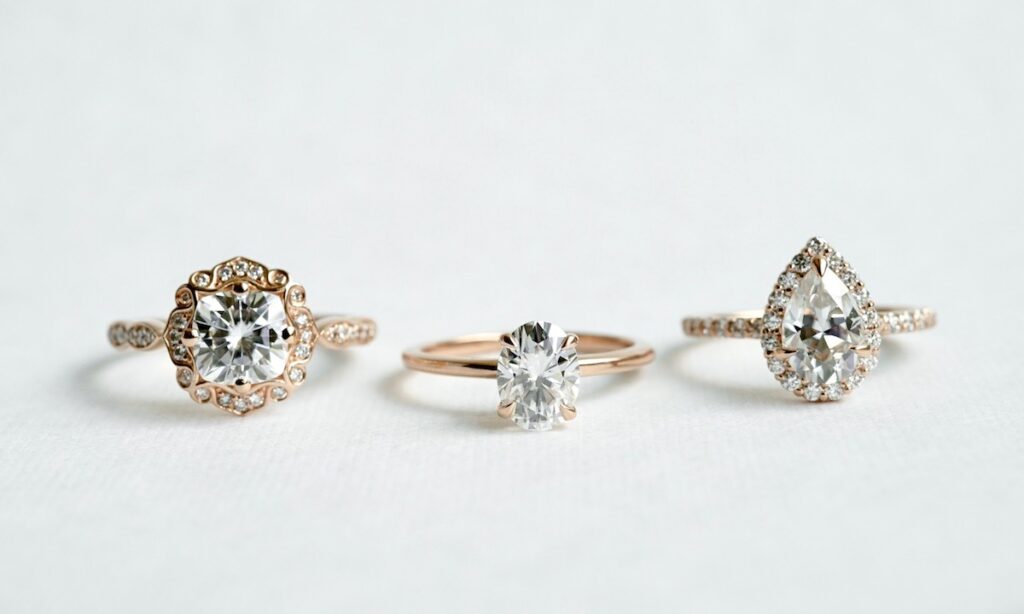
Left: Victoria with 7mm Cushion Moissanite | Middle: Mae with 8x6mm Oval Moissanite | Right: Elle with 9x6mm Pear Moissanite
No single stone is better than diamond for everyone. The best diamond alternative is the one whose appearance, care needs, and origin fit your priorities.
The best diamond alternative rings combine the right stone with a setting that protects its vulnerable points. A carat is a unit of weight, not a stone type, so changing gems is not an alternative to carat weight. If you’re comparing diamond replacements for a lost center stone, match the millimeter dimensions and setting requirements as carefully as the look.
Compare stones with the same shape, carat weight, color, clarity, cut, and grading details before looking at price.
That gives you a like-for-like view and helps prevent a lower price from hiding a difference in specifications.
Do Amore offers both laboratory-grown and responsibly sourced, conflict-free natural diamonds, so you can compare origins without being pushed toward one.
Its selection process filters out diamonds with brown, green, or milky qualities (BGM) and uses clean-energy prioritization.
Ask to see each grading report and compare the exact stones, not category averages.
Each option offers a different balance of sparkle, durability, origin, and price.
A laboratory-grown diamond is the closest match to a natural diamond because both stones are diamonds. According to GIA, the two have essentially the same chemical, physical, and optical properties. Their growth history and some identifying features differ, which is why trained gemologists and specialized screening can separate them.
Both types rank 10 on the Mohs scale and can deliver the same balance of brilliance, fire, and scintillation when well cut. Laboratory-grown diamonds often cost less than comparable natural diamonds, but the gap changes with market conditions, grading details, shape, and size.
You may still see older comparisons framed as 30-50% of the price. Treat that as historical context, not a current pricing promise. Compare live stones with like-for-like grading details before deciding.
Modern laboratory growth can produce diamonds across familiar white color and eye clean clarity ranges. A standard diamond tester may not distinguish laboratory-grown from natural diamond, so read our diamond tester guide for what those devices can and cannot confirm.
You can explore Do Amore’s Lab Diamonds here or browse lab diamond engagement rings once you understand the trade-offs.
Laboratory-grown diamonds give you diamond’s familiar appearance and daily-wear hardness with a different origin and often a more accessible price. They are a strong choice when you want a diamond rather than a simulant.
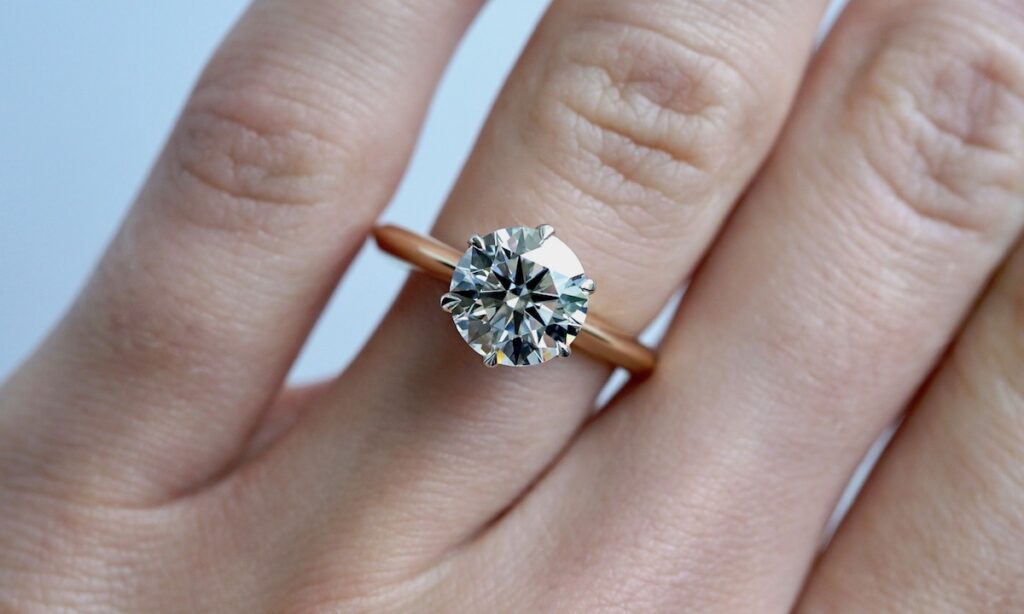
Two-tone Luna Engagement Ring with 2.2ct Lab-Created Diamond
Moissanite is a laboratory-created silicon carbide gemstone with more fire than diamond. GIA notes that it can range from colorless to near-colorless, ranks 9.25 on the Mohs scale, and may show slight yellow or gray color at some angles.
That extra fire is the point for many couples. If you’re choosing between two durable daily-wear options, our moissanite vs. lab diamond guide breaks down how their sparkle, material, and price differ.
Moissanite ranges from colorless to near-colorless without tying the choice to one brand or grade. It may look crisp and colorless face-up, then show a warmer tint or stronger rainbow flashes from another angle. See Do Amore’s wide range of it here.
Moissanite is a great diamond alternative if you want noticeable fire, strong scratch resistance, and good value. Browse moissanite engagement rings to see how different shapes and settings handle its lively sparkle. It is one of the most practical diamond ring alternatives for daily wear.
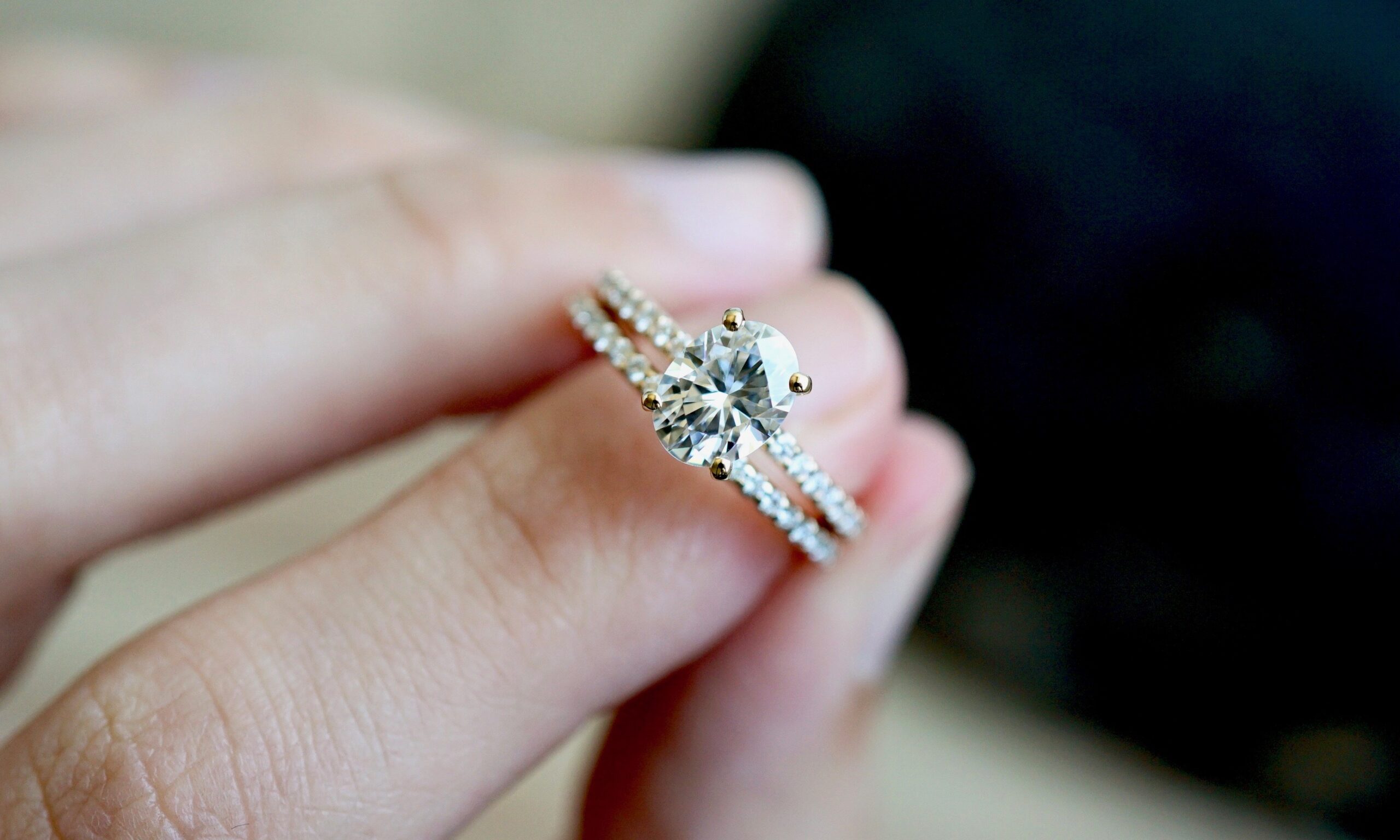
Diana Engagement Ring Set with an 8x6mm Oval Moissanite
White Sapphire is a natural diamond alternative with a calm, all-white sparkle. Sapphire is corundum, which ranks 9 on the Mohs scale. GIA notes that corundum has excellent toughness and no cleavage, making it well suited to rings worn regularly.
Its light return is softer and less fiery than diamond or moissanite. That quieter look is exactly why some people prefer white sapphire.
Treatment can affect both disclosure and care. Instead of assuming a white sapphire is untreated, ask the seller what treatments, if any, the stone has received and request that information in writing.
White sapphire is a durable natural option if you prefer understated white sparkle. Our white sapphire vs. diamond guide explains the visual differences in more depth, and you can view the White Sapphire collection here.
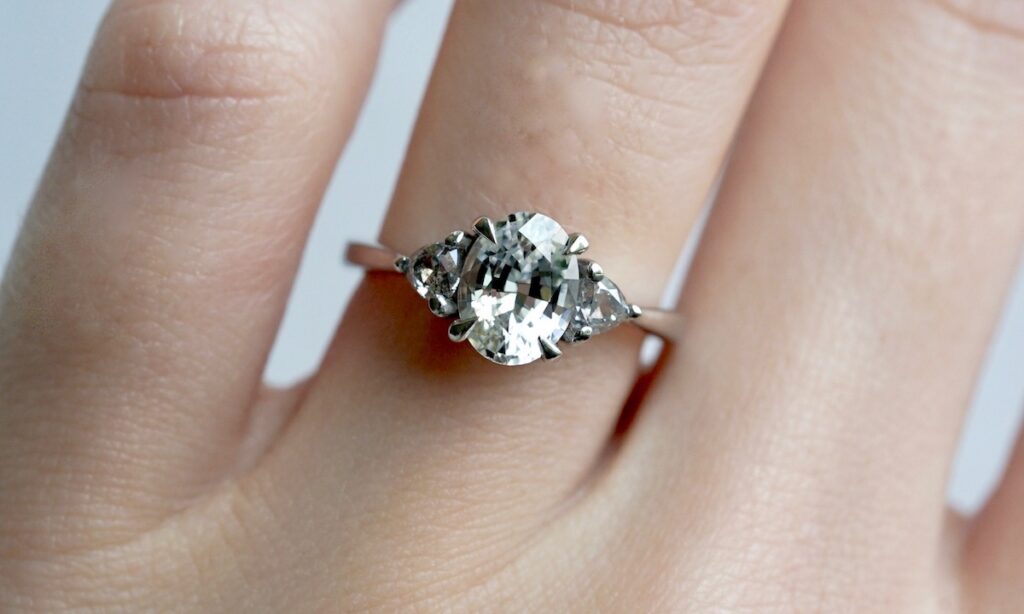
Custom Engagement Ring with 8x6mm Oval White Sapphire
White topaz is a natural, colorless gemstone with cool gray-white sparkle. It ranks 8 on the Mohs Hardness Scale, so it resists scratches better than many softer gems. But hardness is not the whole durability story. GIA’s topaz guidance notes that cleavage makes topaz vulnerable to breaking from a sharp blow or sudden temperature change.
Choose a protective setting, such as a bezel, 6-prong, or halo. Remove the ring for activities that could expose it to hard impacts.
White topaz sits in the lowest relative price band in this guide. Availability and stone-specific pricing can change. Pair it with one of Do Amore’s ethical engagement ring settings and email us here to confirm current options rather than relying on an old fixed price.
White topaz can deliver a larger-looking center stone for a lower relative price. It needs more thoughtful setting protection and wear habits than diamond, moissanite, or sapphire. That makes it one of the more accessible diamond engagement ring alternatives.
Moissanite does not normally become permanently cloudy or lose the optical properties behind its sparkle.
Soap, lotion, skin oils, and hard-water residue can leave a film that makes the stone look dull.
Do Amore’s care guidance starts with warm water, mild dish soap, a soft brush, and a lint-free cloth for routine buildup.
Rings purchased from Do Amore include complimentary lifetime cleaning and inspections, giving you a clear next step if the haze remains.
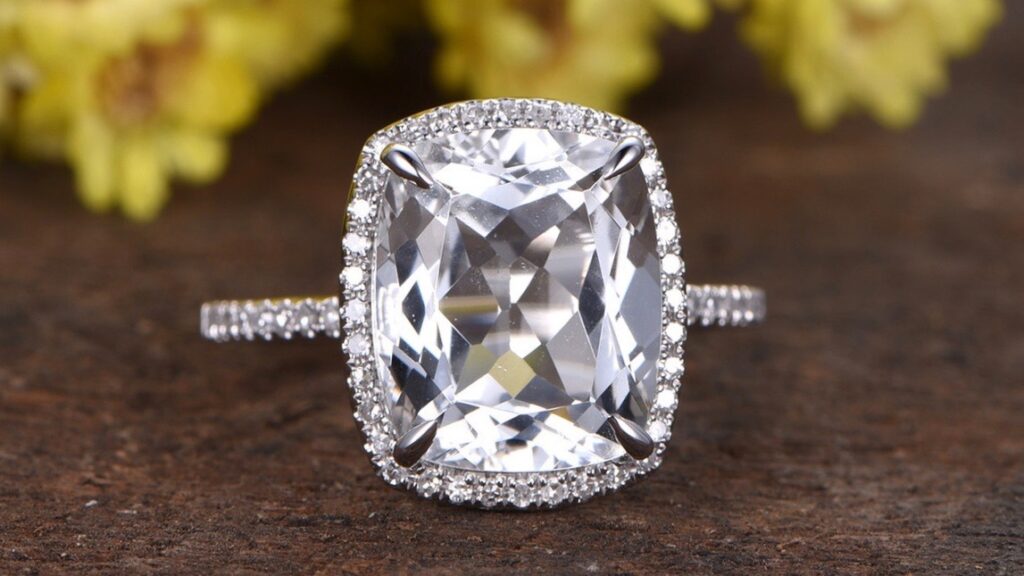
Use this chart as a starting point, then compare the exact stones you’re considering. If you still need help, email us here and we’ll help you weigh the trade-offs.
| Material | Type | Appearance and fire | Mohs | Toughness and care | Origin | Relative price | Best for |
| Laboratory-grown diamond | Diamond | Diamond optics with white light, fire, and scintillation | 10 | Very hard; edges can still chip | Laboratory-grown | $$$$ | Closest match and daily wear |
| Moissanite | Simulant | More rainbow fire than diamond | 9.25 | Very durable with routine care | Laboratory-created silicon carbide | $$ | Maximum sparkle and daily wear |
| White sapphire | Simulant | Soft white sparkle with less fire | 9 | Excellent toughness and no cleavage | Natural corundum | $$ to $$$ | Natural colorless gemstone |
| White topaz | Simulant | Cool gray-white sparkle | 8 | Poor toughness; use a protective setting | Natural topaz | $ | Value with mindful wear |
| Cubic zirconia | Simulant | Bright at first; can abrade over time | 8.5 | More prone to scratches and abrasion | Laboratory-created; not offered by Do Amore | $ | Temporary or occasional wear |
Good diamond alternatives solve different needs. The best diamond alternative depends on what matters most to you. Choose a laboratory-grown diamond for the closest overall match or moissanite for the most fire. White sapphire gives you a natural colorless gem with excellent toughness, and white topaz offers a more accessible fine-gem option that needs extra care.
Yes. Moissanite is a durable, laboratory-created gemstone with a Mohs hardness of 9.25 and more rainbow fire than diamond. It works well for everyday engagement rings. Its stronger flashes and occasional warmth at some angles give it a distinct look rather than a visual copy of diamond.
A laboratory-grown diamond is the closest option because it is a diamond with essentially the same chemical, physical, and optical properties as a natural diamond. Its origin, growth structure, and identifying features differ. Moissanite offers strong durability and high brilliance, but it remains a different material.
Laboratory-grown diamonds, moissanite, and white sapphires all suit everyday engagement rings when they are well set and cared for. White topaz can work with a protective setting and mindful wear, but its cleavage makes impact a bigger concern. GIA notes that cubic zirconia scratches more easily than diamond, so it is better suited to temporary or occasional wear.
Sure. Start with the look, daily-wear needs, budget, and sourcing details that matter most to you. Send us a note here, or email me here, and tell us what you want your ring to feel like. We’ll help you compare the options without pushing you toward one material.
Whichever stone you choose, every Do Amore purchase gives one person access to clean water. It is a quiet way for one treasured moment to create a ripple beyond the ring
Compare Do Amore’s diamond alternatives for engagement rings, including laboratory-grown diamonds, moissanite, and white sapphires side by side, then choose the stone that fits your preferred sparkle, daily-wear needs, and budget.