




Your bag is empty
Explore timeless jewelry that carries love and inspires lasting impact.
We promise that every purchase you make gives one person access to clean, life-changing water.
Explore timeless jewelry that carries love and inspires lasting impact.
A princess cut diamond is a square modified brilliant with straight sides, sharp corners, and triangular or kite-shaped facets. In a ring, princess cut diamonds look crisp and geometric from above and still give you lively, brilliant-style sparkle.
Those pointed corners separate them from radiant cut diamonds, which have clipped corners. Brilliant faceting separates the princess from the squared-off asscher cut, which uses step-cut facets.
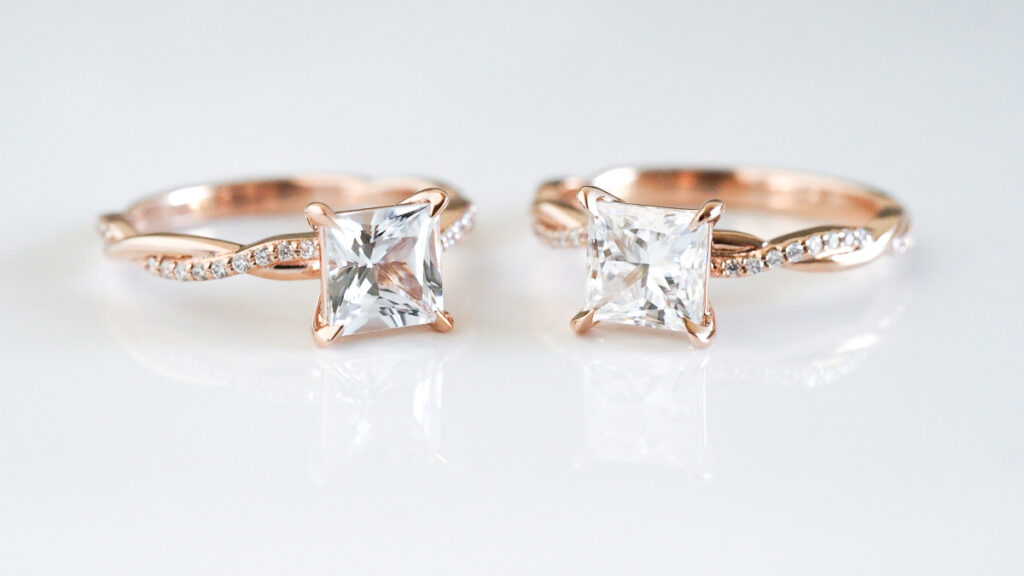
Yes, a well-cut princess diamond can sparkle beautifully when its facets create a balanced pattern of light and dark. A stone with uneven contrast or distracting reflections may look less lively, so compare videos and face-up images instead of judging sparkle from the grading report alone.
Neither color nor clarity is automatically more important in every princess cut. GIA does not use “eye clean” as a clarity grade. Start by deciding what looks eye clean to you, then compare color in the lighting and metal you plan to wear.
A stone that looks white in one setting or lighting condition may show more warmth in another. A well-chosen stone can still be a great value when its visible color and clarity suit your eye, without paying for differences you cannot see.
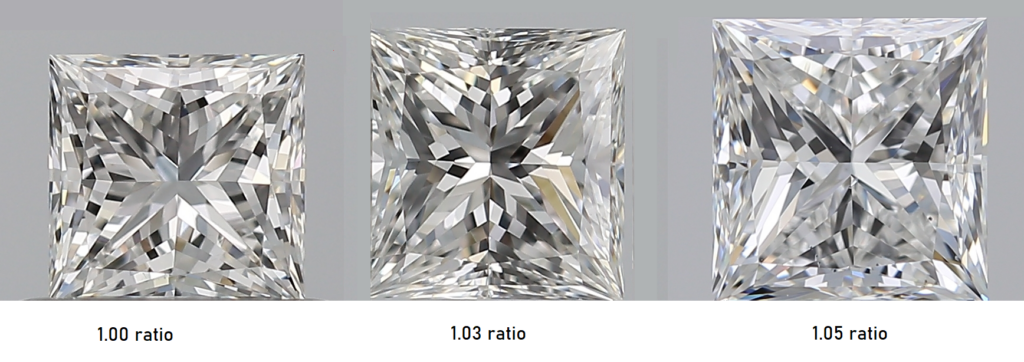
Length-to-width ratio tells you whether a princess cut looks square or elongated. Calculate it by dividing the length by the width. GIA describes a square princess cut as having a length-to-width ratio no greater than 1.05:1. Higher ratios look increasingly elongated, but the ratio is an outline guide, not a universal quality rule. Compare the shape you actually prefer.
Pro tip! For a compass setting, compare the stone’s diagonal outline in the actual mounting. A nearly square stone often gives the most balanced four-point look, but the right ratio is still a style choice.
The best princess cut diamond is the one with a balanced face-up pattern, pleasing outline, secure corners, and color and clarity that suit your preferences. Use industry guidelines for table, depth, symmetry, and polish as screening tools, not guarantees.
Then compare actual images and videos, because faceting and light performance can differ even when two reports look similar. If you want help narrowing the options, start here.
Look for an outline you love, balanced symmetry, lively contrast, clean reflections, even color, and four sound corners. Table and depth can help you filter a large list, but they work together with polish, symmetry, faceting, and face-up appearance. The photos in the mistakes below make those differences easier to spot.
GIA does not currently provide an overall cut grade for princess cut diamonds. A GIA report still lists the stone’s color, clarity, measurements, polish, and symmetry. Use those details to compare candidates, then review each diamond face up because the report cannot show the full light and dark pattern you will see in a ring.
Ask for a side-by-side visual review when two grading reports do not settle the choice. Do Amore’s GIA gemologist can compare the grading details with images and video, helping you focus on face-up balance, corner condition, and the outline you will actually see.
Your preference still decides the winner, but the review can explain why one stone looks more balanced when the paperwork appears close.
Avoid a princess cut with no contrast or an uneven light-and-dark pattern. Contrast is the pattern of dark areas against bright white and rainbow flashes. A balanced pattern can make the stone look lively, but too little contrast may leave it washed out. Compare the right and left sides to see whether the light and dark areas feel balanced.
View the diamond from a normal distance and in motion. Its sparkle should stand out without one side looking noticeably darker or lighter than the other.
Uneven contrast appears when a dark pattern on one side does not mirror the other. A princess cut diamond’s symmetry matters because lopsided facet patterns are easy to notice. In princess cut engagement rings, the sharp corners and chevron-style facets make symmetry and corner protection especially important.
Imagine a line down the center of the stone. The shapes and light patterns on the right should match the left closely. Skip a diamond with a distracting, lopsided pattern.

Avoid a princess cut with distracting or broken-looking reflections. Pavilion facets create complex patterns inside the stone, so compare the right and left sides for crisp, balanced reflections. A diamond that resembles jagged glass or shows a pattern you cannot place may look distracting. Step back and judge it from a normal viewing distance.
Choose a stone whose reflections look balanced and attractive. Skip it if broken patterns distract you from its overall beauty.
Do not judge princess cut sparkle from table percentage or table shape alone. The table is the flat facet on top of the diamond, and its percentage is one useful screening detail. But two princess cuts with the same reported table can still show different faceting, contrast, and face-up character.
Some tables look square. Others appear more cushion-shaped because the table’s corners pull inward. Use the side-by-side comparison, but judge the whole stone. Consider the table with depth, symmetry, polish, crown and pavilion faceting, and the light pattern in motion.
A smaller or cushion-shaped table does not guarantee more sparkle. Use the report to narrow the field, then let clear photos and 360-degree video show whether the diamond looks bright, balanced, and appealing to you.

(left) 73% cushion shaped table vs 73% square shaped table (right)
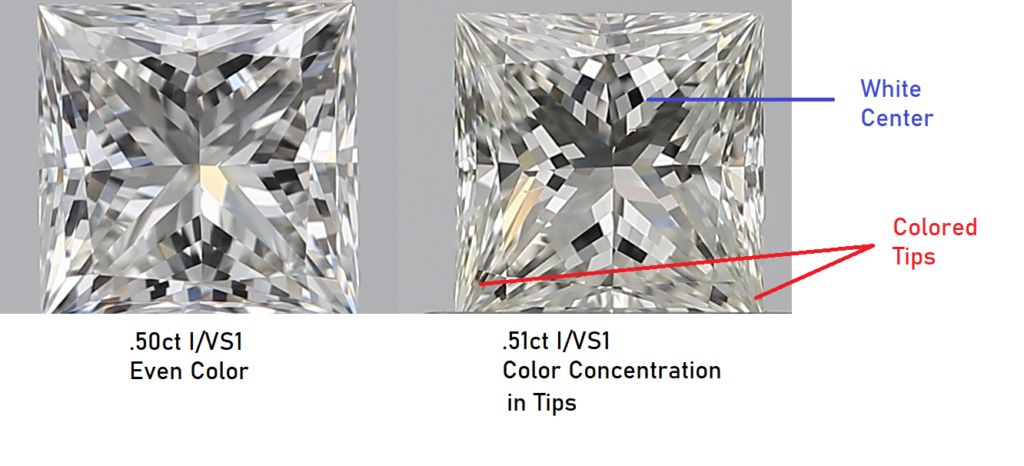
Check all four tips for concentrated warmth before you choose a princess cut. Color can appear differently across a princess diamond, especially near its pointed corners. View the stone from a normal distance in more than one lighting condition. Compare the tips with the center for an even appearance. The metal matters because the setting can change how you perceive the diamond’s color.
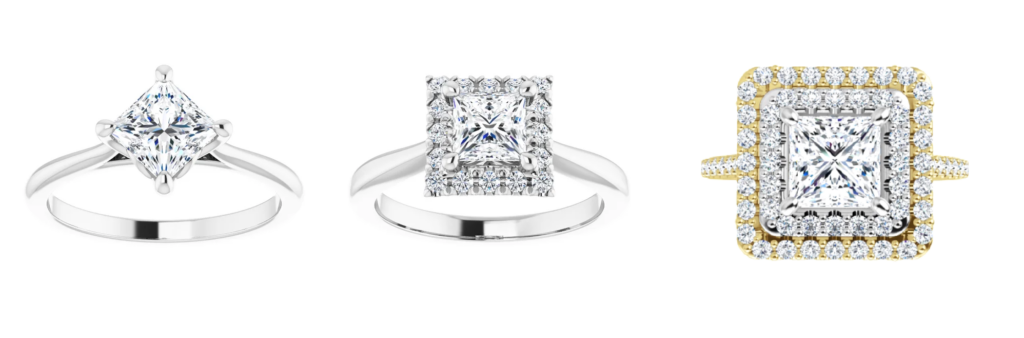
The best setting for a princess cut diamond protects all four corners and matches the look you want. Secure corner prongs or V-prongs can guard the points and keep much of the diamond visible. For example, princess cut solitaire engagement rings put the center stone and its outline front and center, but the prongs must cover every corner.
By comparison, princess cut halo engagement rings surround the center with smaller stones, which can add visual spread and another design layer around the outline. The amount of spread and protection depends on the specific design.
A bezel wraps more metal around the diamond for protection, though it shows less of the stone’s edge. A compass setting turns the princess so its points face north, south, east, and west for a distinctive diamond-shaped look.
Protect princess cut corners by checking the stone and the setting together. Review the grading report and magnified video for inclusions near the girdle or points, open cavities, chips, and very thin girdle areas. Then confirm that the setting shields all four points and holds the diamond securely.
No metal alone makes a princess cut setting safe. What matters is the design, the condition of the stone, careful setting work, and ongoing prong maintenance. If a corner will remain exposed, ask how the setting is intended to protect it during everyday wear.
Princess cuts stand apart from other diamond shapes through their crisp square outline, pointed corners, and brilliant-style faceting. Compare the actual outline, light pattern, measurements, and setting needs before deciding which shape feels right.
No, princess cut diamonds are not inherently out of style. A clean solitaire, compass orientation, or sleek metal band can feel modern. A detailed halo or vintage-inspired setting can shift the same square stone in a more romantic direction.
The diamond’s crisp outline stays the same. The setting, metal, and surrounding details decide whether the finished ring feels current, classic, or vintage.
Your setting can make the same princess cut feel sleek, ornate, modern, or vintage. Do Amore makes its engagement rings to order around each center stone, so the setting can be chosen around the diamond’s actual shape and the look you want.
Start with a solitaire when you want the square outline to lead, or compare halo and vintage-inspired styles when you want more detail. If the ready-made choices do not match your idea, Do Amore offers custom design.
Neither princess nor round is universally better. Round brilliants have a standardized GIA cut grade and a circular outline. Princess cuts give you sharp corners, a square profile, and brilliant-style sparkle. You can compare diamond shapes side by side and choose the one that fits your partner’s style.
Neither shape always looks bigger, so compare the actual measurements. Carat measures weight, not face-up size. Princess cuts often carry more weight in a deep pavilion, which can reduce visible spread, but individual stones vary. Read the length and width on each report, then compare face-up images at the same scale.
A halo can make a princess cut diamond look larger, and a compass orientation can change its visible silhouette, but the result depends on the design. A halo adds smaller stones around the center, and its added spread varies with the size, spacing, and shape of those stones. A compass setting turns the square so its points face north, south, east, and west.
Princess cuts have straight sides and sharp corners, and cushion cuts have softer, rounded corners and a pillow-like outline. Both can use brilliant or modified-brilliant faceting, so each can show lively sparkle.
Compare actual measurements because either shape can carry weight below the girdle. Our guide to cushion cut diamond mistakes can help you compare the softer outline with the princess cut’s crisp geometry.
Neither cushion nor princess is automatically better. Choose a princess cut diamond ring if you love clean angles and pointed corners. Choose a cushion if you prefer a softer outline and antique influence. Both shapes vary in sparkle pattern, so compare videos instead of assuming one cut will always sparkle more.
Princess cut diamonds can cost less per carat than comparable round brilliants partly because their shape can preserve more of the original rough crystal during cutting. Natural diamond rough is often octahedral rather than square, and the princess outline can retain weight efficiently from that rough. Price still depends on carat, color, clarity, cut quality, and the individual stone.
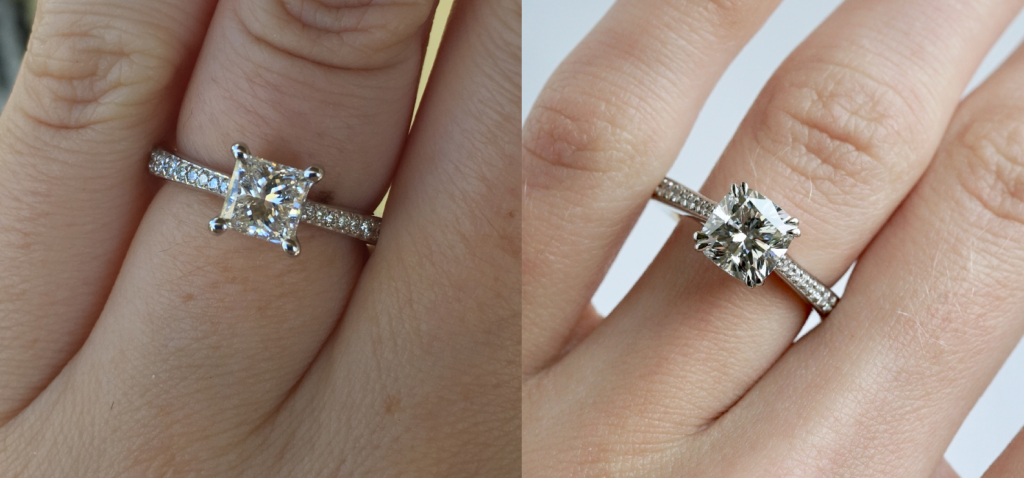
(left) Princess in Talia vs Cushion in Talia (right)
Yes, Do Amore’s GIA gemologist can compare reports, images, videos, and corner condition for the two or three princess cut diamonds on your shortlist. Email us at [email protected], and we’ll explain what the paperwork may miss.
Start with the princess cut options that fit your budget and preferred outline, then send us the shortlist. We’ll help you compare face-up balance, symmetry, and corner condition without pressure. When the ring feels right, your purchase gives one person access to clean water.