


Your Bag Is Empty
Explore timeless jewelry that carries love and inspires lasting change
Every purchase gives one person access to clean, life-changing water.
Explore timeless jewelry that carries love and inspires lasting change
Your engagement ring should suit the way you live. Some stones handle daily wear well, and others need a protective setting or gentler use. Start with the Mohs scale, then look at toughness, stability, and your routine.
Quick comparison
A gemstone engagement ring is a type of engagement ring that has a non-diamond center stone. Often designed using traditional engagement settings such as solitaires, halos, and three-stones, some couples choose less traditional settings to hold their less traditional center stone. Common gemstone choices include Sapphire, Emerald, and Ruby.
Other options include aquamarine, morganite, tanzanite, opal, moss agate, and amethyst. Each has a different tolerance for scratches, impact, and daily wear.
Choose between diamond, moissanite, and colored gemstones by balancing scratch resistance, visual style, care needs, and what the stone means to you.
Natural and lab-grown diamonds share the same Mohs hardness of 10. Moissanite ranks 9.25 and shows more colored fire. Sapphire and ruby rank 9 and give you a broad color range. Softer stones can still work, but they need more protection and a care plan that fits daily life.
Do Amore offers natural and lab-grown diamonds, moissanite, sapphires, and other fine gemstones, so the comparison does not have to start with a preferred category. Start with the look and routine, then rule out stones whose care needs do not fit.
Gemstone engagement rings offer color, symbolism, and room for a style that feels personal. The tradeoff is that each stone responds differently to scratches, impact, heat, chemicals, and daily residue. Understanding those differences makes it easier to choose confidently and care for the ring well.
Care, residue, and stone quality all matter when evaluating whether moissanite gets cloudy or simply needs a thorough cleaning.
Color gives couples room to choose something that feels unmistakably theirs. You might love a red ruby or blue sapphire for its personal meaning or simply its look. Oranges, pinks, greens, and color-change stones open the door to unique gemstone engagement rings that reflect personal taste instead of a fixed rule.
Price can still be part of the decision, but there is no reliable rule that every gemstone costs less than a comparable diamond. Species, origin, treatment, color, size, cut, and quality all affect value. Compare the specific stones you love rather than assuming one category will always cost less.
Some gemstones form in large crystals and are available in sizes or cuts that can be harder to find in diamond. This gives you more freedom to choose an unusual shape for the ring.
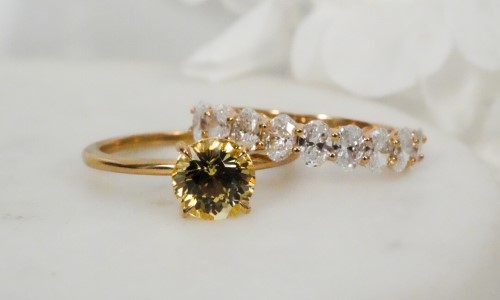
Yellow Sapphire Engagement Ring
While there are many benefits to gemstone engagement rings, there are risks to consider before purchase too. Because gemstones are not as hard as diamond, gemstone engagement rings may scratch or chip more easily. Couples can protect against this by choosing a hard gemstone, and by designing a protective setting.
Another issue to be aware of is that gemstones’ unique colors and shapes can be more difficult to replace in the event of loss or breakage. Because gemstones are often cut in less standard shapes than diamonds, couples may have a harder time finding the exact measurements of their original stone. Likewise, as gemstone color is so unique – consider all the various shades of “blue” at the paint store – finding the exact color you originally had can be tough. Couples can protect themselves by having a gemologist appraise and color grade their gemstone so they have an exact record.
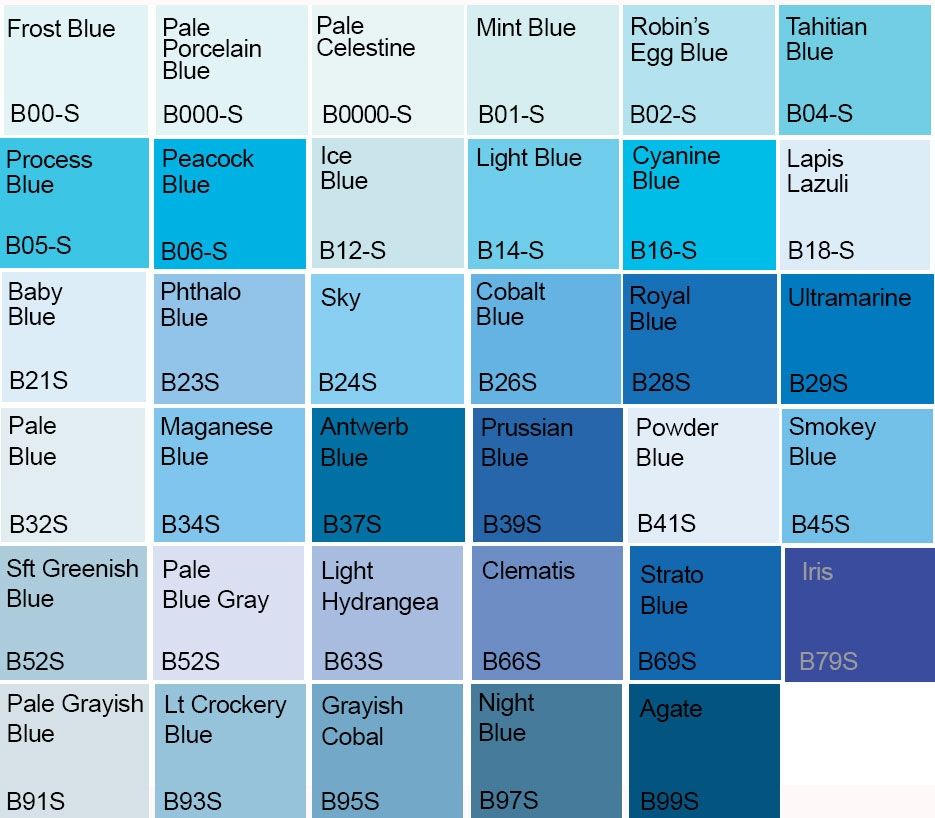
Shades of Blue, from Copic Markers
Some gemstones are, and some aren’t. One of the reasons you’ll hear a “diamond is forever” is because diamonds are a 10/10 on the Mohs Hardness Scale. This means that diamond is (literally) the hardest substance known to man. There is nothing that can scratch at diamond except for, you guessed it, another diamond. Non-diamond gemstones are not as hard.
However, neither is the glass on your car’s windshield, the screen on your iPhone, or the table you’re sitting at right now. In other words, there’s still some pretty durable stuff out there. Let’s talk about how hard a gem needs to be in order to stand up to daily wear.
The Mohs Hardness Scale was developed to rank the hardness of gemstones and minerals. It goes from 1 (Talc) to 10 (Diamond). This is useful when trying to select a gemstone engagement ring center stone, because we know how hard daily life is. Huh? No seriously, hear me out.
You know, the stuff floating around in the air? That’s the stuff that will scratch your gemstone when you try to clean it. So, when choosing a gemstone engagement ring, your best bet is to choose a gemstone of 7.5/10 and above. The closer to 10/10 you get, the more durable your ring will be.
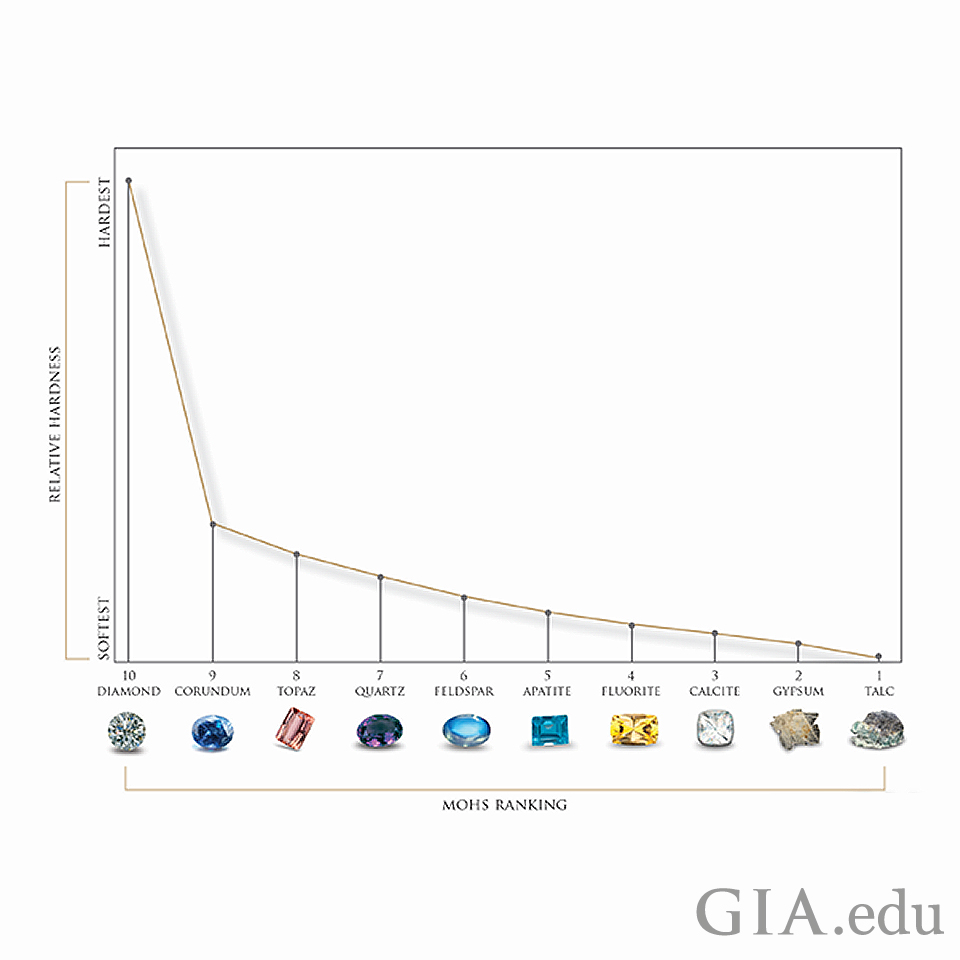
Mohs Hardness Scale. (Photo by: GIA)
Scratch resistance matters, but it doesn’t tell the whole story. GIA explains gemstone durability through three factors.
Hardness describes resistance to scratches and abrasion.
Toughness describes resistance to breaking and chipping.
Stability describes how a gem responds to heat, light, chemicals, and humidity.
That distinction changes how you compare gemstone engagement rings. Diamond leads the Mohs scale yet can chip, and topaz ranks 8 but has poor toughness from cleavage.
Emerald resists many scratches, but fractures and clarity treatments call for gentler wear and cleaning. Match all three durability factors to your setting and routine.
The best stones for engagement rings pair enough scratch resistance with a realistic care plan. This quick guide compares common types of stones for rings, including alternative engagement ring stones that can work beautifully when the setting fits the stone.
The hardness values and durability notes below follow GIA guidance and the gemological sources cited in each section. Use the table as a starting point, then read the stone-specific notes below.
| Daily-wear group | Stone | Mohs hardness | Main durability caveat | Recommended protection |
| Built for everyday wear | Diamond | 10 | Can chip or cleave after a hard blow | Protect exposed points and inspect prongs |
| Built for everyday wear | Moissanite | 9.25 | Very hard, but not impact-proof | Secure prongs and avoid hard impacts |
| Built for everyday wear | Sapphire and Ruby | 9 | Treatments can change care needs | Protect corners and ask about treatments |
| Built for everyday wear | Alexandrite | 8.5 | Can still chip after a hard impact | Use a bezel, halo, or sturdy prongs |
| Built for everyday wear | Spinel | 8 | Good durability, but not damage-proof | Protect exposed edges |
| Suitable with the right setting and care | Topaz | 8 | Poor toughness from basal cleavage | Use a protective mounting and careful wear |
| Suitable with the right setting and care | Emerald | 7.5 to 8 | Fractures and clarity treatments need care | Use a bezel or halo and clean gently |
| Suitable with the right setting and care | Aquamarine | 7.5 to 8 | Can scratch or chip with rough wear | Choose a lower profile or protected edges |
| Suitable with the right setting and care | Morganite | 7.5 to 8 | Can scratch, and pale color shows residue | Use a protective setting and clean regularly |
| Better for occasional wear | Amethyst | 7 | Quartz dust can abrade it over time | Choose occasional wear or strong protection |
| Better for occasional wear | Moss Agate | 7 | Can scratch, chip, or dull with wear | Use occasional wear and protected edges |
| Better for occasional wear | Tanzanite | 6 to 6.5 | Softer and vulnerable along cleavage | Reserve for gentle or occasional wear |
| Better for occasional wear | Opal | 5.5 to 6.5 | Soft and sensitive to impact and moisture changes | Avoid knocks, heat, and frequent wear |
| Better for occasional wear | Pearl | 2.5 to 4.5 | Very soft, and the nacre can wear | Choose occasional wear and gentle handling |
A non-diamond engagement ring can feel just as meaningful when the stone reflects the wearer’s style, story, and daily life.
Color may honor a birthstone, a shared memory, or simply a shade they love. Moissanite can suit someone drawn to bright fire, and sapphire can add color without giving up strong scratch resistance. Meaning comes from how well the choice fits the person, not from following a single tradition.
At Do Amore, every jewelry purchase gives one person access to clean water, regardless of the center stone. That lets a moissanite or gemstone ring carry personal meaning and direct impact without turning the stone choice into a compromise.
A Mohs hardness of 7.5 or higher is a useful starting point, but the best engagement ring center stone needs enough toughness and stability for your routine. The options below show why a single Mohs number never tells the whole story.
Emerald ranges from yellowish green to bluish green and ranks 7.5 to 8 on the Mohs scale. Inclusions are common and often part of an emerald’s character. Many emeralds show extensive eye-visible inclusions. A flawless-looking emerald is uncommon, so evaluate the inclusion pattern and whether any fractures reach the surface.
Emerald’s inclusions are often described as a “garden,” and they are part of the gem’s character. Surface-reaching fractures raise chipping risk. Oils, resins, or polymers used for clarity treatment can change how the stone should be cleaned. Choose emerald engagement rings with a protective setting, ask about treatments, and use steam or ultrasonic cleaning only after a jeweler confirms it is safe for that stone.

Emerald Engagement Ring
Aquamarine is a shiny, light blue gem that symbolizes tranquility and healing. Unlike its sister, Emerald, Aquamarine is a Type I gem, meaning it should be pretty flawless. Like Emerald, it is a 7.5/10 on the Hardness Scale. Aquas can come in light, medium, and darker blue tones. It sometimes shows a hint of green, like the sea. Couples choosing an Aquamarine engagement ring should look for an eye-clean gem that shows its blue color. Lighter blues are less valuable than medium or medium-dark blues. Darker color blues will also help to hide when your Aquamarine engagement ring is not sparkling clean, whereas light blue shows dirt and oil much more easily.
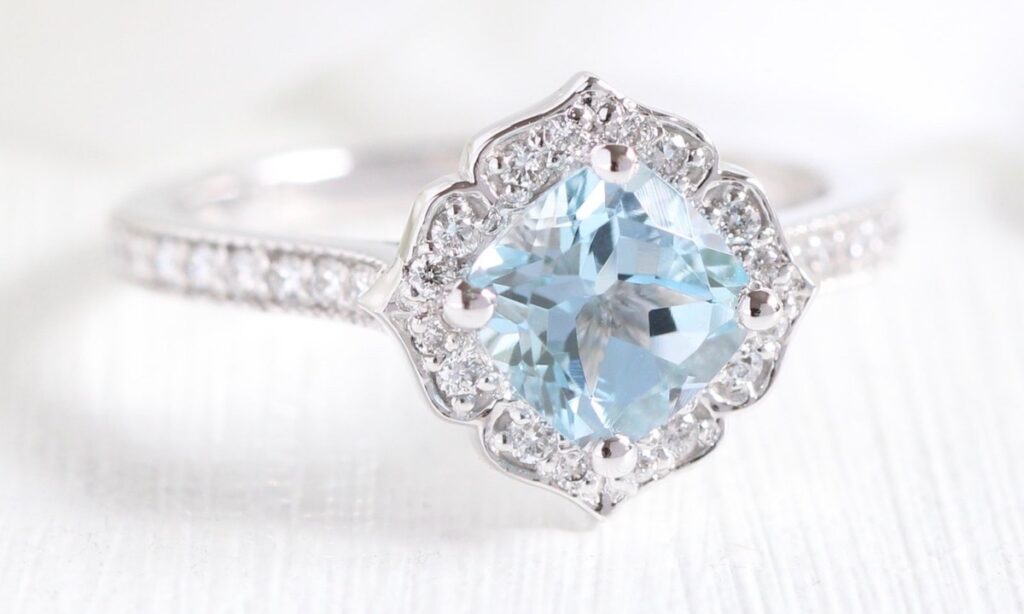
Aquamarine engagement ring. (Photo by: La More Design)
Topaz is an 8/10 on the Mohs Hardness Scale, making it a good engagement ring option. It symbolizes wealth and royalty. The most common color of Topaz today is blue, however it is also naturally found in colorless, pink, yellow, and peach hues. Blue Topaz comes in some massive crystals, making it a great choice for couples that want a huge look. When choosing a Topaz engagement ring, you should look for an eye clean stone with medium color.
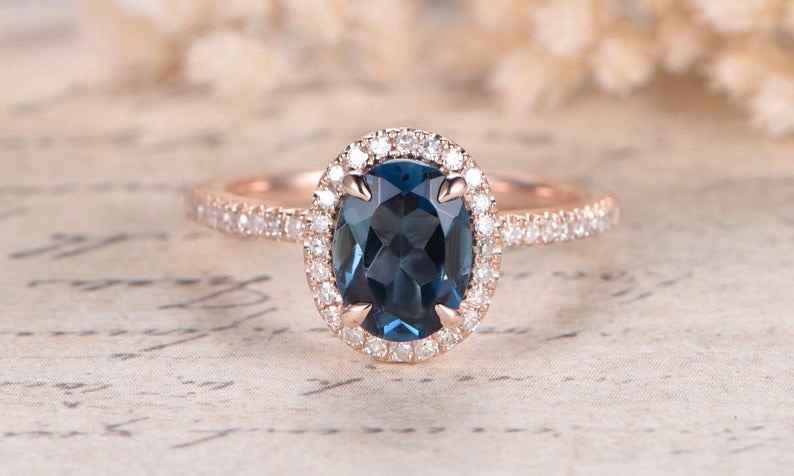
Topaz engagement ring.
My engagement ring is a Spinel! Although it is not commonly heard of, Spinel makes a good engagement ring choice due to its 8/10 hardness on the Mohs Scale and its vast array of colors. Spinel symbolizes power and protection. My Spinel is a blueish-Violet color, but I have also designed Spinel engagement rings in bright Pink and Black. The most sought after colors in this gemstone engagement ring are red, pink, and blue, as they can rival Ruby and Sapphire.
Spinel is a Type II gemstone, which means they often have some inclusions, but can also be eye-clean. So, couples choosing a Spinel should look for an eye-clean stone in a color that speaks to them!
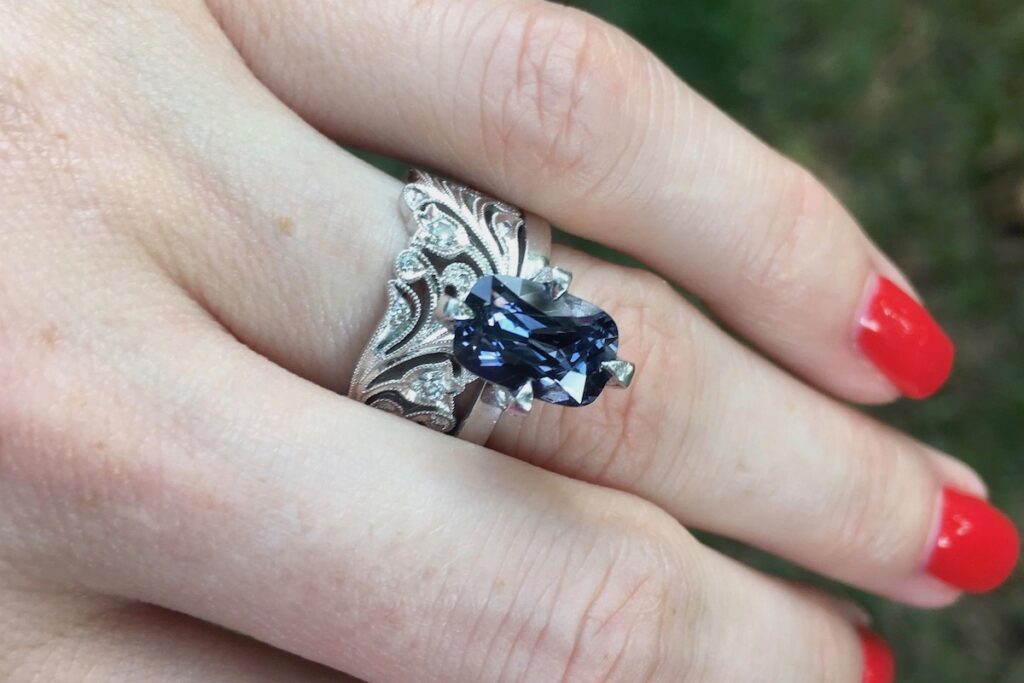
2.75ct Cushion Spinel Engagement ring.
Alexandrite is a great choice for an engagement ring due to its 8.5/10 Mohs hardness. It is the color-change version of the larger gem group Chrysoberyl, and symbolizes luck and balance. Alexandrite changes from green in daylight to red under a light bulb. Non-alexandrite Chrysoberyl comes in yellow, bronze, and green. Chrysoberyl symbolizes protection and healing. Chrysoberyl and Alexandrite are Type II gemstones, meaning they will have some inclusions, but eye-clean gems are available.
So, couples choosing this engagement ring should look for eye clean gems.
When looking for an Alexandrite engagement ring, the most important thing to consider is the quality of its colors and color change. Couples looking for a Chrysoberyl engagement ring should seek out a pleasing, warm color.
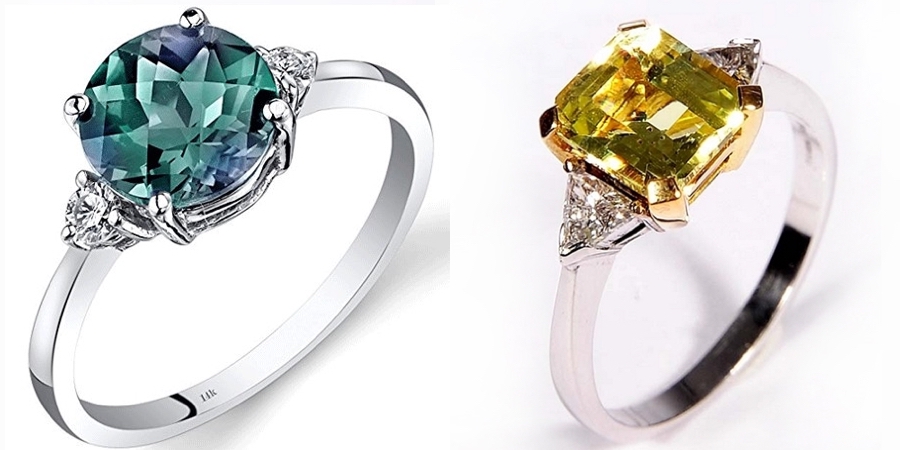
Left: Alexandrite engagement ring. | Right: Chrysoberyl engagement ring.
Sapphire and its sister, Ruby, are the hardest non-diamond gems available at a 9/10 on the Mohs Hardness Scale. Members of the gem family Corundum, red gems are Ruby, and all the other rainbow colors are Sapphire. A Sapphire engagement ring signifies loyalty. A Ruby engagement ring symbolizes love and passion. Sapphire and Ruby are Type II gems, meaning they will have some inclusions, but eye clean gems should be sought out.
Rich medium tones (in other words, not too light and not too dark) are the most beautiful and valuable. Because of its superior hardness and crazy amount of colors, a Sapphire engagement ring is an excellent gemstone engagement ring choice. Likewise, due to its romantic color and great durability, couples looking for something different should definitely consider a Ruby engagement ring.
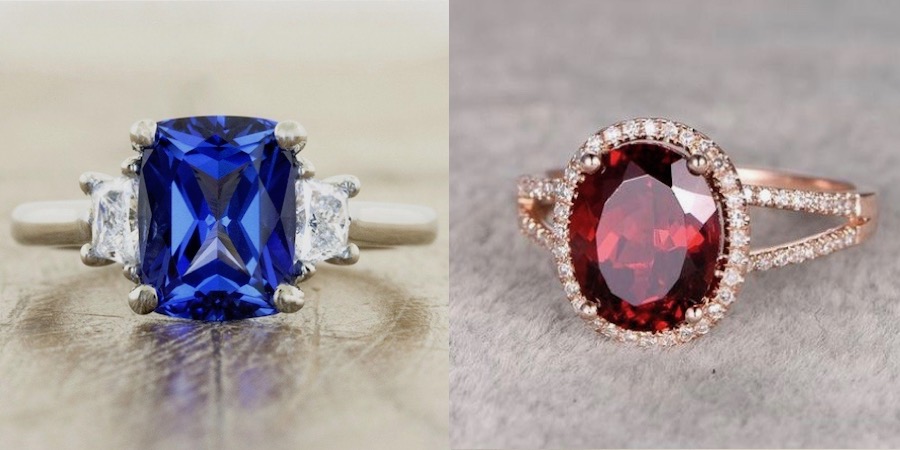
Left: Sapphire engagement ring. | Right: Ruby engagement ring.
Opals are beautiful shimmery gems that are very, very soft. A 5.5-6.5 on the Mohs Hardness Scale, in fact. So, even with extreme caution, there is a real chance the gem will break during normal wear. As a result, Opal engagement rings are not ideal. Instead, couples looking for an Opal engagement ring should check out Star Sapphire, much harder and just as unique!
Left: Chipped Opal center stone. | White star sapphire engagement ring.
Morganite is a peachy-pink gem that is typically eye clean. It symbolizes love and innocence. This may sound like an ideal engagement ring choice, but real life gets in the way. Because of its light color and lack of significant sparkle, Morganite shows dirt and oil almost immediately. Even people who take great care of their rings will experience this, because, well, life. You have oil on your skin, put on makeup, use hairspray, wash your hands.
So, instead of choosing a Morganite engagement ring, couples should check out Pink Topaz, Pink Spinel, or Pink Sapphire, much harder, and do not show dirt and oil as easily!
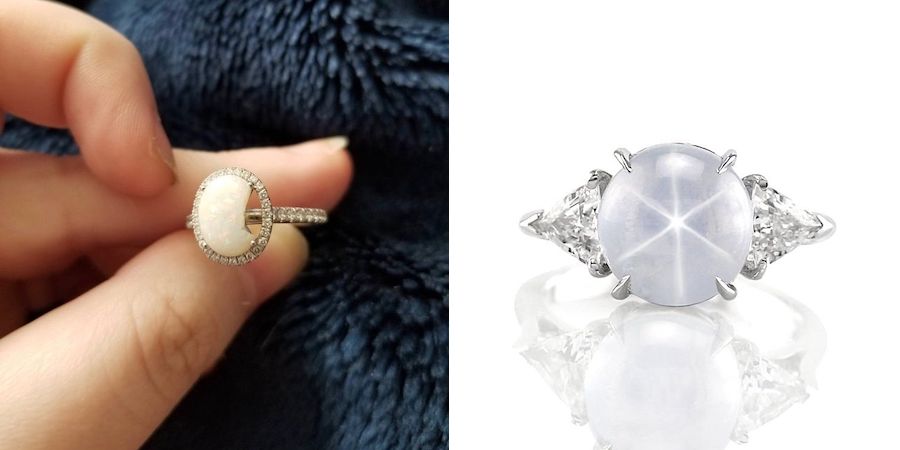
Left: Chipped Opal center stone. | White star sapphire engagement ring.
Pearl engagement rings are romantic. Unfortunately, they are also too soft, at a 2.5-4.5 on the Mohs Hardness Scale. Normal damage we see to Pearl engagement rings include loss of the pearl, dull spots where the nacre has worn off, and chipping. This is tragic! Instead, couples looking for a Pearl engagement ring should consider a white cabochon Sapphire instead. A sapphire engagement ring is much harder, and will last the test of time.
Left: Missing pearl in ring setting. (Photo by: MyJewelryRepair) | Right: Cabochon Sapphire engagement ring.
Amethyst is a rich, Welch’s grape purple that people adore for a unique engagement ring. Sadly, at a 7/10 on the Mohs Hardness Scale, Amethyst is the same hardness as dust. As a result, Amethyst will wear poorly over time, experiencing mini scratches until it is dull. That’s not what you want for an engagement ring! Instead, couples searching for an Amethyst engagement ring should check out Purple Sapphire which is much harder and will always be beautiful.
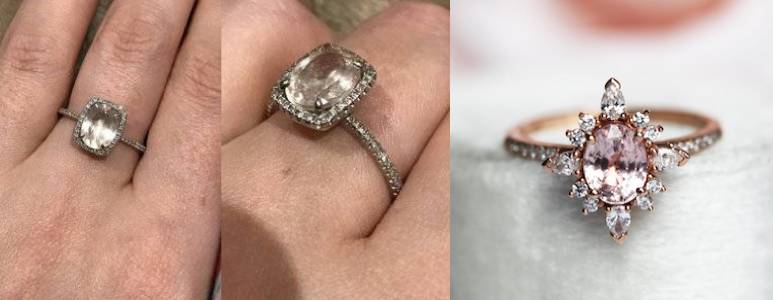
Left: Dull, dirty Morganite engagement ring. | Right: Pink sapphire engagement ring.
Pearl engagement rings are romantic. Unfortunately, they are also too soft, at a 2.5-4.5 on the Mohs Hardness Scale. Normal damage we see to Pearl engagement rings include loss of the pearl, dull spots where the nacre has worn off, and chipping. This is tragic! Instead, couples looking for a Pearl engagement ring should consider a white cabochon Sapphire instead. A sapphire engagement ring is much harder, and will last the test of time.
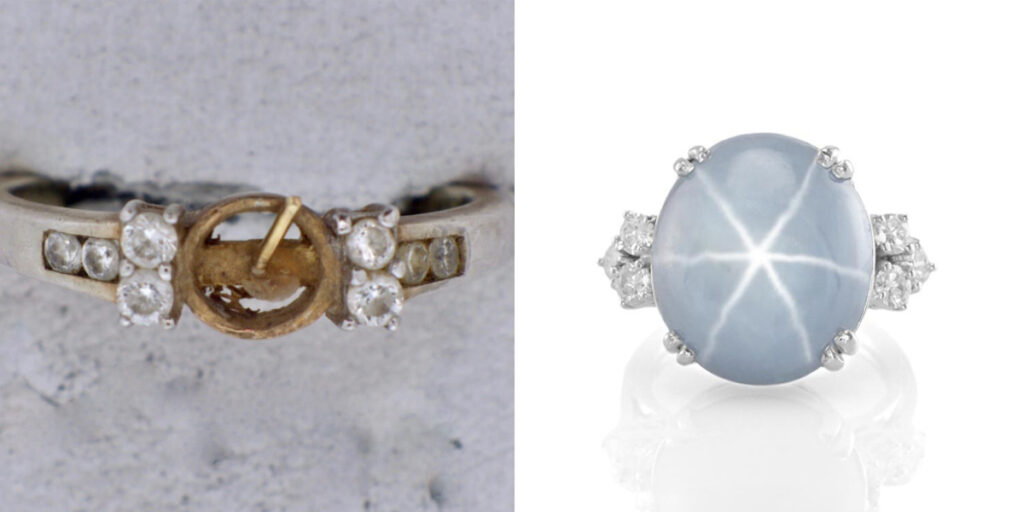
Left: Missing pearl in ring setting. (Photo by: MyJewelryRepair) | Right: Cabochon Sapphire engagement ring.
Amethyst is a rich, Welch’s grape purple that people adore for a unique engagement ring. Sadly, at a 7/10 on the Mohs Hardness Scale, Amethyst is the same hardness as dust. As a result, Amethyst will wear poorly over time, experiencing mini scratches until it is dull. That’s not what you want for an engagement ring! Instead, couples searching for an Amethyst engagement ring should check out Purple Sapphire which is much harder and will always be beautiful.
Left: Scratched Amethyst stone. | Right: Purple sapphire engagement ring.
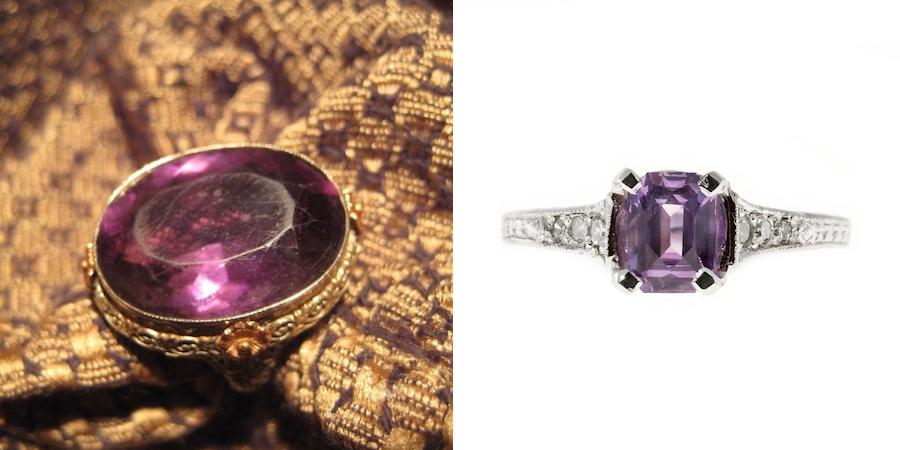
Left: Scratched Amethyst stone. | Right: Purple sapphire engagement ring.
Tanzanite burst onto the scene in 1967, and suddenly everyone wanted a Tanzanite engagement ring. It’s no wonder, it’s a gorgeous blue-violet that is quite uncommon in gems. However, at 6-6.5/10 on the Mohs Hardness Scale, it’s a bad idea for an engagement ring. Instead, couples looking for a Tanzanite engagement ring should look for Violet Spinel (like mine!). Spinel is much harder than Tanzanite and will hold up to daily wear much better.
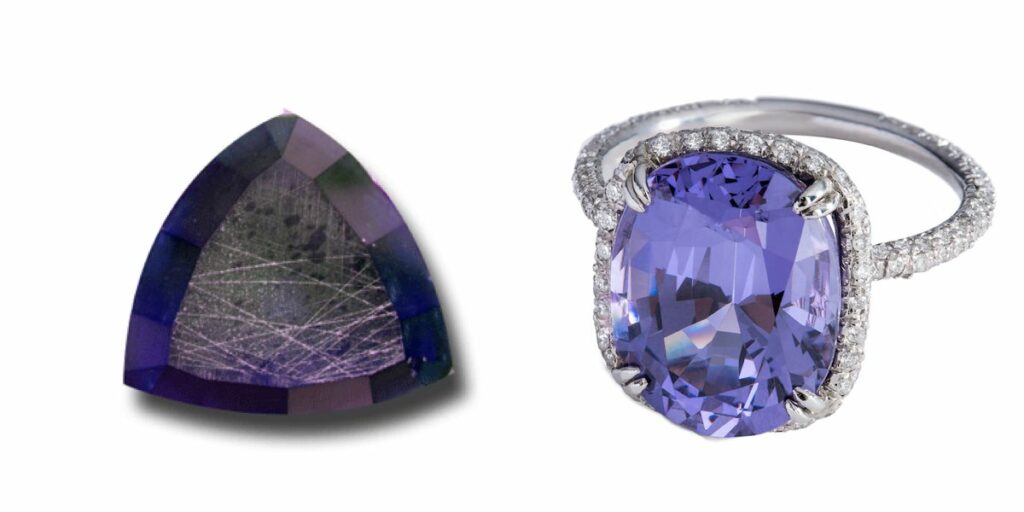
Left: Scratched Tanzanite gemstone. | Right: Violet Spinel engagement ring.
Moss Agate is a unique gemstone with organic, leaf-like inclusions. This kind of appearance is very popular with those who feel a connection with nature! Unfortunately, however, moss agate is a variety of quartz, meaning it is only a 7/10 on the hardness scale. This means it is risk for scratching, chipping, and generally becoming dull, like the ring below. We have helped many couples replace an original moss agate engagement ring that has sadly broken.
Most of these couples opt for emerald or a unique green sapphire! Sapphire is a 9/10 hardness and comes in a ton of beautiful green shades, and it can even have great inclusions, reminiscent of moss agate. Nature-loving couples may also love emerald’s mossy “jardin” appearance, which actually means garden in French!
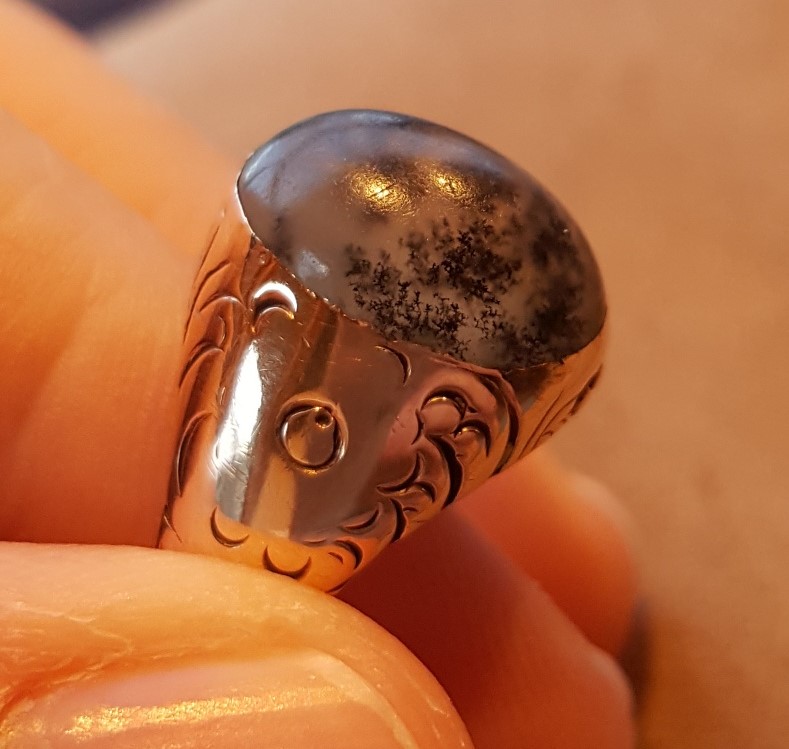
Scratched moss agate ring. Photo by spartcom5 on Antiquers.
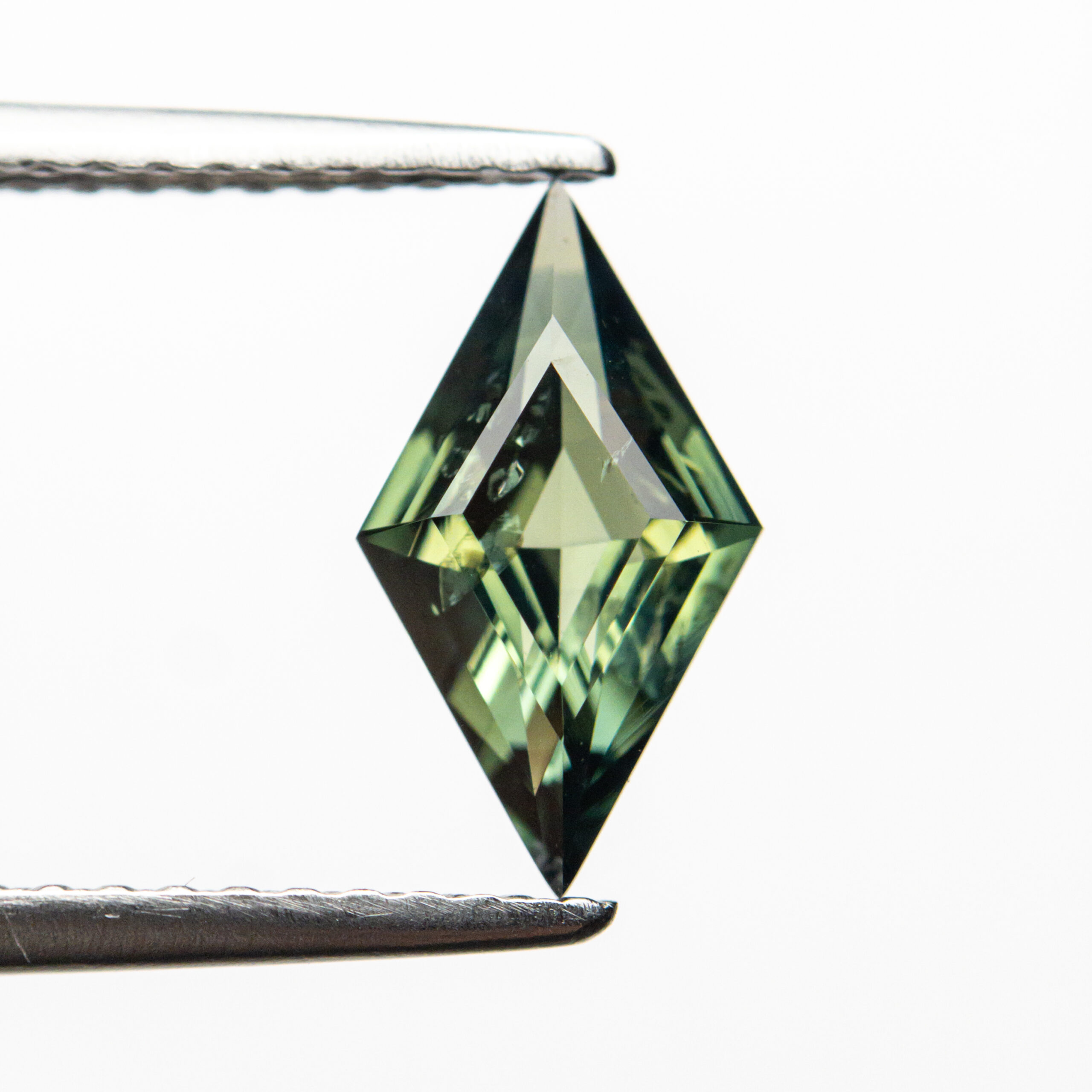
Natural green sapphire ring with lily-pad like inclusions.
I’d love to! Contact me here and describe the delicious color you’re looking for! I will walk you through what gemstone options are the most durable and find the perfect stone for you.
An emerald cut diamond is a rectangular diamond with long, mirror-like facets. It is a traditional cut with major historic value. There are numerous famous emeralds, including those that adorned the fingers of Grace Kelly and Elizabeth Taylor, as well Amal Clooney, JLo, and perennial favorite Victoria Beckham.
Because Emerald cut diamonds require higher color and higher clarity in order to face up white and eye clean, choosing an emerald is a way to showcase value. In this respect, high net-worth individuals enjoy purchasing emeralds because they flaunt wealth. However, you don’t need a D color flawless emerald shape like them, read on for tips on how to score a gorgeous emerald without the celebrity price.
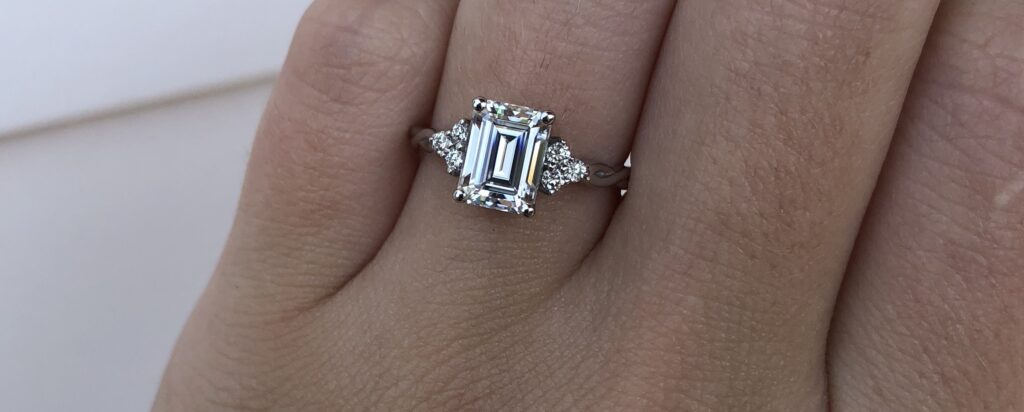
Not really, it’s more of a shine than a sparkle. Emeralds are not meant to be disco balls like other shapes. Instead, they are meant to show an understated mirror-like elegance. In fact, an emerald’s shine is called “hall of mirrors”! So, if “sparkle” is your biggest goal, try radiant instead. But if you love a gorgeous, high-end sheen, an emerald stone is for you.
The perfect emerald cut diamond is white, eye clean, and has a beautiful “hall of mirrors”. So, what is this hall of mirrors you keep hearing about? It is the light and dark bands on either side of an emerald’s table facet. These are important because in order for an emerald to have a shine, the stone needs to have some contrast to shimmer back and forth from. Otherwise, a stone can end up looking “dead”. Likewise, if the stone has too much darkness (often in the form of a “black box”) it can take away from beauty. So, you want to look for a hall of mirrors, not a box of them. Check it out:
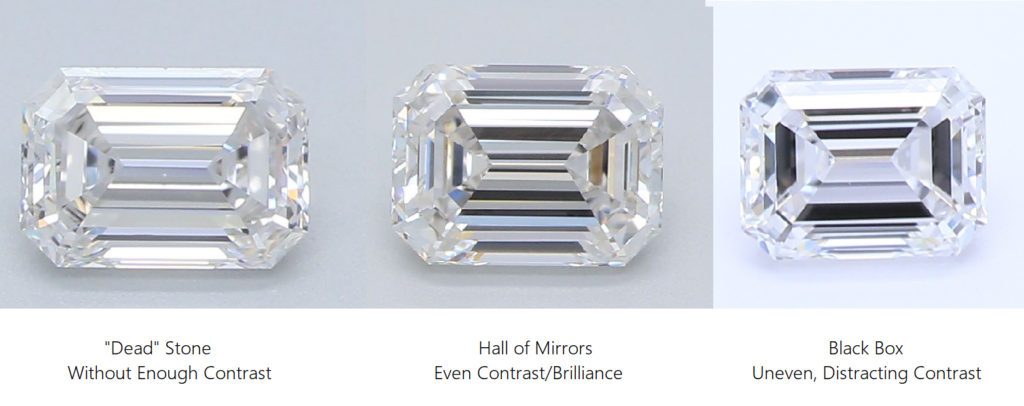
Emeralds are “step” cut stones, meaning they have rectangular and trapezoid shaped facets. Step cut stones (which also include asscher cuts) show inclusions more easily than “brilliant” cut diamonds (every other shape except emerald and asscher). As a result, couples choosing emerald cuts need to select a higher clarity than they otherwise would need to get an eye clean gem. So, which clarity should you choose? Let’s explore:
VS and VVS are higher end clarity ratings in the diamond clarity scale which starts at Flawless and ends in Included. Both VVS and VS tiers include two grades each: VVS1/VVS2 and VS1/VS2. VVS more flawless than VS, and 1 is more flawless than 2. So, the order goes VVS1, VVS2, VS1, VS2. It’s a lot of acronyms that can look a little daunting, but here’s a secret: they literally just mean “very slightly” and “very very slightly”. LOL! So, when all the letters get you down, don’t sweat it. You’ll know that “very very slightly” means there’s basically no inclusions in the stone.
Now, the distinction between these two tiers is very important in emerald cuts, as they typically need to be a minimum of VS1 in order to be eye clean. So, you will need to remember to set your filter to VS1+ (no VS2s allowed!). Then, when looking through stones, make sure that any VS1 you consider is actually eye clean (or email me to double check it!). Fortunately, VVS1 and VVS2 are almost always eye clean (only large stones could ever show an eye visible inclusion at this level).
Lab Diamond Couples: Make sure to be on the lookout for “crystal strain” in your emerald – it’s specifically noticeable in these cuts. Crystal strain is caused by the stone being grown too quickly, and looks like a “streaky” window. Not pretty, and unfortunately, not included in a stone’s certification (it can even happen in VVS stones). This only happens in lab stones. Read more here.
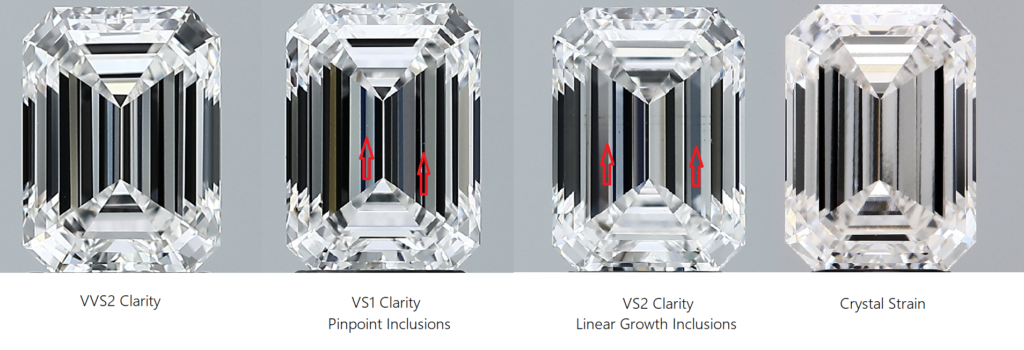
Clarity is more important, because inclusions can be seen easily in emerald shapes, and color can be hidden by gold. Because emeralds have that iconic sheen, and not inclusion-hiding sparkle, clarity has to be your first order of business. VS1+ or VVS to be sure! However – color comes in second only because near colorless shades like H and I can be masked by setting the gem in yellow gold setting or rose gold setting.
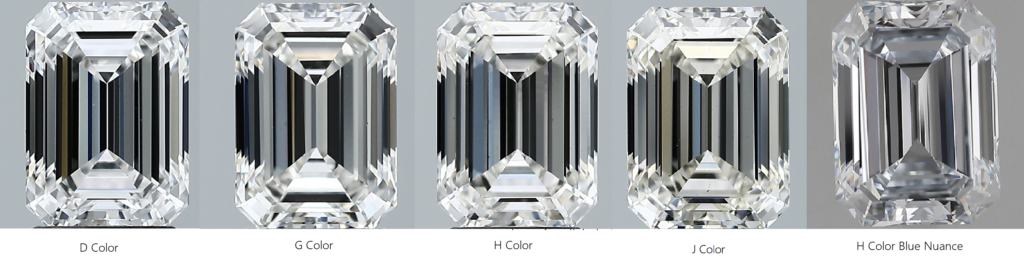
If setting in a white metal like white gold engagement ring, palladium engagement ring, or platinum engagement ring, you’ll still need G+ color to look white-white.
Yes, emerald cut diamonds show more color than other shapes. This is because emeralds do not have that dazzling sparkle to detract from color! In fact, the Emerald shape was originally designed to actually enhance color in colored gems like….emeralds. And, those long facets do the same for diamonds. As a result, while most shapes allow for H+ color to look “white”, emeralds really need G+ in most sizes (unless set in yellow or rose gold).
Pro tip: If you are prioritizing carat weight over color, choosing an emerald with significant contrast will somewhat detract from color. So, choosing a dramatic emerald with lots of contrast (but no black boxes!) can help.
Lab Diamond Bonus: Looking for white gold, but don’t want a warm center stone? Make sure to check out “blue nuance” diamonds in HIJ colors. Crisp icy blue instead of warm – and it looks gorgeous in white metals. Blue nuance is only available in lab created diamonds. Read more here.
Yes, emerald shaped diamonds tend to look a bit larger than other shapes due to their long length and nice spread. Unless Princess cuts and cushions, which carry their weight in their depth, emerald cuts carry their weight in their diameters. You can make sure you’re getting a good spread on your emerald by ensuring its depth is between 60-67% (just don’t give up that hall of mirrors contrast by choosing too shallow of a stone)! You can read more about the industry’s general guidelines for emeralds here.
Emerald cuts are often more expensive than other diamonds of the same size because you need to choose a higher color and clarity to look white and eye clean. However, if all other qualities are equal (for example, a G/VVS2 Emerald vs a G/VVS2 Round) the emerald will be less expensive. This is because emeralds do not waste as much of the rough gem crystal as round cuts do, and they are less in demand as rounds. So, if you’ve decided to go G/VVS already, an emerald can save you money! However, if you’re on the fence, definitely compare mid-range rounds against high-end emeralds to check value. Or email me to send you a selection within your budget!
No – emeralds and baguettes are cousins. A baguette cut is even longer and skinnier than an emerald, and has pointed corners. It also has a few less facets. Traditionally, baguette cut diamonds are used as side or accent stones, whereas emeralds are center stones. However, we have been seeing a few avant garde designers take baguettes on for sleek, modern center stones!
Emeralds and radiants have the same outline, but emeralds are step cut, whereas radiants are brilliant cut. This means that emeralds showcase that gorgeous sheen, whereas radiants show true “sparkle”. Radiants can show a “crushed ice” sparkle or a “chunky” brilliant sparkle. Both shapes are rectangular with clipped corners. So, while emeralds are an understated elegance, radiants show extreme bling. They’re both beautiful in their own right! Which do you prefer?
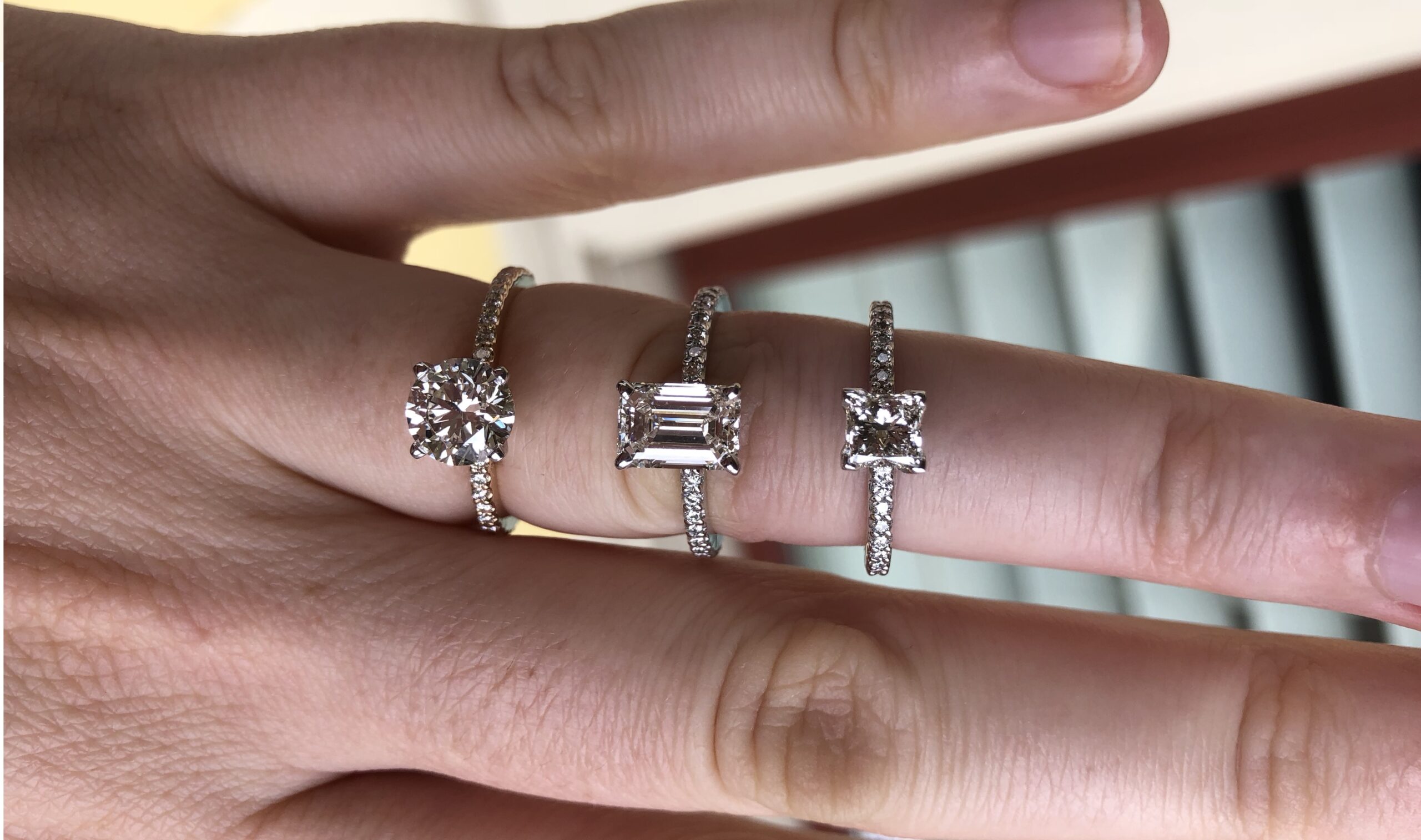
Browse our full collection of emerald cut engagement rings or reach out for a custom curated selection. Just send me a note here, or email me at [email protected]! I can walk you through emerald hall of mirrors, color, and clarity benefits – and keep you on budget. We specialize in diamonds with max bang for your buck!
No. Contrary to popular belief, Emeralds are actually quite scratch resistant, being a 7.5-8 on the Mohs Hardness Scale. This means they are pretty durable for everyday wear! What is actually more important to understand about Emeralds is that many have extensive inclusions. Jewelers call these special Emerald inclusions its “jardin” (or its garden!). Emerald jardin is very normal, as Emeralds are a Type III stone (inclusions expected). Importantly, however, is that some of these inclusions may reach the surface. And, surface-reaching inclusions can make a stone vulnerable to chipping. So, by choosing a stone without (or without many) surface-reaching inclusions, your Emerald is not “too soft” to be an engagement ring!
Yes. Like all stones (yes, even diamonds!) Emeralds can crack or chip if struck. Because many Emeralds have surface-reaching inclusions, cracks can occur more easily. So, when choosing an emerald, make sure to look for a stone with no (or only minor) surface-reaching inclusions. If the stone you’re looking at has a surface-reaching inclusion, make sure to set it in a protective setting, such as a bezel or halo!
Many are, but not all! Because Emeralds are a Type III stone, we expect them to have inclusions – and often so many that the gem is somewhat cloudy. However, super high-quality natural Emeralds can be eye-clean! Another way of choosing an eye-clean Emerald is to choose a Lab-Created Emerald. Lab-Created Emeralds have the exact same mineral makeup as a natural Emerald, but will not show a jardin (and are therefore often more durable).
Eye clean Emeralds will offer green flashes, but not “diamond-like” rainbow sparkle. This is because Emerald’s refractive index is 1.566 – 1.600, whereas diamond’s is 2.42. That means that when light enters an Emerald, it does not reflect it as much as a diamond. Instead, light makes an eye-clean Emerald brighten and almost glow.
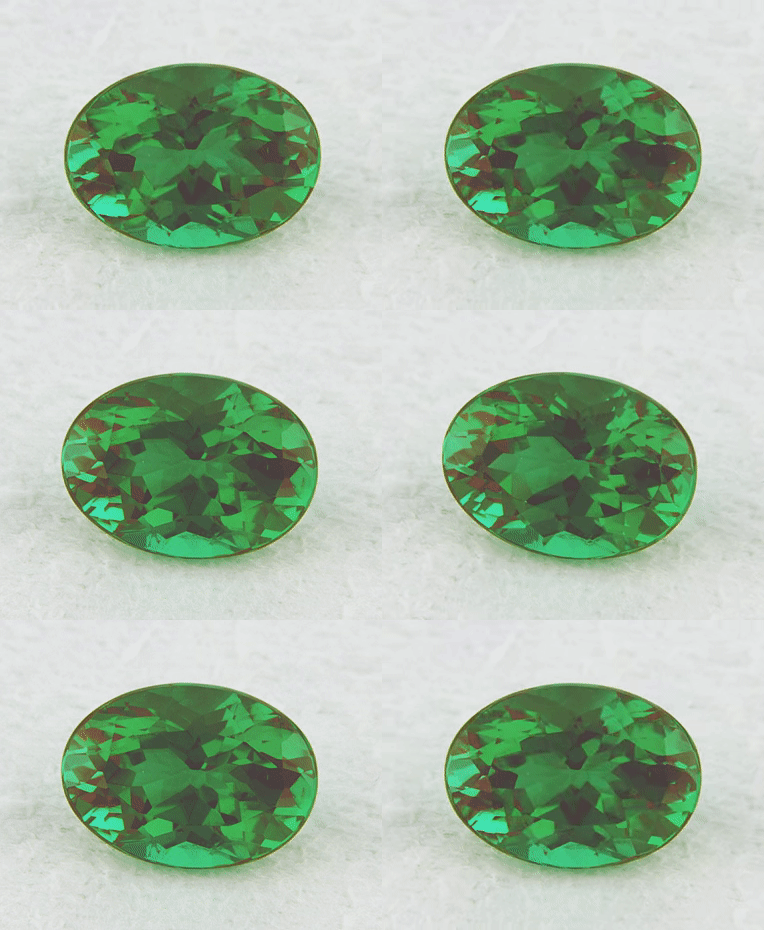
High-quality eye clean natural Emeralds are rarer than diamonds! It takes moving around 2.5x more rock to locate a high-end Emerald than it does a Diamond. So, you can rest assured that choosing an Emerald engagement ring shows your love.
To make an Emerald’s jardin less noticeable, and it’s green more green, natural Emeralds are oiled after they are faceted. This is a normal treatment and all natural Emeralds are expected to be oiled (just like Sapphires are expected to be heated.) Think about it like a hot oil treatment you put on your hair!
Because natural Emeralds are oiled, natural Emeralds should be cleaned by hand in warm soapy water with a soft toothbrush, and not with an ultrasonic or steam cleaner (which may strip out the oil). If you accidentally remove the oil from your natural Emerald, don’t panic! A competent jeweler can have your Emerald re-oiled (don’t try this at home, kids).
PS: If you’ve chosen a Lab-Created Emerald, you can clean your Emerald by hand or ultrasonic – no oil to worry about!
Sure. Because Emeralds are a 7.5-8 on the hardness scale, they are durable enough for everyday wear. Like all fine jewelry (yes, even diamonds), you should remove your rings before doing anything strenuous. So, before you work out, garden, do the dishes, etc., take off your ring! This will help protect it from unnecessary hits.
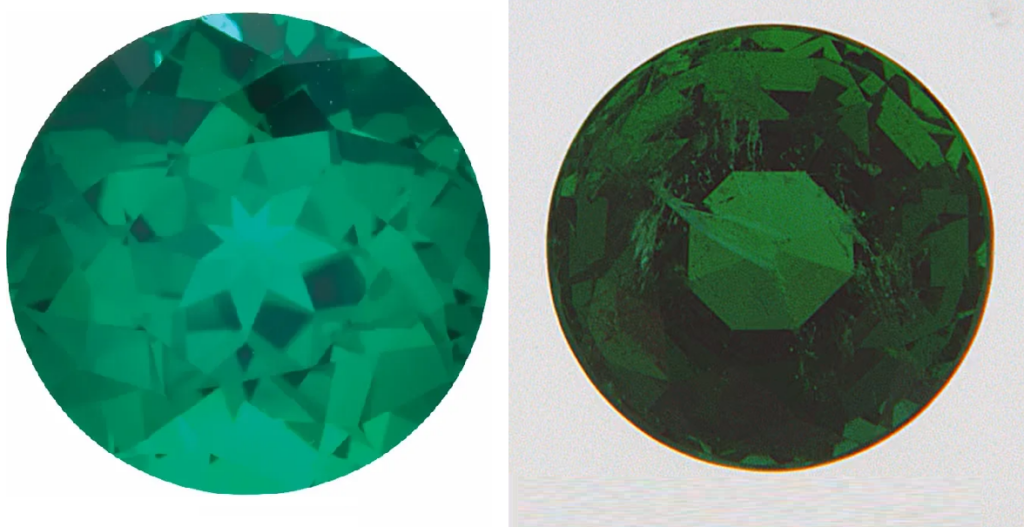
(left) Lab Emerald vs Natural Emerald (right)
Natural top AAA quality Emeralds will be more expensive than diamonds. This is because they are rarer in nature and much more expensive to find! However, if you like the look of an Emerald with more jardin (and there are some cool looking jardins out there), you can definitely find a natural Emerald that is less expensive than diamond. Also, Lab-Created Emeralds are incredibly affordable! And, a Lab-Created Emerald is much less expensive than a Lab Created Diamond.
A natural top quality 1 carat Emerald will range upwards of $4,500+, however, a Lab-Created 1 carat Emerald is only $880! Check out below how this compares with diamond:
| 6.5mm Natural AAA Emerald | 6.5mm Round Lab Emerald | 1ct (6.5mm) Round I/VS2 Diamond | |
| Cost | $4,500+ | $880 | $4,000+ |
The price of your Emerald Engagement ring is simply the cost of your chosen Emerald center stone and your ring setting – we have Emerald engagement rings starting at $930! Couples can choose from large Emerald center stones, beautiful Emerald three-stone engagement rings, or even Emerald halos! We love it all, and can make the Emerald engagement ring of your dreams.
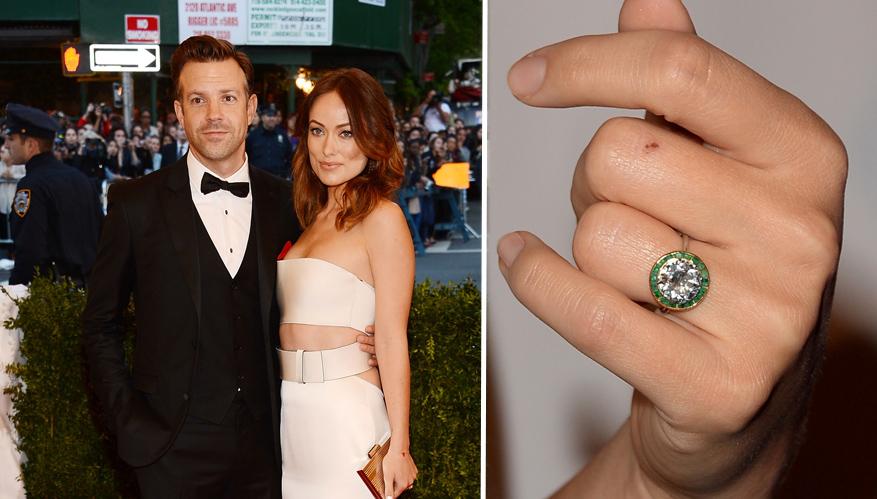
Yes! Emeralds make great engagement rings: they’re beautiful, rare, and durable! I love Emerald engagement rings because they are unique and said to bring good fortune, too.
Although not as popular as Sapphire engagement rings, Emerald engagement rings are popular with those who love green. They enjoy a celebrity following, too! Halle Berry’s engagement ring showcases a gorgeous Emerald cut Emerald, as did Jacqueline Kennedy’s! Victoria Beckham has a beautiful cushion cut Emerald, and Olivia Wilde’s engagement ring has a unique Art Deco Emerald halo.
People who do not want to have to remove their jewelry before being active should consider other stones. Those who want an ultra-durable green gem should consider green diamond (we can source natural, color enhanced natural, or lab green diamonds!) or green sapphire. Both of these gems are more durable for extreme wear.
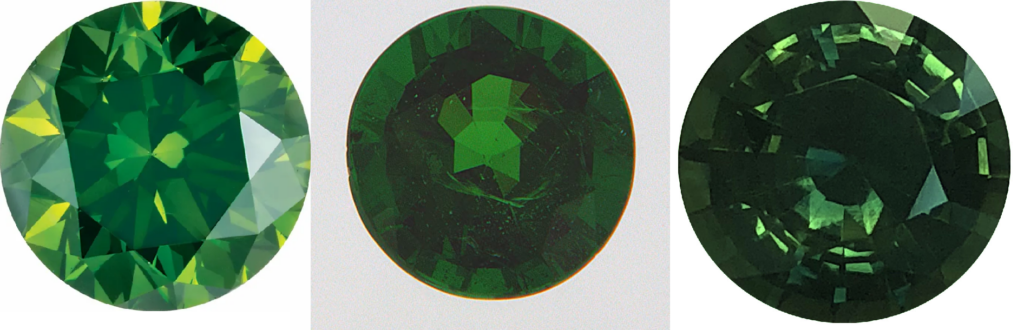
(left) Green diamond vs Emerald vs Green Sapphire (right)
Those who love a natural green look and who will treat their Emerald with care! Emeralds are a lovely engagement ring choice for lovers of green and gardening. They are best for people who don’t mind removing their jewelry when being active.
It depends on why you want an Emerald! Couples choose Natural Emeralds for their rarity, prestige, and natural beauty. Couples choose Lab-Created Emeralds for their price, their high clarity, and their ease of maintenance. Both are beautiful, durable, and make excellent engagement rings!
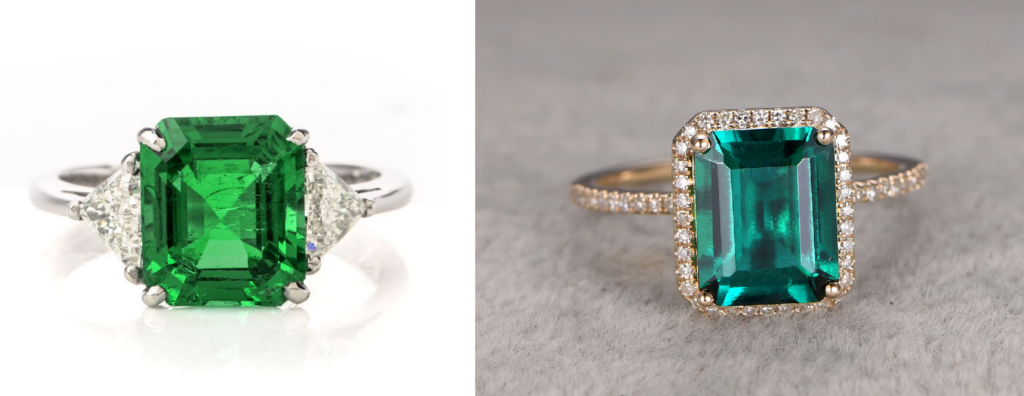
(left) Natural Emerald engagement ring vs Lab Emerald engagement ring (right)
The top color for an Emerald is very slightly blueish Green. The slight blue tint gives your Emerald a regal look! That said, color is an incredibly personal choice. Some people love a super dark Emerald, some like Emeralds with a more yellowish tone! As the most important factor when choosing a colored stone is color, so don’t let anyone tell you to like something you don’t! For example, I love greyish toned gemstones, even though they are less valuable than their more vivid counterparts.
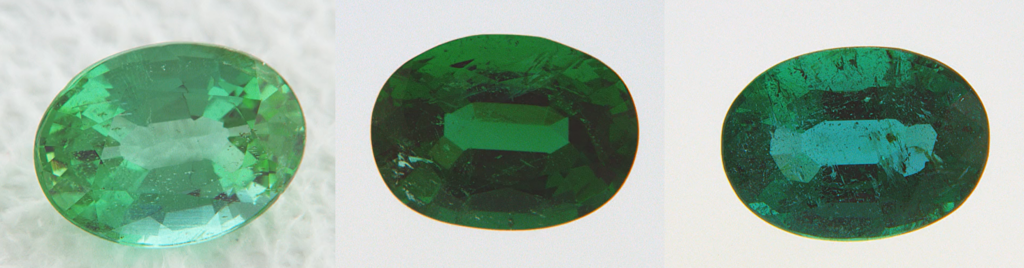
(Left) medium-light very slightly yellowish green; medium-dark green (middle); medium-dark bluish green (right)
The most valuable tone (meaning how light or dark an Emerald is) is medium-toned (so not too light, and not too dark). You want to be able to see green (not black), but also not have it be so light that it appears washed out. So, try to strike a happy medium.
That’s ok! Most Emeralds are not eye-clean. Think of your Emerald’s jardin as its unique fingerprint – there’s not another one out there like it! Moreover, many people love Emeralds for their mossy, lush look. That includes its beautiful garden-like inclusions!
As you would expect, emerald cut engagement rings is the traditional shape for Emeralds! However, Emeralds are beautiful in all shapes. Ovals and Pears are also common shapes, as their long facet patterns echo natural Emerald crystal shapes. Couples choosing a natural Emerald should be aware that because of their rarity, natural Emeralds may have some cutting and symmetry inconsistencies. That means that sometimes an Emerald may have a small flat area on a curve, or extra facets on one side. And that’s ok! Cutting inconsistencies occur because gem cutters try to keep as much weight for you as possible out of the small amount of Emerald material mined!
PS: If you’re choosing a lab-created Emerald, the sky is the limit! You can choose any size and shape, as gem scientists are growing and cutting it special for you.
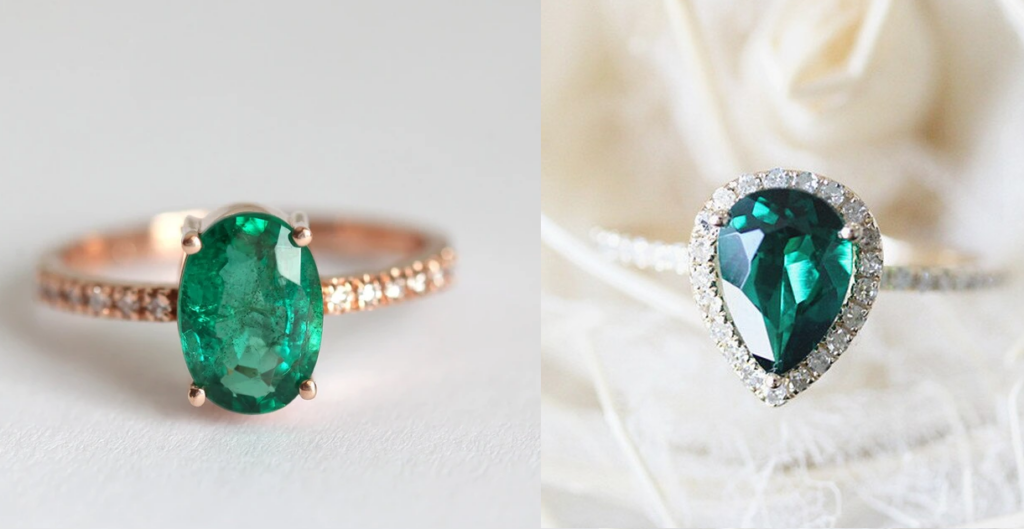
I love the look of an Emerald set in a yellow gold head with a white band, but it looks great in all metals! Yellow gold will bring out the color of an Emerald, While white metals (such as white gold or platinum) will give it a cooler tone, we suggest against rose gold, as pink and green are not as complementary.
Email us at [email protected] or drop us a note here! Let us know about the Emerald you want, and we’ll happily provide you a quote. Don’t know what you’re looking for, or what you can afford? No worries! Let us know what budget you’d like to stick to, and we’ll give you options. Feel free to ask for me, Corinne, the gemologist. I love helping customers find the perfect gemstone engagement rings (I have one too!).
Art Deco engagement rings have geometric patterns and often feature colored gems like sapphire, ruby, or emerald in addition to diamonds. Shapes are BIG in Art Deco. So, you’ll often see large rectangular center stones, circular or square halos, or uniquely-shaped side stones. Descriptions often used for Art Deco jewelry include bold, stately, elegant, and even architectural. Most Art Deco jewelry is done in white gold or platinum.
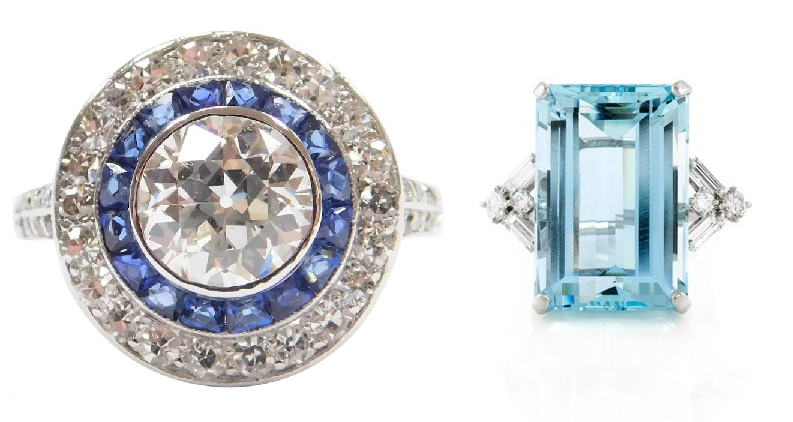
Art Deco engagement rings are popular because they make a big impression, both in personality as well as size! This is because the style’s lines and shapes are instant classics. Everyone loves a large Emerald cut, sapphire paired with diamond, and cool shining platinum. Because these looks never go out of style, they lend a sense of timeless elegance to any outfit or occasion.
Art Deco jewelry first gained popularity in the 1920s and 1930s. This was during the jazz and flapper period! Think old school glam, like The Great Gatsby and Chicago. And, as you can see, the jewelry of the age has endured. Some of the most popular engagement ring designs of today are actually Art Deco!
Yes! Art Deco engagement rings are wildly popular today thanks to a resurgence of interest in diamond halos and gemstone engagement rings. Do Amore offers several different halo designs, as well as a great selection of emerald and asscher cut diamonds, as well as some beautiful sapphire! So, if you are looking for a Deco engagement ring, you are in luck.
One of the biggest design elements of an Art Deco Engagement ring is its shape. Whether it is a large center stone, or an architecturally-inspired setting, Deco style rings feature bold shapes. Some rings feature different shapes in contrast, like a round center in a cushion halo. Other rings highlight large Emerald cut center stones stones mirrored with vertical and horizontal lines. One design element unique to Deco rings is using small square gemstones set into halos instead of tiny rounds! Another common theme is to add triangular or trapezoidal side stones to a round or square center, adding interest and flair to the piece.
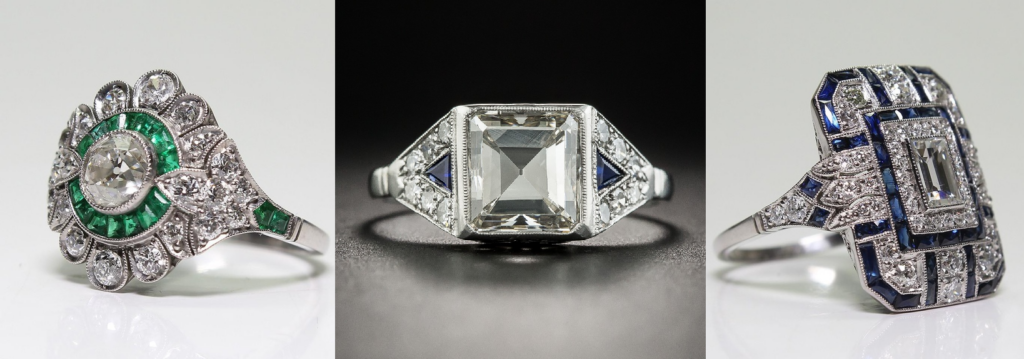
Going with the big and bold theme, Art Deco Engagement rings often feature colored gemstones in addition to diamond. Sometimes these gems are the center stone, sometimes they are placed in a bold colored halo, and other times they act as accent side stones. Popular colored center stones in Deco rings include Sapphire, Aquamarine, and Emerald. Colored bezels are typically made from Sapphire or Ruby. On the other hand, you’ll often find Emerald or Blue Sapphire accent pops.
One enduring design factor in Deco is SIZE. Ladies in the 20s were celebrating their independence and wanted to show off their style and worth. So, the Deco period was flashy! As a result, many Art Deco engagement rings are centered around huge stones. Luckily, you can do this with any budget! Aquamarine or Lab-Created Sapphire or Ruby are very affordable, even in large sizes. Don’t want a big rock, but still want to rock the look? Another way to accomplish a flashy Deco look is to choose a big geometric setting for a smaller stone, like a halo in round, cushion, or even square.
Did you know? A large portion of authentic from-the-20s Deco rings are man-made Sapphire. It’s true! Lab-created gemstones have been around for centuries
Art Deco happened in the 1920s and 30s, when platinum was all the rage. In fact, white gold was invented during this time as a less expensive platinum substitute for those who could not afford the rare metal. While a few Deco pieces are kicking around in yellow gold, the majority of Art Deco jewelry is platinum or white gold. This preference shift began around 1900, at the end of the Victorian period which loved yellow and rose. Wanting something fresh and new after a 70-year trend, Edwardian and Art Deco fashionistas embraced ice-cool platinum.
Art Deco jewelry is very geometric and bold, whereas Art Nouveau features flowing, nature-inspired motifs. As in any shift in style, there are crossover pieces. But, in large part, Art Deco jewelry is meant to make a statement. Art Nouveau, on the other hand, is more sensual and flowery. Art Nouveau jewelry often includes floral patterns, flowing colored enamel, and delicate metalwork. Deco, as you know, is more brash and linear.
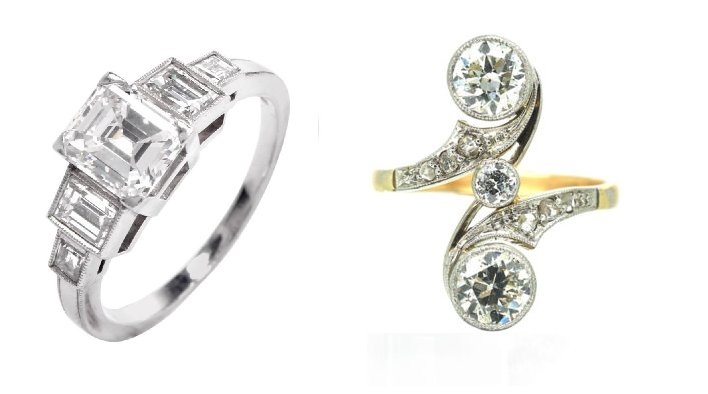
(Left) Art Deco vs Art Nouveau engagement rings (Right)
The Great Gatsby, and the fabulous jewels it constantly inspires, are classic examples of Art Deco Jewelry. Note the cushion halo around Daisy’s round diamond engagement ring, and all the straight lines and circular motifs in her headband? Tiffany’s collection, made specifically for Baz Luhrmann’s 2013 hit, also features intricate geometric colored stone rings and necklaces.
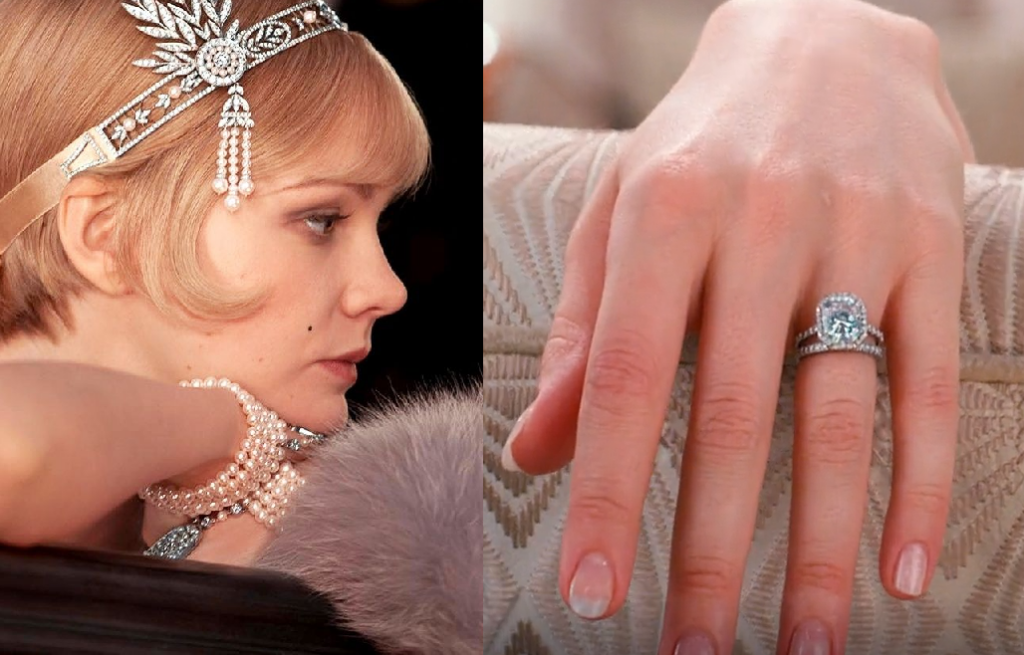
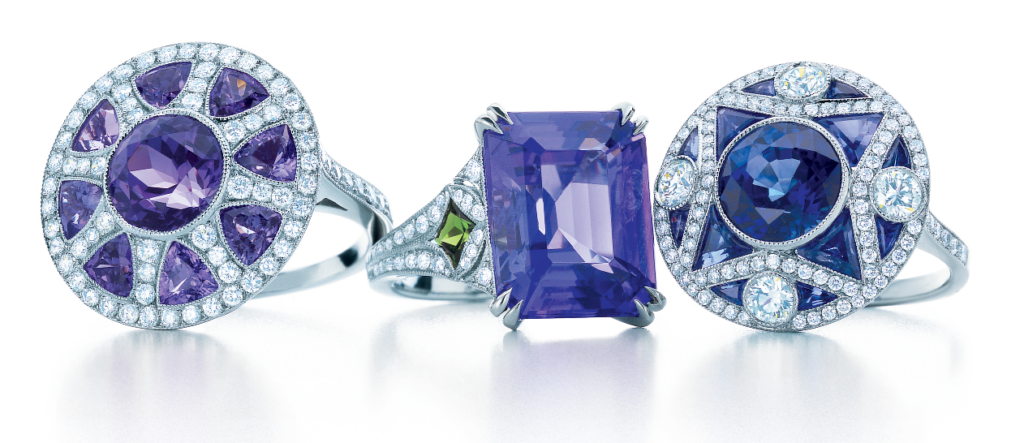
Credit: Tiffany & Co.
We can design great Art Deco engagement rings starting at $809! Here are a few other ideas:
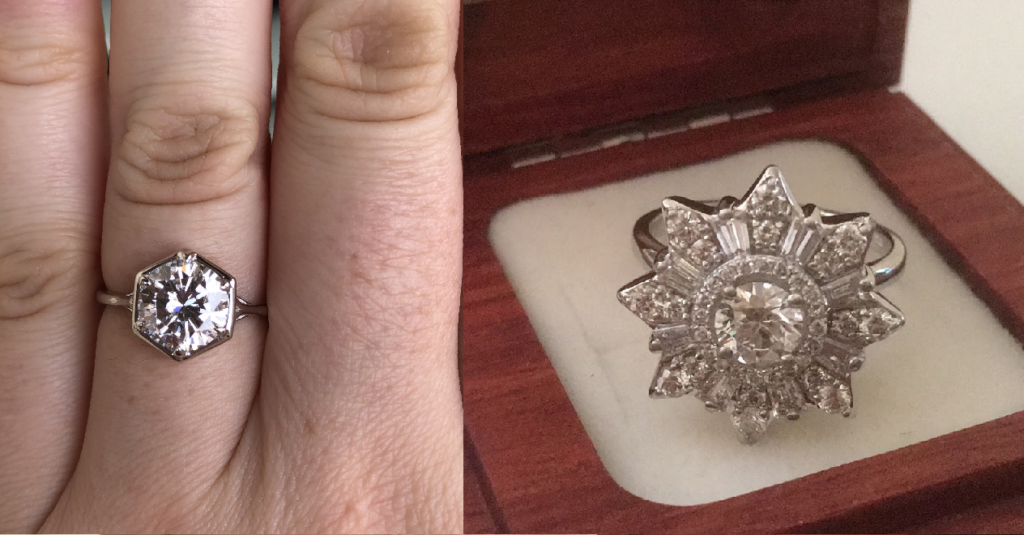
Or, you can go completely custom. We’ve done everything from simple hexagonal bezels to intricate diamond snowflake halos!
No, the value of a diamond comes from its 4cs – color, cut, clarity, and carat weight. Generally speaking, an old cut diamond such as an old European, old Miner, Rose, or “Transitional” cut will not be any more expensive than a modern Round brilliant. In fact, they are often less due to lower current demand. That said, old cut diamonds have a particular appeal to them (I love old cut diamonds). They can be both difficult to originally source and difficult to replace! But, we love them all and have made some gorgeous rings with old diamonds.
Bonus! Using an old diamond is super sustainable – no new mining needs to take place to build your ring when you choose an old diamond!
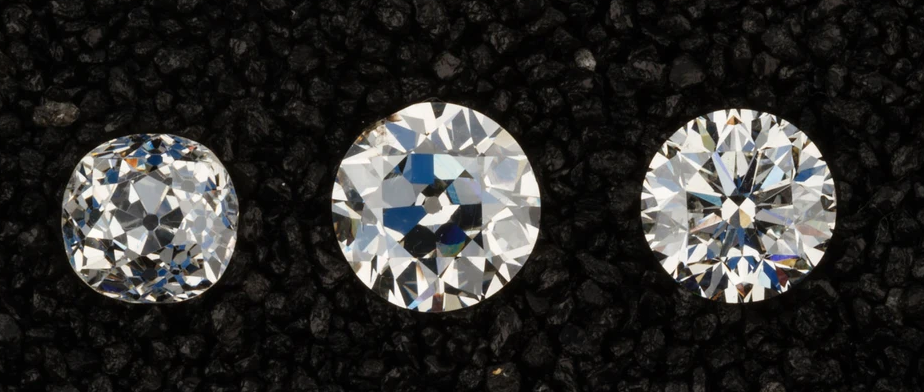
Old Miner (left); Old Euro (middle); Modern brilliant (right)
Another reason to choose an old cut diamond is that many have warmer body colors (think J, K, L…even S, T, U)! This is because back when they were originally faceted, bright white LED lights just weren’t around. Instead, people gazed at their diamonds by warm candlelight. So, warmer toned diamonds were just as desirable! What’s great about that for you is these lower colored stones are much less expensive. And not only will choosing an old cut diamond get you a great deal, you’ll also get your pop of Art Deco color too!
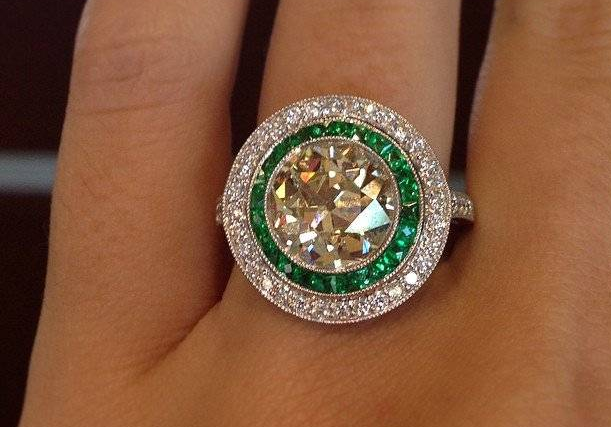
We have Art Deco engagement rings already designed – or you can design your own Deco ring! Choosing a current design and modifying it to your liking is the quickest, most cost-effective method. To do this, choose a Cushion halo with your choice of Round center stone like our Sophie, or a vintage linear setting with a huge emerald cut, like our Katherine! You can choose an icy white diamond or moissanite, or pop in some color with a Sapphire, Aquamarine, or Emerald center stone. If custom design is more your thing, we’d be happy to make the Art Deco ring of your dreams! Simply email us photos, links, or a sketch to [email protected] for a prompt quote. You can also drop us a note here, too!