





Your bag is empty
Explore timeless jewelry that carries love and inspires lasting impact.
We promise that every purchase you make gives one person access to clean, life-changing water.
Explore timeless jewelry that carries love and inspires lasting impact.
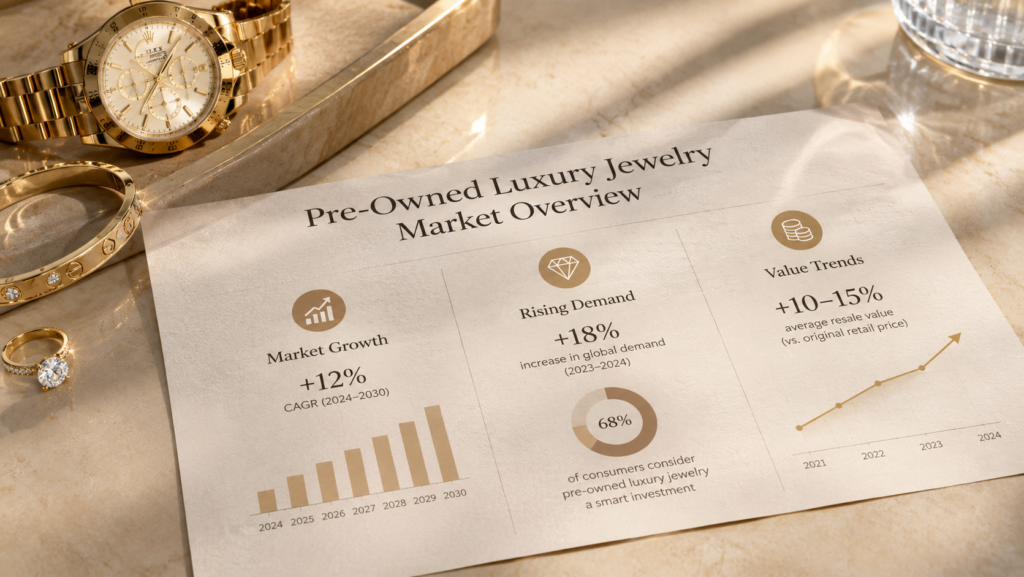
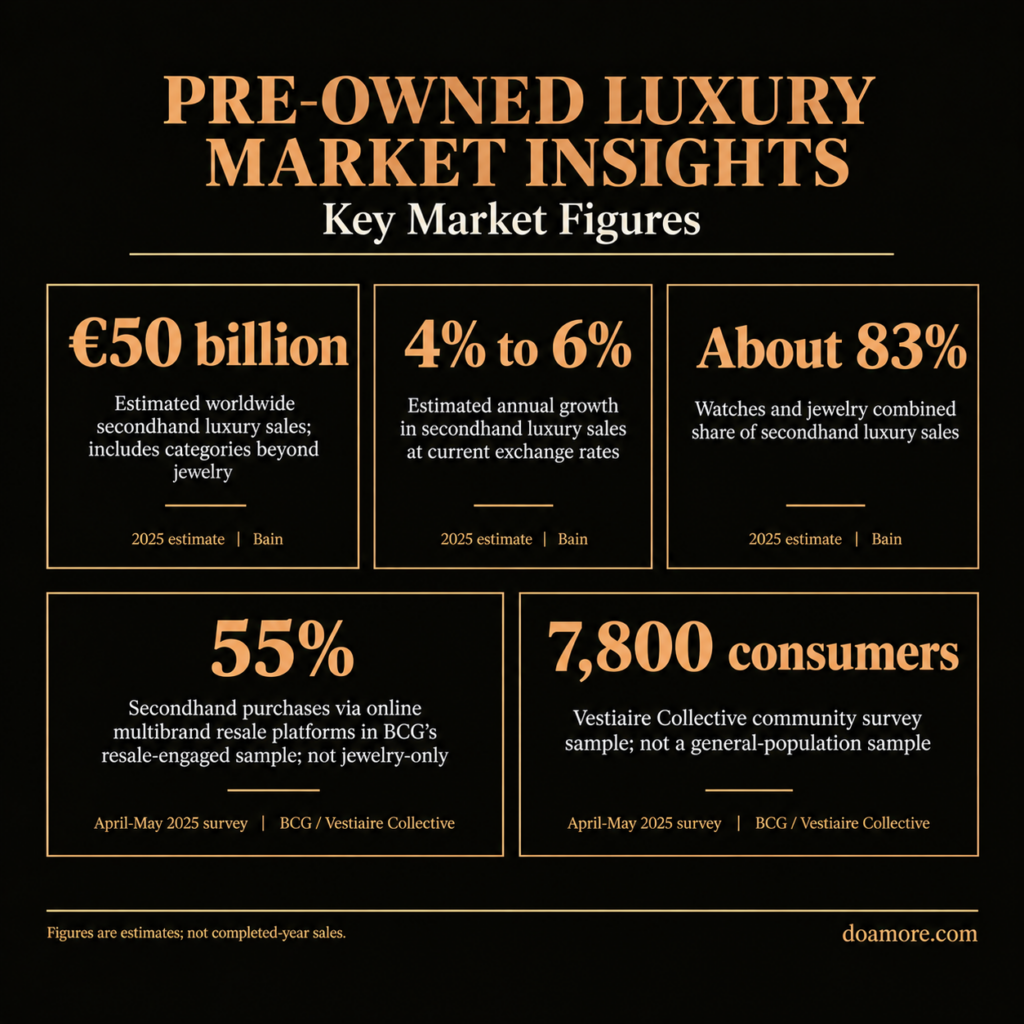
Current pre-owned luxury jewelry market statistics provide a clear estimate for secondhand luxury as a whole, but not for jewelry Current pre-owned luxury jewelry market statistics provide a clear estimate for secondhand luxury as a whole, but not for jewelry by itself. Bain estimated the global secondhand luxury market at €50 billion in 2025, up 4% to 6%. Watches and jewelry together represented about 83% of sales. No authoritative worldwide total for pre-owned luxury jewelry alone was identified in the sources reviewed for this page.
That distinction matters. Bain combines watches and jewelry, and BCG covers the broader fashion and luxury market, so neither source publishes a jewelry-only total. The statistics below keep each year, population, category, unit, and evidence type visible.
| Statistic | What it measures | Year + source |
| €50 billion | Estimated worldwide secondhand luxury sales; includes categories beyond jewelry | 2025 estimate | Bain |
| 4% to 6% | Estimated annual growth in secondhand luxury sales at current exchange rates | 2025 estimate | Bain |
| About 83% | Watches and jewelry combined share of secondhand luxury sales | 2025 estimate | Bain |
| 55% | Secondhand purchases via online multibrand resale platforms in BCG’s resale-engaged sample; not jewelry-only | April-May 2025 survey | BCG / Vestiaire Collective |
| 7,800 consumers | Vestiaire Collective community survey sample; not a general-population sample | April-May 2025 survey | BCG / Vestiaire Collective |
Pre-owned luxury jewelry market statistics often sit inside larger datasets. GIA uses estate jewelry to mean any previously owned jewelry. It reserves antique for pieces more than 100 years old. The word vintage is used less consistently, so a careful report should state the age or period it means instead of assuming every seller uses the same definition.
Those labels are not interchangeable with a recycled stone or a newly made vintage-inspired design. A diamond can be removed from an older piece and set into new jewelry. Do Amore’s guide to recycled and mined diamonds explains that material distinction without treating the finished new ring as pre-owned.
The same care is needed when comparing resale with the wider jewelry market. Do Amore’s jewelry market overview includes new jewelry, gold demand, shopping behavior, business data, and secondhand luxury. Those figures give context, but they cannot be carried into this page as if every jewelry sale were pre-owned.
Each figure above keeps its scope attached. A market estimate in euros, a modeled forecast in dollars, and a survey response from resale-engaged consumers answer different questions. None is a jewelry-only global sales total. Do Amore’s broader jewelry statistics provide context for the wider market without relabeling all jewelry sales as pre-owned.
Bain provides the most focused current benchmark for the secondhand luxury goods market. Its 2025 analysis estimated €50 billion in sales and 4% to 6% growth at current exchange rates. Bain reported that secondhand grew faster than new luxury goods during 2025. (Bain & Company)
Hard luxury represented about 83% of secondhand luxury sales in Bain’s framework. The report defines hard luxury as watches and jewelry together. That combined share shows that high-value durable categories matter to resale, but it does not reveal jewelry revenue, unit sales or the split among rings, necklaces, bracelets, and other pieces. (Bain & Company)
BCG uses a broader product universe. Its model includes fashion and luxury, where leather goods, clothing, and shoes account for roughly 80% of the secondhand market. The broader product scope makes the BCG total much larger than Bain’s estimate and should never be presented as a pre-owned jewelry total. (Bain & Company) (BCG and Vestiaire Collective)
The reviewed public data remains broader than jewelry alone. Reports on the pre-owned luxury goods market often combine watches with jewelry or place both inside fashion and luxury. The reviewed authoritative sources do not publish a clean worldwide revenue total for pre-owned luxury jewelry alone. The sources do not provide a jewelry-only global unit count, a representative worldwide buyer count, or a jewelry-only forecast for 2030. (BCG and Vestiaire Collective)
It would be tempting to apply Bain’s 83% watches-and-jewelry share to its €50 billion total, then subtract a watch estimate from another report. That calculation would combine different product universes, periods, and methods. Without a watch share produced inside the same Bain dataset, the subtraction would create false precision. (Bain & Company)
The honest answer is that the available public evidence is stronger for broad luxury resale than for jewelry-only resale. Reporting that gap is more useful than manufacturing a number that no source published.
BCG’s broader luxury resale market size estimate was $210 billion to $220 billion for secondhand fashion and luxury in 2025. It forecast $320 billion to $360 billion by 2030, with secondhand penetration rising from about 8% to about 10% of total fashion and luxury sales. (BCG and Vestiaire Collective)
BCG modeled annual growth of about 10%, which it described as roughly three times the firsthand market’s pace. These are broad mixed-category figures. Leather goods, clothing, and shoes make up around 80% of the model. Watches and jewelry are smaller categories described as gaining momentum. (BCG and Vestiaire Collective)
The report separately projected watch resale at 35% to 40% of the global watch market by 2030. That watch-specific projection is useful because it shows why the categories must stay separate. It cannot be subtracted from Bain’s combined hard-luxury share or used as a jewelry forecast. (Bain & Company)
Growth depends on the definition. Bain estimated 4% to 6% growth for secondhand luxury in 2025. BCG modeled about 10% annual growth for the broader secondhand fashion and luxury market. The figures do not conflict because their product universes and methods differ. (Bain & Company) (BCG and Vestiaire Collective)
Luxury resale market growth is only meaningful when the evidence type is clear. An estimate describes a researcher’s measurement of a current or past market. A forecast models a future outcome. A survey response records what a participant said. A reported transaction records an actual sale inside a defined dataset. These labels should remain attached whenever a statistic is quoted.
A forecast endpoint does not become an observed result when the target year arrives. The top of a range is not automatically the most likely outcome either. Preserving the complete range and publication date gives readers a more accurate view of uncertainty.
Affordability, access to premium labels, discovery, and online platforms were the main demand signals in BCG and Vestiaire Collective’s 2025 survey. The study covered 7,800 resale-engaged consumers from April to May 2025. Respondents reported a median annual fashion budget of $5,300 and were more familiar with secondhand platforms and high-end brands than the general population. The findings describe that community, not all consumers and not jewelry buyers alone. (BCG and Vestiaire Collective)
Nearly 80% of surveyed buyers cited affordability as a reason to buy secondhand. More than half said they preferred premium labels secondhand to lower-priced firsthand alternatives, and nearly half said they bought used items to avoid paying full price. (BCG and Vestiaire Collective)
Price remained a barrier. Among respondents who had not bought secondhand premium, designer or luxury fashion in the previous 12 months, 30% said prices were not attractive enough. Another 28% said they did not find anything interesting. (BCG and Vestiaire Collective)
Resale introduced buyers to brands too. Sixty-six percent said secondhand had enabled them to discover or buy a brand for the first time, up from 59% in BCG’s 2022 survey. Those figures point to access and assortment, but they do not establish jewelry sales. (BCG and Vestiaire Collective)
These survey results are not a direct measure of the vintage jewelry market, but they show how variety, limited items, and discovery can shape broader secondhand demand. For Gen Z respondents, secondhand items made up 32% of closets, including 45% of handbags and 36% of clothing. Affordability was the main reason for 74% of Gen Z respondents. (BCG and Vestiaire Collective)
Around 80% of Gen Z respondents said they discovered or bought a new brand through secondhand, compared with 66% across the full sample. Gen Z respondents were seven percentage points more likely than average to cite the thrill of finding limited or sold-out items and five points more likely to cite personal style. (BCG and Vestiaire Collective)
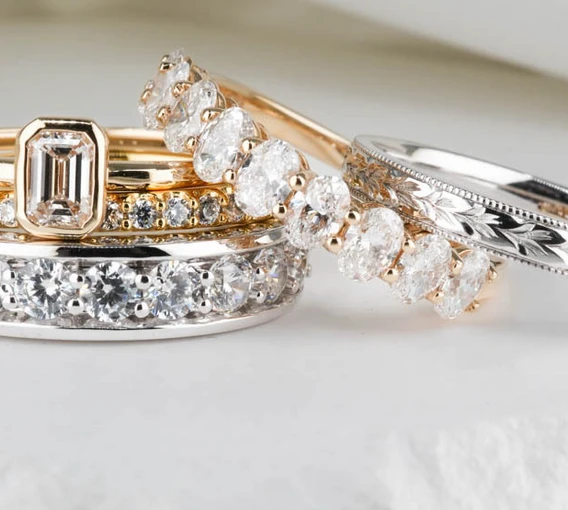
These are fashion and luxury survey findings, not vintage jewelry sales data. A shopper who likes the look of an earlier era can choose a new design. Do Amore’s vintage-inspired engagement rings use details such as milgrain, engraving, and halo settings. These are newly made pieces.
No. Vintage-inspired jewelry can borrow design details from an earlier era in a newly made piece. That gives buyers another path when condition, repair history, or provenance are difficult to confirm.
For example, the Valencia vintage halo ring uses an ornate gallery, side stones, milgrain finishing, and floral motifs in a newly made design.
Among the surveyed community, 55% of secondhand purchases occurred through specialized online multibrand resale platforms. Secondhand items represented nearly 28% of respondents’ closets, up from 25% in 2022 and 21% in 2020. (BCG and Vestiaire Collective)
The channel statistic records where participants said they bought secondhand items. It does not show where a buyer discovered an item, whether an authentication step happened online or in person, or how many jewelry transactions took place worldwide. Do Amore’s online jewelry sales data explains similar boundaries between transactions, discovery and broader ecommerce estimates.
BCG reported that secondhand items made up 32% of U.S. respondents’ closets. Handbags reached 66% for U.S. respondents compared with 39% in Europe. These are category and regional observations inside the platform community, not population-wide market shares. (BCG and Vestiaire Collective)
Affordability was cited by 87% of U.S. respondents, 11 percentage points more than in Europe. Twenty-eight percent of U.S. respondents said they had adopted more sustainable fashion behavior, compared with 33% in Europe. Twenty-five percent of U.S. respondents said they considered resale value very often or always when buying new, compared with 19% in Europe. (BCG and Vestiaire Collective)
The regional differences reinforce the need to keep geography beside every percentage. They show why a global headline should not be used to predict the behavior of one jewelry buyer.
Digital product passports are structured records that can carry product specifications, material information, certifications, authentication details, condition, repairs, and ownership changes. In BCG’s survey, 65% of respondents had never heard of them and another 15% knew the term without understanding what it meant. (BCG and Vestiaire Collective)
The information still mattered to participants. Authentication and verification were selected by 70% when buying and 67% when selling. Product specifications followed at 68% for buying and 64% for selling. Handbags were the leading requested category for passport use at 79%, which means the result should not be relabeled as a jewelry preference. (BCG and Vestiaire Collective)
These findings describe stated preferences, not current adoption across pre-owned jewelry. Standards remain in development. For a buyer today, the practical lesson is to look for clear records of authenticity, materials, condition, repairs, and provenance regardless of the technology used to store them.
Completed jewelry auctions provide narrower evidence than broad fashion forecasts. Christie’s London online jewelry auction, held May 21–June 6, 2025, reported £5,475,078 in sales. Its catalog included antique and modern jewelry. The total includes hammer prices and buyer’s premiums; it is one auction’s turnover, not a market valuation or the amount sellers received.
Christie’s Geneva online jewelry auction, held November 6–18, 2025, reported CHF 8,345,551, also including buyer’s premiums. These two sales demonstrate documented activity in jewelry itself. Their different currencies, consignments and dates prevent a direct growth comparison, and the totals should not be added without a stated currency-conversion method.
The RealReal’s 2026 resale report supplies a different kind of jewelry-specific signal: it says Dallas buys 2.5 times more David Yurman jewelry than its national comparison. This is a geographic observation within one resale platform, not a share of all U.S. jewelry purchases. The release does not provide the underlying city-level sample or a complete calculation, so it cannot support a national market-size estimate.
Public jewelry-only resale value data remains fragmented. A sale price, seller payout, original retail price, and insurance replacement appraisal are different measures. A percentage is not useful until its denominator and sales route are clear.
Original retail price is the amount charged when an item was sold new. Secondary-market resale price is what a later buyer pays. A seller payout is what the owner receives after a dealer margin, platform fee, or auction commission. An insurance replacement appraisal estimates replacement cost under stated policy conditions.
Do Amore’s engagement ring statistics show why purchase prices and replacement appraisals should remain separate. The same logic applies to pre-owned jewelry. A high replacement appraisal does not establish the amount a reseller, auction house or future buyer will pay.
Brand demand, condition, metal and gemstone content, size, repairs, provenance, documentation, commissions, and time to sale can all influence a result. These are valuation inputs, not a formula that guarantees appreciation.
GIA advises estate-jewelry buyers to inspect for dents, deep scratches, missing stones, and evidence of repairs. GIA recommends a written description of the piece, including its materials and approximate age, plus an independent grading or identification report when significant stones are involved. (GIA)
A category average cannot replace inspection of the actual item. Check stone security, sizing limits, repair history, available reports, and the seller’s return terms. Rarity may affect demand, but it does not guarantee a higher resale value.
Compare the records and policies, not just the prices. For a pre-owned piece, check condition, repair history, grading information, seller terms, and provenance. For newly made jewelry, check the materials, sourcing, return policy, warranty, and production details.
Do Amore’s ethics and sourcing approach states that its engagement rings are made to order from recycled precious metals and set with ethically sourced stones. The same page lists free 60-day returns and a limited lifetime warranty. Those details do not make a ring pre-owned, but they give buyers a clear basis for comparison.
To read any luxury goods resale market figure, start with five labels beside every number. Record the data year, geography, product scope, unit, and evidence type. Those labels reveal whether a figure is an observed transaction, a survey response, a market estimate or a forecast.
Bain answers a broad market-size question for secondhand luxury and combines watches with jewelry. BCG models the larger secondhand fashion and luxury market, then adds survey evidence from resale-engaged platform users. GIA provides buying and terminology guidance rather than a market-size estimate. (Bain & Company) (BCG and Vestiaire Collective)
Do not average percentages across those sources. Their denominators differ. Do not convert currencies without stating the exchange-rate date. Apply a combined category share to a broad total only when the publisher provides the resulting figure.
Missing data should remain visible. This review did not find a defensible worldwide pre-owned luxury jewelry revenue total, a jewelry-only global unit count, a representative worldwide buyer count, or a jewelry-only 2030 forecast.
Pre-owned luxury jewelry market statistics can sharpen your questions, but they cannot choose a piece for you. Compare details you can verify, including condition, materials, grading information, provenance, seller terms, and the gap between the resale price and the amount an owner may receive.
Do Amore’s ethics and sourcing approach includes recycled natural diamonds and recycled precious metals in newly made jewelry. That is a material-sourcing choice, not proof that a finished ring is pre-owned.
If you want to explore new jewelry after reviewing the resale data, browse Do Amore’s fine jewelry rings. The collection includes newly made rings, so the destination is useful without blurring the definition of pre-owned jewelry.
Newly made, vintage-inspired designs should still be evaluated on their materials, construction, policies, and fit rather than on assumed future value.
A market average cannot make a piece meaningful. Start with the facts you can verify, then choose the materials, design, and story that fit the person who will wear it. If a newly made piece suits you better, use the fine-jewelry and vintage-inspired options above to compare designs at your own pace. Every Do Amore purchase gives one person access to clean water, so your choice can carry purpose beyond the jewelry.