






Your bag is empty
Explore timeless jewelry that carries love and inspires lasting impact.
We promise that every purchase you make gives one person access to clean, life-changing water.
Explore timeless jewelry that carries love and inspires lasting impact.
Use the grade as a comparison tool, not a final verdict. Two diamonds with the same clarity grade can look different because the number, size, position, nature, and relief of their characteristics differ.
Diamond clarity describes the relative absence of internal inclusions and external blemishes. GIA uses an 11-grade scale and evaluates clarity under 10x magnification, so many characteristics that affect the grade may not be visible without magnification.
Common clarity characteristics include the following.
A diamond’s combination of characteristics is individual to that stone. That is why clarity is more useful when you read the grade together with the report and the diamond’s actual appearance.
The diamond clarity scale contains 11 grades grouped into five practical bands. The chart moves from FL and IF at the top through VVS, VS, SI, and I grades, but the scale does not promise whether a particular diamond will look eye-clean.
| Grade band | Meaning under 10x | Naked-eye note |
|---|---|---|
| FL / IF | FL shows no inclusions or blemishes. IF shows no inclusions, but blemishes may be present. | These grades do not define an unaided viewing test. |
| VVS1 / VVS2 | Minute inclusions are difficult for a skilled grader to observe. | Characteristics are usually subtle, but grade alone does not guarantee eye-clean appearance. |
| VS1 / VS2 | Minor inclusions are observed under magnification. | Appearance varies with the stone, shape, size, and inclusion placement. |
| SI1 / SI2 | Noticeable inclusions are easy or very easy for a grader to observe. | A diamond may or may not look eye-clean under your viewing conditions. |
| I1 / I2 / I3 | Prominent inclusions may affect transparency, brilliance, or durability. | Eye-visible inclusions are common, so inspect the stone and report carefully. |
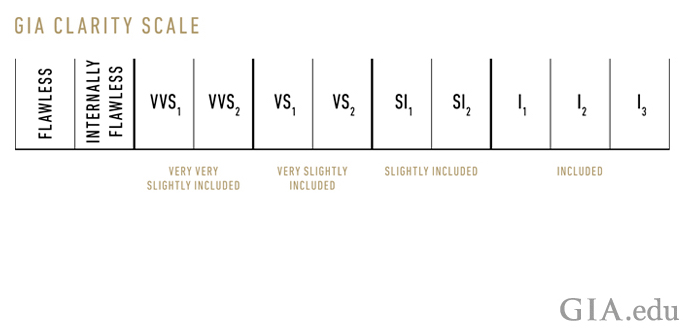
A scale showing a range of diamond clarity ratings from “Flawless” to “Included”. Photo Credit: GIA
Flawless (FL) diamonds show no inclusions or blemishes to a skilled grader under 10x magnification. Internally Flawless (IF) diamonds show no inclusions at 10x, but minor blemishes may be present.
VVS means “very, very slightly included.” VVS1 and VVS2 diamonds have minute inclusions that are difficult for a skilled grader to find under 10x magnification. The difference between the two grades reflects how readily those inclusions are observed, not a guaranteed naked-eye result.
VS means “very slightly included.” VS1 and VS2 diamonds have minor inclusions seen under 10x magnification. Their visibility without magnification depends on the individual stone, including its size, shape, and inclusion placement.
SI1 and SI2 diamonds have noticeable inclusions under 10x magnification. Some may look clean without magnification and others may not, so the report and actual diamond matter more than a blanket promise by grade.
SI3 is not part of the GIA diamond clarity chart. If a report from the European Gemological Laboratory (EGL) or another lab uses SI3, note that GIA does not issue that grade. Do not translate an SI3 label into a specific GIA grade without an independent assessment.
I1 diamond clarity sits at the top of the Included band, followed by I2 and I3. These grades have prominent characteristics under 10x magnification, and inclusions may affect transparency, brilliance, or durability. An I3 diamond is at the lowest end of the GIA clarity scale, so inspect the individual stone and report carefully.
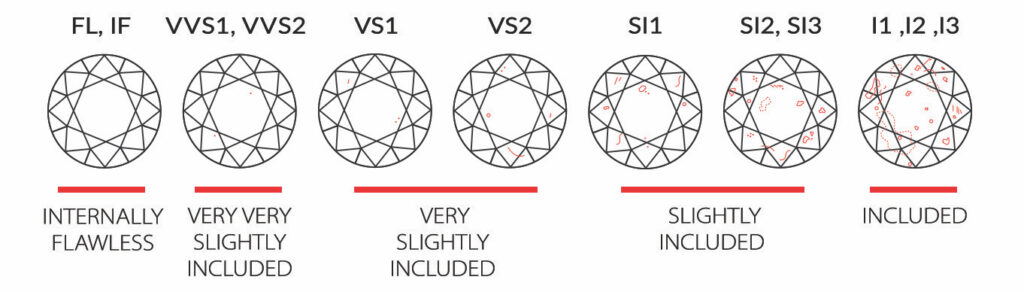
A diagram showing a range of diamond clarity grades. Photo Credit: www.whiteflash.com
Choose a tentative clarity range, then test it against the individual diamond. What clarity diamond you should buy depends on the appearance you want, the stone’s other characteristics, and how you prefer to use your budget.
Do Amore’s role is to explain the comparison process, not to replace a grading laboratory. Its Diamond Education hub places clarity beside the other 4Cs and shape guides, so first-time shoppers can use the chart to set a tentative range, check the report and inclusion placement, and compare individual stones without treating one grade as the answer for every ring. The hub supplies context for the decision, but it cannot assign a grade or guarantee eye-clean appearance.
An eye-clean diamond has no inclusions that are noticeable to the unaided eye under the viewing conditions being used. Eye-clean is an informal appearance description, not a GIA clarity grade, so it should include context such as distance, lighting, eyesight, and whether the diamond is viewed face-up.
Facet style changes what you notice. Brilliant styles, including round and oval cut engagement rings, can make some characteristics less obvious through their pattern of reflections. That does not make every VS2 or SI1 diamond eye-clean, and it does not replace viewing the individual stone.
You do not need a Flawless grade to get a diamond with no inclusions visible to the unaided eye because many lower-grade characteristics are visible only under magnification. Compare the individual stone at a realistic size because no single lower grade guarantees the right result for every shape, size, or viewer.
Clarity answers a different question from ethical sourcing. Treat those as separate parts of the decision, along with cut, color, carat weight, design, and budget.
Gemologists assign diamond clarity grades under 10x magnification using five factors that describe the characteristics and their effect on the stone.
The grade reflects the combined effect of these factors. Carat weight can change how easy a characteristic is to notice, but size alone does not determine the grade.
Start by checking the laboratory name, report number, measurements, carat weight, and clarity grade. Report formats vary. Some include a plotted diagram of clarity characteristics. Others list significant characteristics or use an image instead.
When a plot is present, use it to understand the type and approximate position of the listed features. A plot may not show every faint or widespread characteristic, and it cannot tell you exactly how noticeable the diamond will look at normal size. Do Amore’s Diamond Grading guide explains grading terms and how the 4Cs work together. Use it for educational context before comparing reports, not as a substitute for the report on a specific diamond.
Diamond shape affects how readily you may notice inclusions, but shape does not change the meaning of the clarity grade. Step cuts such as the emerald cut and Asscher shape use broad, open facets that can make some characteristics easier to notice.
If you are comparing emerald cut engagement rings, inspect the report, imagery, and face-up appearance instead of applying a universal VVS minimum. The same principle applies to brilliant styles. Reflections can make some inclusions less obvious, but the result varies from stone to stone.
For pear shape engagement rings, heart shape engagement rings, radiant cut engagement rings, marquise cut engagement rings, or a princess cut engagement ring, review the individual inclusion placement and realistic-size appearance instead of relying on one grade floor.
Clarity is one part of the 4Cs, alongside cut, color, and carat. Cut affects how the diamond returns light, color describes its body color, and carat measures weight. A higher clarity grade cannot compensate for a cut or appearance you do not like, and a larger carat weight may make some inclusions easier to notice.
Set your priorities before comparing stones. That makes it easier to decide whether a clarity difference matters to your eye or whether you would rather place more of the budget toward another characteristic.
The grading laboratory matters because a clarity grade is useful only when you know who issued the report and which standards it applies. GIA publishes its clarity scale and report formats, but another laboratory may use different terminology or documentation.
The blanket statement that many other labs do not grade as strictly is not enough to judge a particular report. Compare the named laboratory’s published standards, confirm the report number, and avoid translating one laboratory’s grade into another without evidence.
Diamond clarity decisions depend on eye-clean appearance, laboratory terminology, and how Included grades affect each stone.
A good diamond clarity meets your appearance requirements without forcing you to maximize a grade that may not look different at normal viewing distance. Use the chart to narrow the range, then compare individual stones.
VS2 and SI1 diamonds are not always eye-clean. VS2 and SI1 describe what a grader sees under 10x magnification. Eye-clean appearance depends on the individual diamond, its shape and size, the inclusion placement, and the viewing conditions.
Do not assume every laboratory uses the same terminology for natural and laboratory-grown diamonds. Since October 1, 2025, GIA has used Premium and Standard assessments for colorless-to-near-colorless laboratory-grown diamonds instead of the natural-diamond color and clarity nomenclature.
I1 diamond clarity begins the Included band, and I3 is the lowest grade on the GIA scale. Included diamonds have prominent characteristics under 10x magnification, and those characteristics may affect appearance or durability, so each stone needs careful review.
Do Amore gives you two ways to ask about the shape, carat range, budget, or grading report you are considering. Email me here or send us a note here before you narrow your shortlist.
Or browse the recommended diamonds and use the filters to compare clarity with shape, cut, color, carat, and price. Save promising stones to compare side by side, then use the diamond clarity chart as a reference while you check the individual report and appearance. The tools narrow a shortlist, but they cannot guarantee an eye-clean result from a grade alone.

A couple showing off their new engagement ring. Photo Credit: Jasmine Wallace Carter