Your Bag Is Empty
Explore timeless jewelry that carries love and inspires lasting change
Every purchase gives one person access to clean, life-changing water.
Explore timeless jewelry that carries love and inspires lasting change
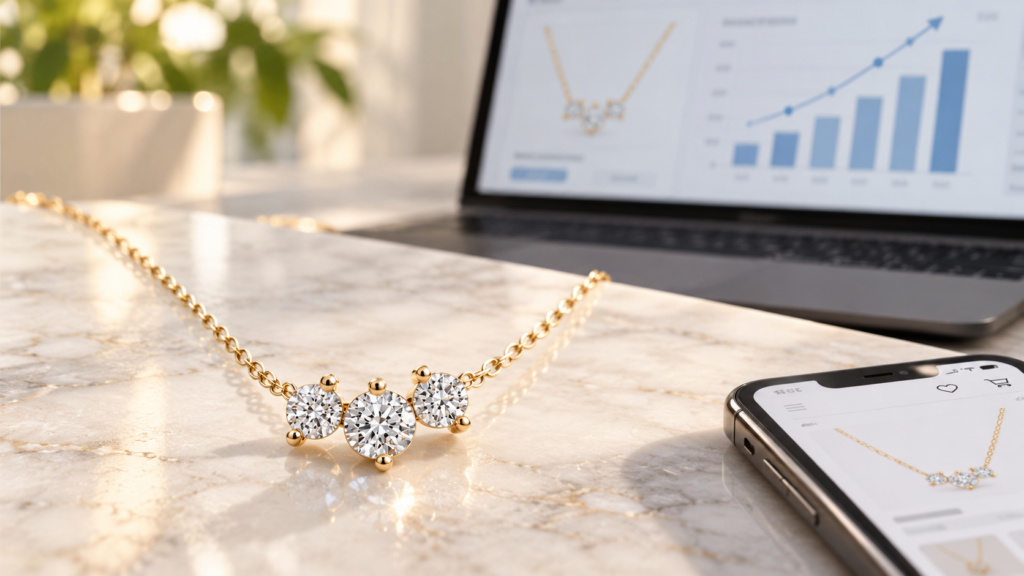
Jewelry carries emotion, craft and material value, but the market behind it is measured in many different ways. This guide brings current jewelry statistics into one place, with the year, population, unit and scope attached to each figure.
A note on dates: this page was prepared in 2026, but that does not turn older observations into 2026 data. Grand View Research uses 2025 as its base year and models 2026 through 2033. The World Gold Council figures cover the first half of 2026. The shopping survey is from 2024, while the resale and business data have their own stated periods. Estimates, forecasts and proprietary platform findings are labeled so they are not mistaken for audited industry totals.
Grand View Research values the worldwide jewelry market at $381.5 billion in 2025. Its modeled estimate rises to $397.7 billion in 2026, then to a $578.5 billion forecast for 2033. The implied 2026 to 2033 compound annual growth rate is 5.5%. These are revenue estimates in U.S. dollars, not transaction counts or consumer-survey results. [1]
The market is not evenly distributed. Asia Pacific represented 60.4% of global revenue in 2025. North America accounted for 22.2%, and the United States generated 92.5% of North American jewelry revenue. Grand View Research also forecasts India to grow at a 6.5% compound annual rate from 2026 to 2033. [1]
Product and material mix help explain where that revenue sits. Rings held the largest product share at 33.9% in 2025. Gold jewelry led materials at 55.0%, while diamond jewelry is forecast to grow at 5.5% annually through 2033. Necklaces have the fastest stated product forecast at 6.0% annually over the same period. [1]
Rings are both a large market category and a deeply personal purchase. Someone comparing engagement ring designs may care about proportions and setting details as much as broad market growth.
Physical retail remains the largest measured channel. Offline stores generated 83.9% of global jewelry revenue in 2025. At the same time, online jewelry retail is forecast to expand at an 8.0% compound annual rate from 2026 to 2033, faster than the 5.5% forecast for the overall market. [1]
Those figures describe where revenue is booked, not where a shopper first discovers or researches a piece. A purchase completed in a store may still begin with online education, comparison and customization. That distinction matters when interpreting jewelry e-commerce statistics.
A 2024 Jewelers Mutual engagement-ring study offers a closer look at a high-consideration jewelry purchase. Among its respondents, 80% researched before buying and typically began one to three months ahead of the purchase. Another 46% said they shopped together. These findings belong to the study’s engagement-ring respondents and should not be generalized to every jewelry shopper. [3]
Where people completed that purchase also varied: 43% used jewelry brand stores, 28% used retail stores and 10% bought from a local business. [3]
The same 2024 study reported an average respondent ring-value range of $2,500 to $5,000. White gold was selected by 35% of respondents and rose gold by 33%. Settings with mined diamonds appeared in 68% of responses, while 18% contained lab-grown diamonds. The study placed the typical center-stone range between one and two carats. [3]
Setting choices also differed. Channel settings led at 31%, and solitaire settings followed at 22%. These percentages reflect this study population rather than the full jewelry market. [3]
Ownership habits show why service, fit and care information matter after the sale. Half of respondents wore their engagement ring daily, and 35% wore it several times a week. Seventy-five percent wore it to work, while 63% wore it to social events. [3]
Gold market data illustrates why sales value and physical demand can move in opposite directions. The World Gold Council reported total Q2 2026 gold demand of 1,269 metric tonnes, broadly flat from a year earlier. First-half demand reached 2,522 tonnes, up 2%, with a total value of about $380 billion. [2]
Jewelry told a different story. Global gold jewelry demand volume fell 17% year over year in Q2 2026 as high prices weighed on purchasing. Across the first half, however, the value of gold jewelry demand climbed 22% to $86 billion. Shoppers bought less metal by weight, but the higher gold price lifted spending value. [2]
Supply context matters too. Q2 mine production rose 2% to a record 966 tonnes, while recycled gold supply fell 6% year over year. Those are whole gold-market measures, not jewelry-only supply totals. [2]
Material origin is only one part of a thoughtful choice. Do Amore’s ethics and sustainability approach explains how its recycled precious metals, responsibly sourced natural and lab-grown diamonds, and clean-water impact fit together.
Pre-owned jewelry is usually reported inside the broader secondhand luxury market, so its totals should not be confused with the global jewelry market. Bain estimates that secondhand luxury reached €50 billion in 2025, with growth of 4% to 6%. Watches and jewelry together made up 83% of those secondhand sales. [4]
For comparison, Bain estimated the entire luxury market at €1.44 trillion in 2025. Personal luxury goods were €358 billion, down 2% from €364 billion in 2024, and the market lost roughly 20 million consumers during 2025. Online sales represented 21% of personal luxury goods, up from 20% a year earlier. Bain separately placed new luxury jewelry sales at €32 billion, with 4% to 6% growth. These are luxury-market estimates, not totals for all jewelry at every price point. [4]
The RealReal’s 2026 report adds platform-specific context. Its analysis spans 15 years, more than 50 million sold items and 44 million members. On that marketplace, vintage demand had risen 432% since 2020. Saved searches organized by decade rose 135% year over year, and searches for 2000s fashion rose 93%. These figures describe activity on The RealReal and should not be treated as a representative sample of all resale shoppers. [5]
Pre-owned and newly made pieces can both prompt questions about material history. This guide to recycled and newly mined diamonds helps separate reclaimed stones, newly mined stones and the recycled metals used in settings.
Jewelers Board of Trade counted 17,549 retail jewelers in North America in Q2 2026, a net decline of 271 from the prior year. Since January 1, 193 retailers had been taken out of business, while 78 companies were removed from the Red Book for other reasons. Separately, 156 retail jewelers ceased operations, down from 256 over the comparable prior-year period. [6]
Consolidation and financial distress still deserve attention. JBT recorded 27 mergers or sales through Q2 2026, compared with 50 in the comparable prior-year period. Retail bankruptcies rose to 10 from 5, while bankruptcies across all jewelry sectors rose to 15 from 7. [6]
Credit activity moved sharply. Claims increased 19.6%, from 214 to 256, and the average claim climbed 172.1%, from $8,830 to $24,023. New wholesale operations rose 20.8%. The South Central region added nine retail jewelers, a 30% increase, even as several other U.S. regions contracted. [6]
These are business-record and credit statistics for North America. They indicate changes in operating firms and trade risk, not total consumer demand.
A single percentage rarely answers a shopping question. Market-research estimates describe revenue; the World Gold Council measures physical gold demand and value; a survey describes its respondents; business records show firm openings, closures and credit events; and a resale marketplace reports behavior among its own members.
The most useful comparison keeps five details attached to every number: the data year, geography, population or market covered, unit of measure, and whether the figure is observed, surveyed, estimated or forecast. That is why a 2026 publication can responsibly include 2024 and 2025 data without relabeling those findings.
For a shopper, the practical takeaway is simpler. Use market trends as context, then focus on what can be verified about the piece in front of you: metal, gemstone, grading information, sourcing, craftsmanship, fit and care.
Jewelry statistics can reveal broad shifts, but a meaningful piece still comes down to the person, the occasion and the details you can examine. A well-described stone, a clearly identified metal and transparent sourcing information are more useful than trend language alone.
When you are ready to explore, Do Amore’s jewelry collection brings together fine gemstones, recycled precious metals and designs made to mark real milestones. Take your time, compare the information provided and choose the piece that feels true to your story.