






Your bag is empty
Explore timeless jewelry that carries love and inspires lasting impact.
We promise that every purchase you make gives one person access to clean, life-changing water.
Explore timeless jewelry that carries love and inspires lasting impact.
A result cannot prove that a stone is natural, lab-grown, or unquestionably authentic. Use the pen as a starting point, then look at the device’s limits and the right follow-up for the stone in front of you.
When someone says “diamond tester,” they usually mean a handheld diamond checker or diamond detector with a probe that measures a gemstone’s thermal conductivity. In other words, it checks how quickly heat moves away from the tip through the stone.
Basic thermal pens screen for materials with diamond-like heat transfer. Combination testers also assess electrical conductivity, which can help separate some stones that overlap on a thermal reading. The exact lights, bars, or tones vary by model, so follow your device instructions before interpreting a result.
Diamond testers work well as screening tools when used correctly, especially for separating many lower-conductivity simulants such as CZ from diamond. But are diamond testers accurate enough to stand alone? No. Accuracy depends on the tester type, setup, stone, environment, and technique. Moissanite can overlap with diamond on a basic thermal reading, and a pen cannot identify natural versus lab-grown origin.
Every diamond tester pen is different, so start with the manufacturer’s instructions for warm-up, calibration, and its result scale.
Some devices beep, light a scale, or show a bar. Treat that signal only according to that model’s instructions because one pen’s “diamond” reading may not mean the same thing on another.
False readings usually come from a dirty or wet stone, room or stone temperature, a low battery, skipped calibration, a worn or damaged probe, contact with metal, very small facets, or use outside the tester’s stated scope. Take multiple readings after correcting setup issues. If results stay inconsistent, stop and use a trained gemologist or laboratory.
A “diamond” reading should lead to the grading report, not a final verdict about the stone.
When a grading report is available, compare its number, carat, cut, color, clarity, and measurements with the stone in front of you. Do Amore’s diamond education treats that report as an identity document, not just a quality score. The tester narrows the material. The report and qualified screening address identity and origin.
Will moissanite pass a diamond tester? On some basic thermal pens, yes. Moissanite may register as diamond because this lab-created gemstone also transfers heat very efficiently. That result doesn’t make moissanite a diamond; moissanite engagement rings use a distinct gemstone with unusually high thermal conductivity. Care, residue, and stone quality all matter when evaluating whether moissanite gets cloudy or simply needs a thorough cleaning.
CZ and white sapphire usually do not register as diamond on a basic thermal tester. But a typical result isn’t guaranteed, so confirm an uncertain stone with appropriate gemological testing.
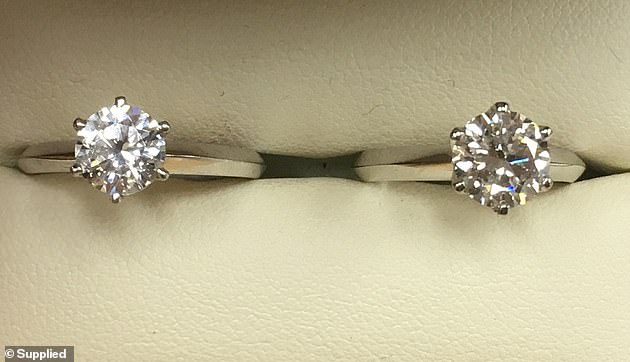
Note the CZ’s (left) lack of depth and “plasticky” reflection vs the Diamond’s (right) multi-tonal shades and crisp reflection?
| Stone | Typical basic thermal result | What the result does not prove | Next step |
| Natural diamond | Usually reads as diamond | That the stone is natural or matches a report | Check the grading report; use a laboratory if identity matters |
| Lab-grown diamond | Usually reads as diamond | Whether the stone is natural or lab-grown | Check the report and use origin screening when needed |
| Moissanite | May read as diamond on some pens | That the stone is diamond | Use a combination tester or trained gemologist |
| Cubic zirconia | Usually does not read as diamond | That a negative result identifies CZ | Confirm with other gemological tests |
| White sapphire | Usually does not read as diamond | That a negative result identifies sapphire | Confirm with other gemological tests |
Trained gemologists identify a stone by combining visual examination with appropriate instruments. They may assess optical properties, thermal and electrical response, and other features that separate diamond from moissanite, CZ, white sapphire, and white topaz. A scratch test isn’t a safe home check. GIA’s guidance recommends a trained gemologist or independent laboratory when identification matters.
Yes! Rainbow sparkle in a diamond is called “fire”. There is some misinformation out there that diamonds do not show colored light, however this is false. In fact, a diamond’s ability to show a rainbow of color is one of its most prized features, and one of the reasons it is preferred by many over other white stones like white sapphire or white topaz. Moreover, diamonds show a balanced display of rainbow and white sparkle.
This should be compared against moissanite and CZ’s major colored sparkle, which outshines its white sparkle.
Yes. A lab-grown diamond will usually register as diamond on a basic thermal tester because its physical properties closely match those of a natural diamond. That means a pen cannot answer the origin question. If you’re comparing lab diamond engagement rings or checking a stone you own, use the grading report and appropriate origin-screening tools rather than relying on one thermal reading.
No. A basic thermal pen can’t tell whether a diamond formed in the earth or in a laboratory. Some screening instruments check additional properties and may return “pass” or “refer,” but those results must be interpreted within the tool’s stated scope. GIA explains that definitive origin identification can require advanced gemological testing. Some instruments may respond differently to certain HPHT lab diamonds, which is why a refer result is a cue for more testing, not a final identification. If a lab-grown diamond produces a confusing result, our moissanite vs. lab diamond guide explains why the stones still differ even when a tester reading overlaps. Here’s what to check next:
Ask what training and instruments are being used. For a valuable or uncertain stone, consider an independent qualified gemologist or appraiser (for example, a member of NAJA).
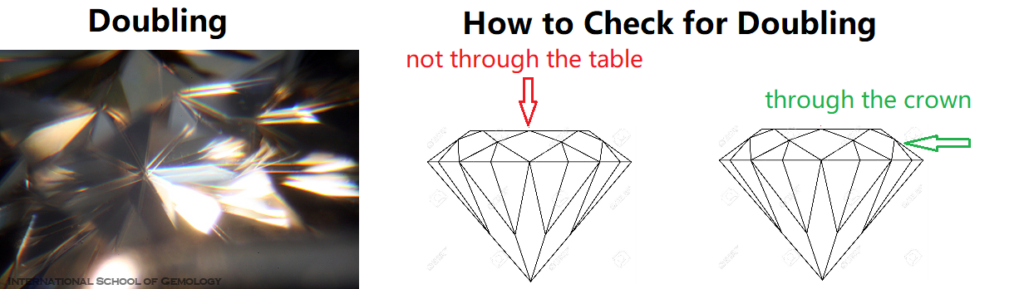
Treat visual clues as supporting evidence. A trained gemologist may examine double refraction (“doubling”) and other optical features, but one observation is not always conclusive. If the result affects a purchase, insurance, resale, or dispute, ask for laboratory confirmation.
Check the grading report and look for a microscopic certificate number inscription if the report says one should be present. Many graded diamonds carry a girdle inscription, and GIA lab-grown diamond reports include one, but an absent or matching inscription is not conclusive by itself.
Start with the grading report and any readable girdle inscription, then use appropriate screening for origin. Because natural and lab-grown diamonds share many chemical, optical, and physical properties, a basic thermal pen and routine observation cannot reliably separate them. GIA uses advanced instruments and laboratory testing for definitive identification. If you’re weighing lab-grown vs. natural diamonds, choose based on your priorities, not a pen result.
No. A tester screens the material, but it cannot compare the tradeoffs that shape a ring purchase.
Do Amore offers responsibly sourced, conflict-free natural and lab-grown diamonds without pushing shoppers toward either option. Compare the grading details, budget, and personal preferences that matter to you, then use the pen result only for what it can show.
Natural diamonds and lab-grown diamonds usually pass, and moissanite can also pass on some basic thermal pens. A handheld tester measures heat transfer, not chemical composition or origin, so the reading is one piece of the identification process.
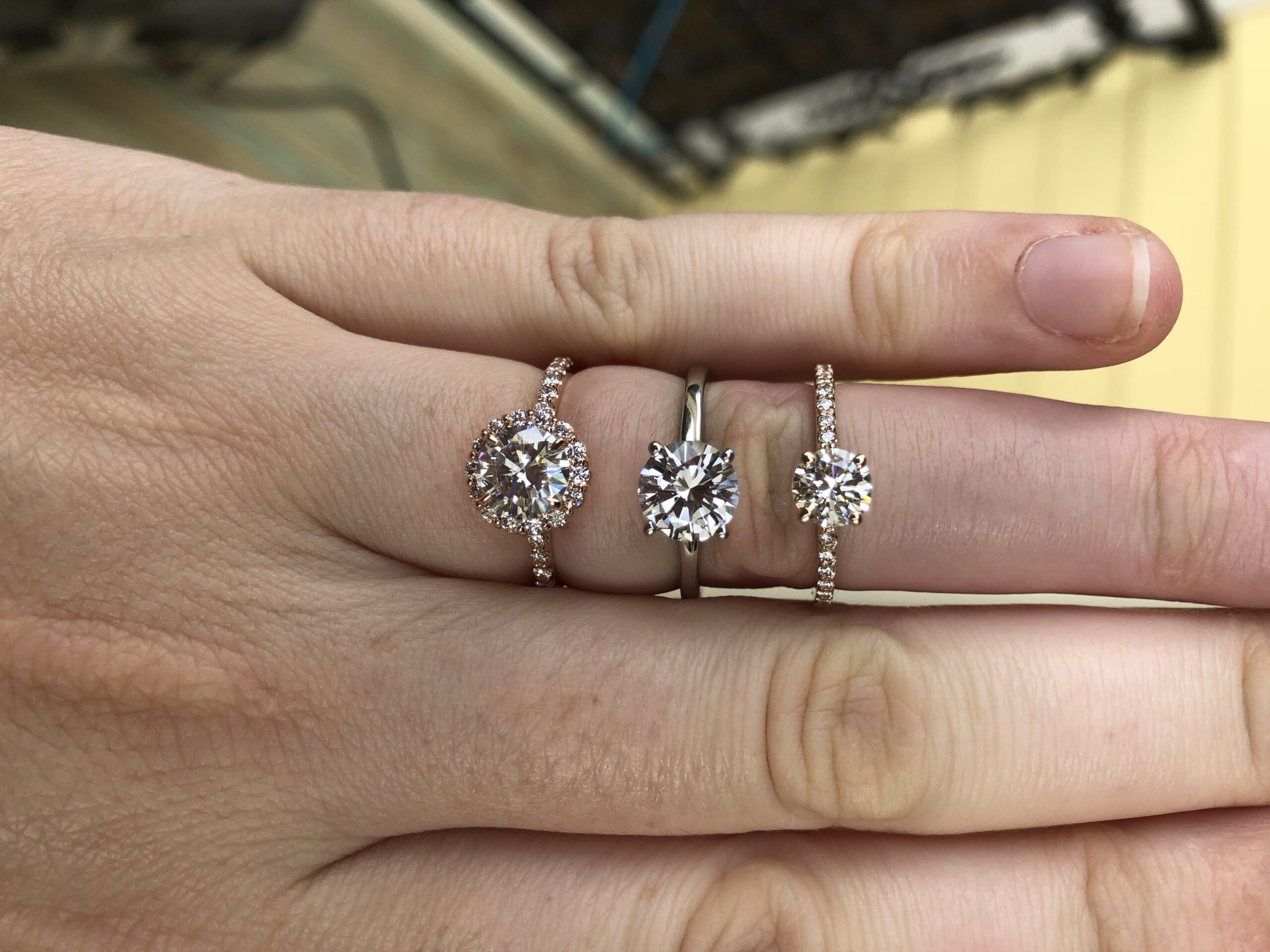
Moissanite (left) vs White Sapphire vs Diamond (right)
Sometimes. A combination tester may indicate moissanite, while a basic thermal tester may read it as diamond. The outcome depends on the model and testing conditions. A “diamond” or “moissanite” signal narrows the possibilities but doesn’t settle identity. Follow the device instructions and use trained gemological examination when needed.
Yes, combination testers can use thermal and electrical conductivity to help separate moissanite from diamond. A trained gemologist may also examine optical features, including double refraction, but no single check should be treated as conclusive when the stone is valuable or uncertain.
Use a tester only as the first screen. Then confirm the result with the stone’s documentation and a trained examination.
How to test for Moissanite using doubling instructions
Usually, no. Cubic zirconia (CZ) doesn’t transfer heat quickly enough to register as diamond on most basic thermal pens. Still, device setup and stone conditions can affect a result, so a negative reading is not enough to identify the material.
Thermal testing can help separate the two, but a trained gemologist combines that result with visual examination and appropriate instruments. Many graded diamonds carry a microscopic girdle inscription, yet the presence or absence of an inscription alone is not proof. Avoid home scratch tests or improvised light tests.
Cubic zirconia has a specific gravity of about 5.6 to 6.0, compared with 3.52 for diamond. That makes CZ more than 1.5 times as dense, so a loose same-size stone can feel noticeably heavier.
No. White Sapphire does not have high enough thermal conductivity to pass. And, white sapphire looks quite different than diamond, moissanite, and CZ, so using a pen tester is not common. Whereas the high conductivity gems show rainbow sparkle, white sapphire shows white and silver sparkle. It also tends to have a silvery undertone. So, these are often easier ways to spot sapphire from diamond.
Whereas diamond will pass a pen test and have rainbow sparkle, white sapphire will not pass and has white and silver sparkle. Sapphire is usually faceted differently than diamond, as well, with rectangular facets on the bottom of the stone. Finally, more nuanced tests include finding the “refractive index” of the gem. Notably, white sapphire’s refractive index also helps to distinguish white sapphire from white topaz!
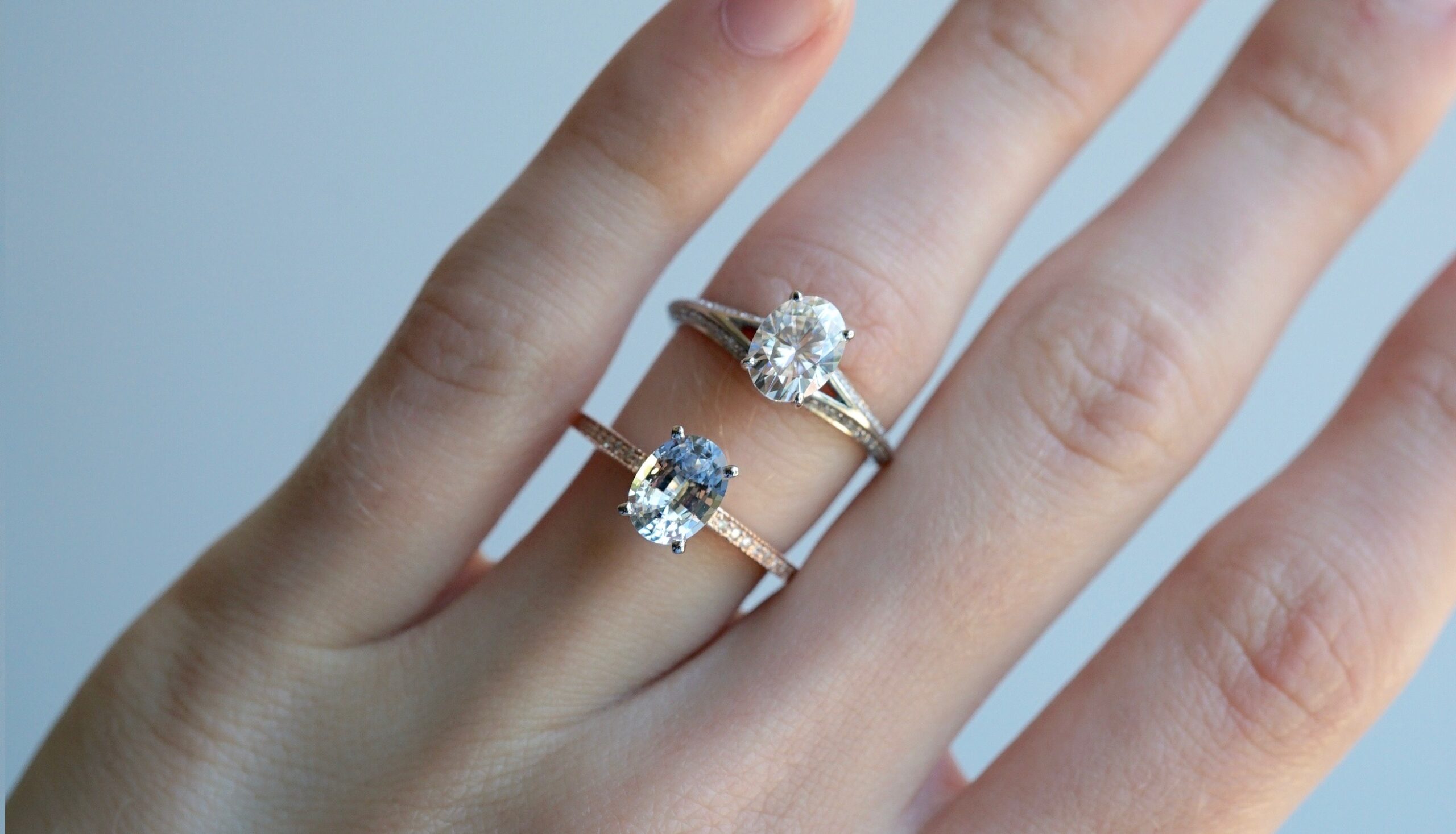
Moissanite (top) vs White Sapphire (bottom) ovals
Diamond testers can be accurate as screening tools when the correct device is clean, calibrated, and used as directed. Their result is not a guarantee of identity or origin, especially when moissanite or lab-grown diamond is possible.
Often, yes, if the tester tip can touch a suitable flat facet without contacting metal. Settings can make access harder and metal contact can distort some readings, so repeat the test and follow the model’s instructions.
Some devices have minimum-stone-size or probe-position requirements. Small facets are harder to contact cleanly, so check the tester’s stated limits and use a gemologist when the stone is too small for a reliable reading.
A correctly used electronic probe should not scratch a diamond, but pressing too hard, slipping into the setting, or using destructive home tests can damage the stone or metal. Use light contact and never substitute a scratch test.
Use an independent qualified gemologist or gemological laboratory when the result affects a valuable purchase, insurance, resale, or an identity dispute, or when repeated readings disagree. That’s also the safer next step for natural-versus-lab-grown origin.
Do Amore doesn’t offer appraisal or gem-testing services. If a result affects a valuable purchase, insurance, resale, or a stone-identity dispute, ask an independent qualified gemologist or gemological laboratory for the next step. When you’re choosing a ring, work with a jeweler that explains what was tested, which report supports the stone, and what the result does not prove. You can also read verified customer experiences (find them on Facebook, The Knot and Wedding Wire)!
When a pen result leaves you with more questions than answers, choose a ring with clear documentation and guidance behind it. Do Amore offers responsibly sourced, conflict-free natural and lab-grown diamonds, and every purchase gives one person access to clean water. Browse Do Amore’s engagement rings to compare both options with a clearer sense of what the tester can and cannot tell you.