Engagement Ring - In Progress
Setting
Stone
We guarantee that every single purchase directly impacts one person's life by giving them access to clean water.
Heart shaped diamonds are romantic and whimsical. As the universal symbol of love, choosing a Heart cut is the ultimate in romance. However, at the time of writing, only 1.6% of GIA-certified diamonds available for sale globally are Hearts (19,195 out of 1,178,007 diamonds)! In fact, they are the second most uncommon diamond shape in the world. Because of this rarity, most jewelers do not have much experience with Heart shaped diamonds. So, let’s go over several things you should look for prior to selecting one.
Heart cut diamonds are dreamy and whimsical. They have soft curving arcs (or “lobes”) at the top, and a graceful point at the bottom. Hearts can be tall and slender, or shorter and plump. Couples choosing a Heart should always look for a symmetrical, pleasing shape, a centered culet, and even contrast/brilliance.
Like other fancy cuts, GIA does not grade the cut quality of Heart shaped diamonds. So, jewelers that advertise Hearts with cut grades are merely offering their own opinion. The GIA Certificate will not have a cut grade. Couples should also know there is no industry accepted standard of what makes an “Ideal Cut Heart Shaped Diamond.” That said, there are certain things look for to ensure your Heart is the graceful beauty you want. We have put together the table below as a guideline for evaluating Heart cut.
EVEN CONTRAST/BRILLIANCE
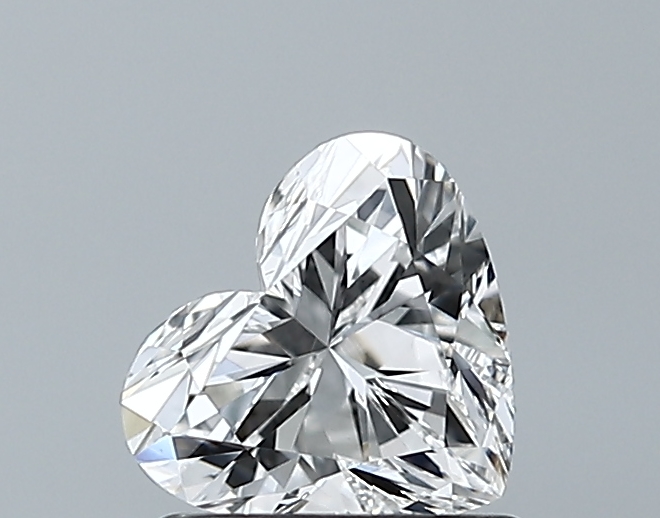
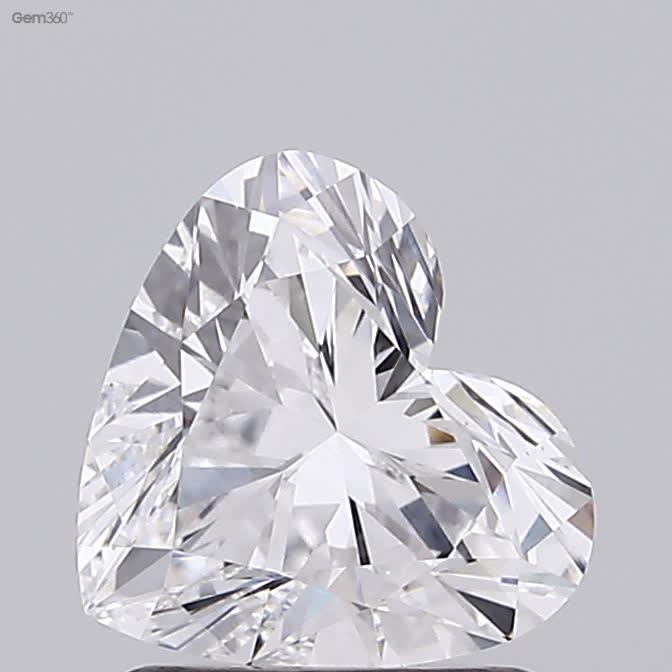
“Contrast” is dark areas of reflection within a diamond, whereas “brilliance” is light reflection! When looking for the most sparkly heart shaped stone, you want even areas of darkness and light. This allows for maximum play of light and sparkle.
Here is an example of a stone with even contrast/brilliance next to a stone with out it – note the second stone’s “washed out” appearance.
Additionally, here are the table and depth parameters to help ensure an ideal cut:
| IDEAL/EXCELLENT | PREMIUM | GOOD | |
| TABLE | 53-63 | 64 | 64.5+ |
| DEPTH | 60-63 | 64 | 64.5+ |
Ideal Cut (Most Sparkle)
Excellent Cut
Very Good
Table %
53 - 62
63-64
65 and Above
Depth %
57-62
55-56 or 63-66
Below 54 or Over 67
Girdle
Thin to Slightly Thick
Thin to Slightly Thick
Very Thin or Very Thick
Culet
Centered Point (No Culet)
Mostly Centered Point (No Culet)
Off-Centered Point or Small Culet
Length to Width Ratio
1.10 - 1.20
1.0-1.1 or 1.21 to 1.23
Below 1.0 or Above 1.24
Outline
Pleasing, Symmetrical
Slightly Too Flat or Rounded
Asymmetrical or Too Tall or Wide
Bow-tie
No Dark Bow-tie
Slightly Dark
Dark Bow-tie
Lobes
Rounded
Slightly Pointy
Pointy
A diamond’s “color” is how white it is, or how much yellow or brown warmth it shows. Evaluating color in Heart diamonds is unique! Color can concentrate in the bottom point of your stone due to different faceting technique, so always look at each area of your gem. You want your stone to look the same color in all areas.
Luckily, the brilliance of a Heart will mask a bit of color, so G-H colored diamonds will often appear colorless. This is especially true in warmed toned metals like yellow or rose gold. In white metals, color matters a bit more.
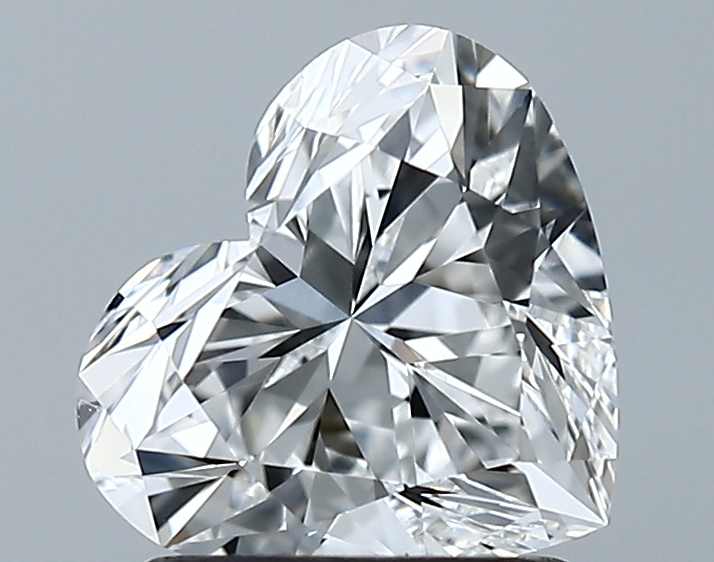
Here is an example of an E colored heart diamond next to an I colored heart shape diamond:

The following is a short guide to what many of our couples decide:
| WHITE METAL | YELLOW OR ROSE METAL | |
| >1ct | D-G | D-I |
| 1-2ct | D-G | D-H |
| 2+ct | D-F | D-G |
Carat Weight
No Visible Color
Slight Tint
Warmer Color
< 0.5
D - J
K - L
M - Z
0.5-1.0
D - I
J
K - Z
1.0-1.5
D - H
I
J - Z
1.5 +
D - G
H - I
J +
A diamond’s “clarity” is how many, or how few, birthmarks (“inclusions”) it has. Almost all diamonds have birthmarks – just like us!
Heart cut diamonds are “brilliant” cut stones that produce a ton of sparkle. As a result, small inclusions can be hidden by well-placed facets. So, couples choosing a Heart cut diamond can often select VS2 clarity gems and still get a flawless, eye-clean look. Because clarity is graded by how obvious inclusions are, a larger diamond with a small inclusion will receive a better clarity grade than a smaller stone with the same size inclusion. That said, this also means larger stones may have small eye-visible inclusions that are not too distracting. So, always look over your stone carefully (we double check for “eye clean” clarity in every stone we sell and inform couples if they are not!).
Here is an example of an SI1 clarity heart next to a VS1 clarity heart diamond:


The following is what we recommend to our couples:
| CLARITY | |
| >1ct | SI1+ |
| 1-2ct | VS2+ |
| 2+ct | VS1+ |
Carat Weight
Clean Under Light Magnification
Eye Clean
Visible Blemish Okay As Long As Not Very Obvious
< 0.5
FL-VS2
SI1-SI2
l1
0.5-1.0
FL-VS1
SI1-SI2
l1
1.0-1.5
FL-VS1
VS2-SI1
Sl2
1.5 +
FL-VS1
VS2
SI1-Sl2
When looking for a Heart, the overall shape of your diamond is the most important part. Great shape and sparkle will give you the best bang for your buck. Don’t be fooled by an unsymmetrical, pointy-lobed Heart for a low price! Instead, look for a nice plump Heart shaped diamond. It will give you the biggest look for the money, and the most sparkle!
01.
Photo & Video - Always ask the jeweler you are buying from for a detailed picture or video. Look for soft, curving lobes and symmetrical shape.
02.
Inspect It - Ask the jeweler to actually see the diamond. Inspect the diamond for visible inclusions and color consistency!
03.
Measure It - Make sure your diamond’s length-to-width falls between 1.10 and 1.20. Closer to 1.20 will give you a bigger bang for your buck!