




Your bag is empty
Explore timeless jewelry that carries love and inspires lasting impact.
We promise that every purchase you make gives one person access to clean, life-changing water.
Explore timeless jewelry that carries love and inspires lasting impact.
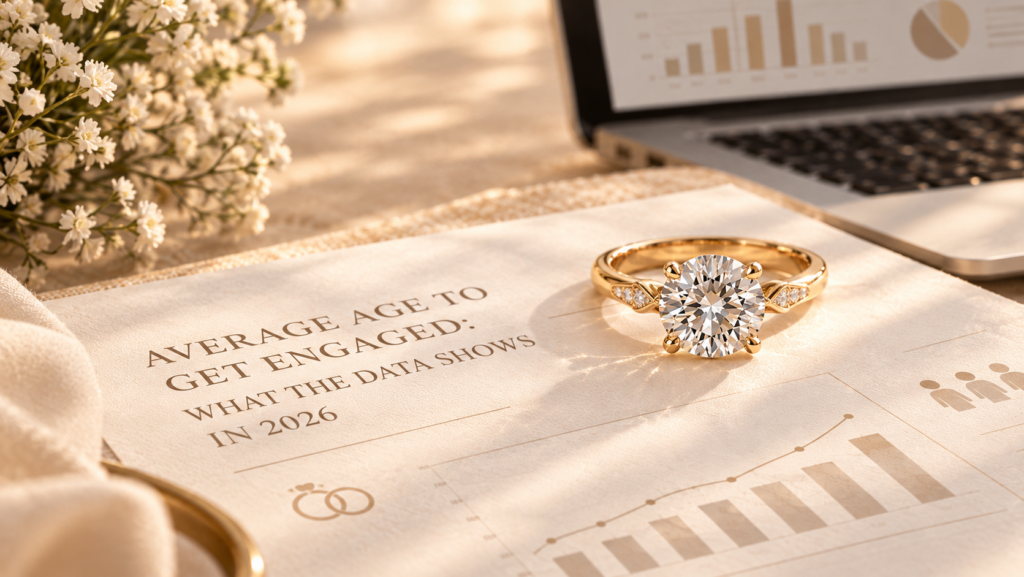
There is no single, reliable national or global average age to get engaged. A 2024 U.S. wedding-industry article puts the U.S. average at 29. Bridebook’s 2025 UK data gives a couple-level average of 34.4. The sources cover different countries and use different methods, so the two figures are not directly comparable (WeddingPro) (Bridebook engagement report).
This 2026 review keeps each figure attached to its real data year and separates age at engagement from age at marriage, dating time before engagement, and engagement length. The U.S. Census source used here reports age at first marriage, but this review found no current U.S. government series measuring age at engagement (U.S. Census Bureau).
| Statistic | What it measures | Year + source |
| 34.4 years | Average age of engaged couples in Bridebook’s UK report; not separate partner ages | 2025 report | Bridebook |
| 30% | Newly engaged couples under 30 in the UK report | 2025 report | Bridebook |
| 19% | Newly engaged couples over 40 in the UK report | 2025 report | Bridebook |
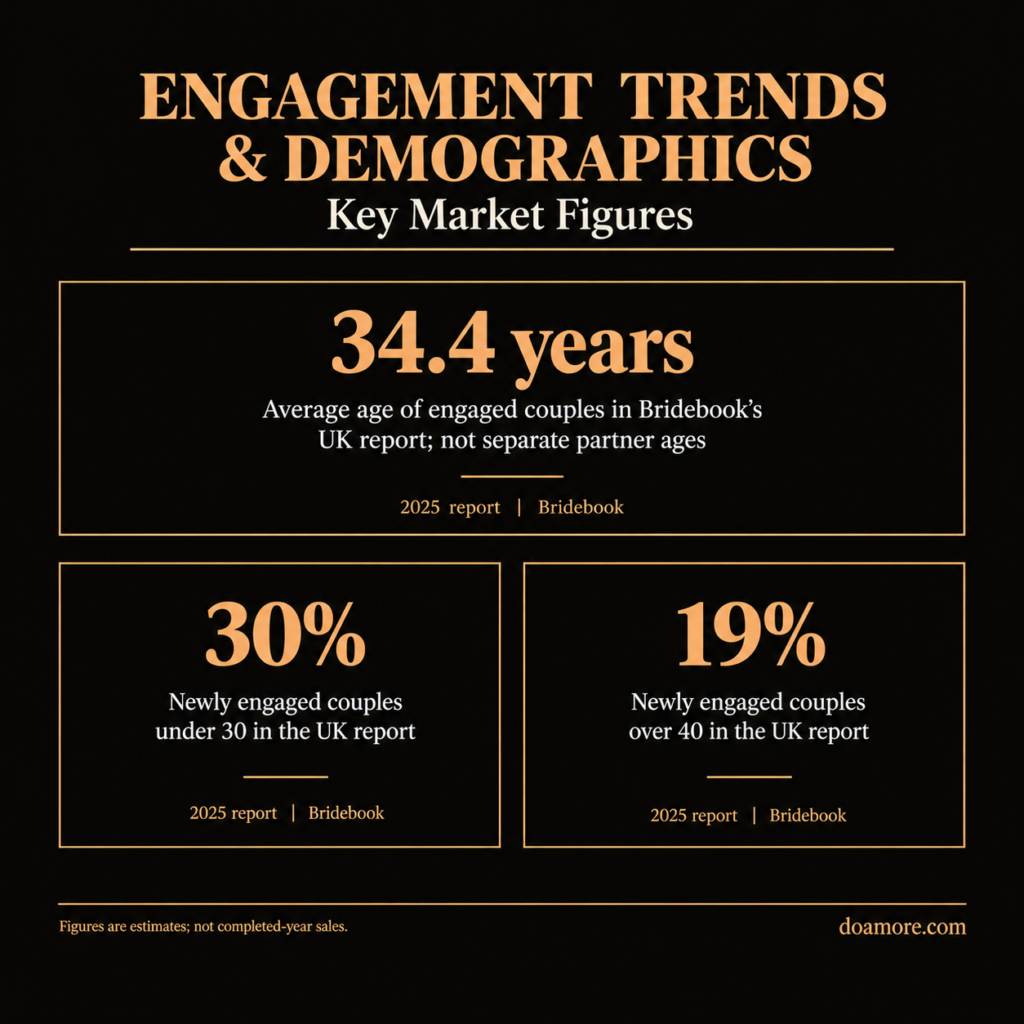
No single reliable national or global average age to get engaged exists. A 2024 U.S. wedding-industry article reports 29. Bridebook’s 2025 UK data reports a couple-level average of 34.4 (WeddingPro) (Bridebook engagement report).
WeddingPro does not disclose the sample, field dates, calculation, or measure behind its U.S. figure, so 29 should be treated as an industry estimate rather than a national population statistic (WeddingPro).
Bridebook’s 2025 findings, drawn from more than 6,800 UK couples, report that 30% of newly engaged couples were under 30 and 19% were over 40 (Bridebook engagement report) (Bridebook 2025 report).
The U.S. Census Bureau reports 2025 median ages at first marriage of 30.8 for men and 28.4 for women. These are marriage figures, not engagement ages (U.S. Census Bureau).
Averages do not identify an ideal timeline or predict relationship success. Do Amore engagement rings are made to order with recycled precious metals, and every purchase provides one person with clean water.
Available sources place the average at 29 in a 2024 U.S. wedding-industry article and 34.4 among engaged couples in Bridebook’s 2025 UK data. Neither is a national government engagement-age statistic, and the different populations and methods make a direct U.S.-UK comparison unreliable (WeddingPro) (Bridebook engagement report).
Bridebook says its 2025 report draws on more than 6,800 UK couples (Bridebook 2025 report). WeddingPro provides no corresponding public sample detail for its U.S. figure (WeddingPro). Without matching sample details, a clean comparison isn’t possible.
| Geography | Data year | Population | Measure | Figure | Sample | Main limitation |
| U.S. | 2024 publication | People who get engaged | Average, type unstated | 29 (WeddingPro) | Not disclosed | No public method |
| UK | 2025 data | Engaged couples | Couple-level average | 34.4 (Bridebook engagement report) | 6,800+ (Bridebook 2025 report) | Partners not separated |
For the U.S., the clearest current figure we found is 29. WeddingPro published that number in March 2024 as the average age of someone who gets engaged in the U.S. (WeddingPro).
Treat 29 as an industry estimate. The public article gives no sample size, field period, calculation method, engagement order, or separate partner data. The article leaves unclear whether the figure is a mathematical mean, a median, or a rounded summary. (WeddingPro)
We found no current national U.S. mean or median for age at engagement in Census Bureau or other government data. Marriage is a legal event. Engagement is a private relationship milestone. No comparable national engagement registry surfaced in this review.
Bridebook’s 2025 figures provide the most detailed current engagement-age distribution located for this article. The average age of engaged couples was 34.4, 30% of newly engaged couples were under 30, and 19% were over 40 (Bridebook engagement report).
The UK Wedding Report behind those figures covers more than 6,800 UK couples (Bridebook 2025 report). Its public article labels 34.4 as the average age of engaged couples. It does not provide separate ages for each partner or explain on the page how the couple-level average was calculated.
The UK result should stay in its own lane. It cannot stand in for the U.S. population, and it cannot be converted into separate averages for women, men, or partners of any gender.
Age averages can describe a group, but they cannot tell one couple whether an engagement fits their plans.
Before treating any published average as a milestone, an engagement ring guide can help couples compare ring preferences before they talk through proposal expectations, budget, and timing. Do Amore gives that decision a values-based option through made-to-order engagement rings crafted from recycled precious metals. Every purchase provides one person with clean water.
Those choices do not define the right age. They give couples concrete questions about cost, design, and impact to discuss together.
These measures answer different questions. Age at engagement records how old someone was when the proposal or agreement to marry occurred. Age at marriage records age at the legal wedding. Engagement duration measures time between those events.
| Measure | Meaning | Do not infer |
| Age at engagement | Age when the proposal or agreement occurs | Age at marriage |
| Age at marriage | Age at the legal wedding | Age at engagement |
| Engagement duration | Time from engagement to wedding | Dating length or either partner’s age |
Subtracting 14 or 26 months from an average marriage age would create an unsupported estimate. The people, age distributions, engagement histories, and calculation methods in the source datasets do not line up closely enough for that arithmetic. (Bridebook engagement report) (The Knot 2026 study)
Engagement order matters too. A first engagement and a later engagement may happen at very different ages. None of the current direct sources used here separates first engagements from subsequent engagements, so this article does not claim to do so.
Marriage records show that people are reaching a legal first marriage later than in the past, but they do not reveal when those couples got engaged. In the 2025 U.S. Current Population Survey Annual Social and Economic Supplement, the median age at first marriage was 30.8 for men and 28.4 for women. In 1975, the medians were 23.5 and 21.1 (U.S. Census Bureau).
Those are medians, meaning half of the measured population falls below the reported value and half above it. They are not means, and they apply to first marriages rather than every marriage.
England and Wales data show the same need for careful labels. For 2022 first legal partnerships, the median age for opposite-sex marriages was 32.7 for men and 31.2 for women. For same-sex marriages, the medians were 36.2 for men and 32.6 for women (Office for National Statistics).
Surveyed married couples can produce another kind of number. The Knot’s study of 10,474 U.S. couples married in 2025 reported an average age of 32 (The Knot 2026 study). Bridebook’s 2026 report, based on more than 7,000 UK couples and describing 2025 weddings, reported an average age of married couples of 34.8 (Bridebook 2026 report). Neither figure measures age at engagement.
Timing data can describe how long couples dated or remained engaged, but it still cannot supply age at engagement. Bridebook’s 2025 UK figures report an average engagement length of 26 months. The same source says 22% got engaged within the first year of dating and 64% within two years (Bridebook engagement report).
Bridebook’s 2026 report, which summarizes 2025 weddings from more than 7,000 UK couples, reports an average engagement duration of 23.8 months. It says 68% of engagements lasted less than 24 months (Bridebook 2026 report).
The Knot’s 2026 study surveyed 10,474 U.S. couples who married in 2025 and reports an average engagement of 14 months (The Knot 2026 study). Participants were recruited from The Knot or WeddingWire membership, so this is a platform-member married cohort rather than a national engagement registry.
The data runs out quickly. No verified current U.S. national dataset separating first engagements from later engagements was found. The direct sources omit a current U.S. engagement-age median, separate partner means, and a population-wide age distribution.
Platform and customer surveys still tell us what happened among the people who responded. Present them as complete national counts only when the methodology supports that claim.
Age alone says nothing about readiness, compatibility, or future relationship outcomes. A descriptive average can show where a surveyed group clustered. It cannot turn 29, 34.4, or any other value into a recommendation. (Bridebook engagement report)
Start with the measure. A mean adds all values and divides by the number of observations. A median is the midpoint. A percentage describes a share of the sample. A couple-level average may combine partners in a way that an individual average does not. Do Amore’s engagement ring statistics page applies the same discipline to cost, carat-size, and trend data.
Then check the year, country, population, sample, and wording. Different datasets can answer different questions even when they use similar language. A national administrative series, a customer survey, and a market estimate should never be treated as interchangeable.
Older figures can remain informative when their dates are visible. Do Amore’s broader jewelry statistics keeps each market figure tied to its source and year. Calling older figures 2026 results would be misleading. Here, 2026 describes when this evidence review was completed, not when every underlying observation was collected.
| Source | Geography | Population | Sample | Data year | Publication | Known limitation |
| WeddingPro | U.S. | People who get engaged | Not disclosed | Unstated | 2024 | Mean or median unspecified (WeddingPro) |
| Bridebook article | UK | Engaged couples | From 2025 report | 2025 | 2026 update | Couple-level wording (Bridebook engagement report) |
| Bridebook report | UK | Report respondents | 6,800+ | 2025 report | 2025 | Landing page gives sample only (Bridebook 2025 report) |
| U.S. Census Bureau | U.S. | First-marriage estimate | CPS ASEC | 2025 and 1975 | 2025 | Marriage, not engagement (U.S. Census Bureau) |
| ONS | England and Wales | First legal partnerships | Administrative marriage data | 2022 | 2024 | Marriage, not engagement (Office for National Statistics) |
| The Knot | U.S. | Couples married in 2025 | 10,474 | 2025 | 2026 | Member-recruited cohort (The Knot 2026 study) |
| Bridebook 2026 | UK | Couples with 2025 weddings | 7,000+ | 2025 weddings | 2026 | Married-couple and timing data (Bridebook 2026 report) |
Current public engagement-age data remains sparse. No verified current national dataset covering first versus later engagements, separate partner averages, and a U.S. population-wide distribution was found.
Once the average age to get engaged is in context, your next question may be financial rather than demographic. Do Amore’s guide to how much to spend on an engagement ring covers budgeting without treating a group average as a rule. Use the guide to set a range that fits your life, then talk through style and meaning together. If clean-water impact belongs in that plan, compare Do Amore’s made-to-order settings after you agree on the budget.