














Your bag is empty
Explore timeless jewelry that carries love and inspires lasting impact.
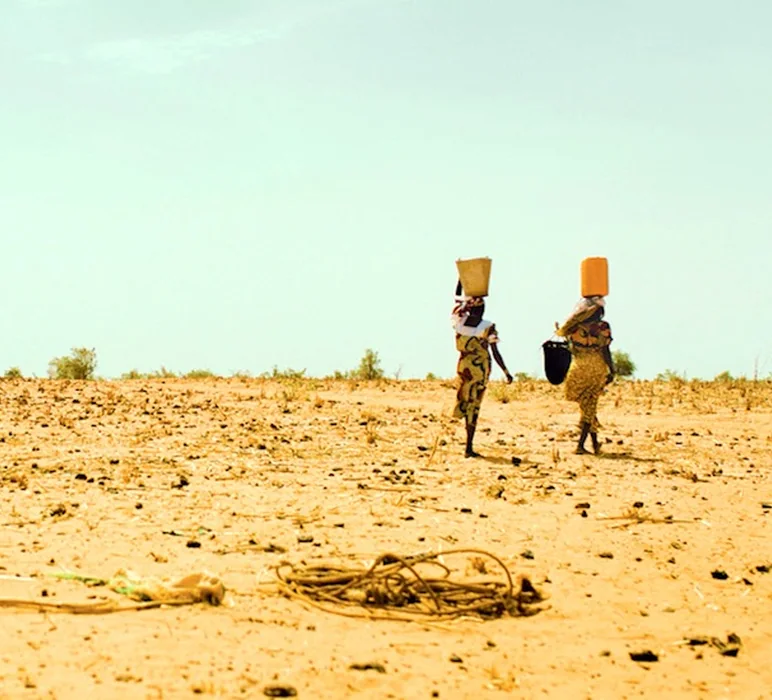
We promise that every purchase you make gives one person access to clean, life-changing water.
Explore timeless jewelry that carries love and inspires lasting impact.

Conflict diamond statistics can answer useful questions, but only when the data is described precisely. The latest complete Kimberley Process trade tables available for this 2026 update cover calendar year 2025. They record legal natural rough-diamond production and cross-border shipments. (Kimberley Process annual statistics)
They do not count every conflict diamond, measure all smuggling, or prove that each stone is free from wider human-rights, labor, or environmental concerns. (OECD)
| Statistic | What it measures | Year + source |
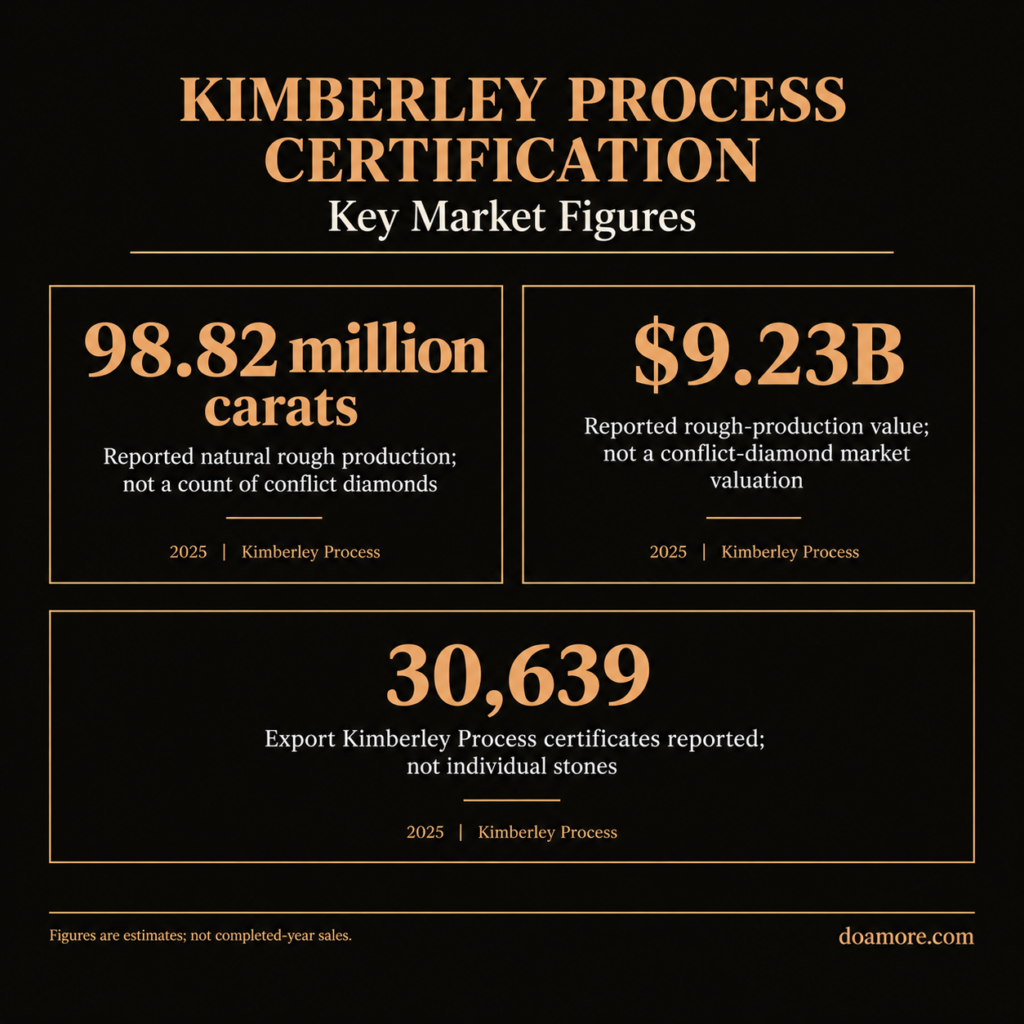
| 98.82 million carats | Reported natural rough production; not a count of conflict diamonds | 2025 | Kimberley Process |
| $9.23 billion | Reported rough-production value; not a conflict-diamond market valuation | 2025 | Kimberley Process |
| 30,639 | Export Kimberley Process certificates reported; not individual stones | 2025 | Kimberley Process |
Keep those categories separate. A large legal-trade total does not mean the same volume was newly mined, and a certificate count is not a stone count.
War-era estimates cannot be carried forward as current facts. This guide keeps the boundaries visible, giving you a practical way to compare claims without mistaking confidence for proof.
The Kimberley Process defines conflict diamonds narrowly. They are rough diamonds used by rebel movements or their allies to finance armed conflict aimed at undermining legitimate governments. The term “blood diamonds” is often used more broadly in everyday conversation, but the legal scheme is built around that specific conflict-financing definition. (Kimberley Process FAQ)
The definition has a tight scope. It applies to rough diamonds and centers on financing by rebel movements or their allies. The definition ties that financing to armed conflict against a legitimate government, which means serious claims involving labor abuse, unsafe mining, corruption, environmental damage, or state violence may fall outside the formal definition even when the harm is real.
This is why “Kimberley Process compliant” and “free from every ethical concern” are not interchangeable statements. The scheme addresses one defined problem in the rough diamond trade. Broader responsible sourcing requires additional due diligence, transparent business practices, and careful attention to evidence beyond a single shipment certificate.
That narrow wording creates real confusion. One person may use “conflict diamond” for any diamond connected to serious harm. Another may mean only the formal KPCS definition. Both are asking important questions, but each question calls for different evidence. Name the definition first, then address wider concerns separately.
Precise wording guards against overclaiming. A broader sourcing concern does not automatically make a stone a KP-defined conflict diamond. Falling outside the formal definition does not make a documented labor, environmental, or human-rights concern unimportant. The evidence deserves clear language.
The Kimberley Process controls international rough-diamond shipments through participant laws, tamper-resistant containers, government-validated certificates, and trade only among compliant participants. (Kimberley Process FAQ) (Kimberley Process core document)
The Kimberley Process began with a meeting of southern African diamond-producing states in Kimberley, South Africa, in May 2000. Representatives from 37 countries signed the Kimberley Process Certification Scheme in November 2002, and the scheme entered into force in 2003. (Kimberley Process)
Participating economies are expected to maintain internal controls and trade rough diamonds only with other participants that meet the scheme’s minimum requirements. International shipments must travel in tamper-resistant containers with government-validated certificates.
The covered customs categories are HS 7102.10, 7102.21, and 7102.31. Polished diamonds do not require a Kimberley Process certificate. (Kimberley Process FAQ) The core document sets a reporting rhythm. Participants provide aggregated import and export totals and certificate counts each quarter.
They report production by carat weight and value every six months. (Kimberley Process core document) These administrative records make the legal rough trade more visible, but they depend on the quality and consistency of national controls.
The rules and institutions have shifted since then. The Central African Republic was suspended in 2013, and the remaining export restrictions were lifted in 2024. (UN report on the Central African Republic)
A Permanent Secretariat was inaugurated in Gaborone, Botswana, in 2024, and Uzbekistan joined the same year. (Kimberley Process) A World Trade Organization waiver supporting the scheme was renewed through December 31, 2030. (WTO)
The main 2025 Kimberley Process statistics recorded 98.82 million carats of natural rough-diamond production with a value of US$9.23 billion. It recorded 263.65 million import carats and 264.12 million export carats. (Kimberley Process annual statistics) Those figures answer different questions.
Production measures rough diamonds reported as mined during the year. Import and export tables measure shipments crossing participating borders.
The same parcel can appear in more than one country’s trade record when it moves through a cutting center or trading hub. Re-exports and mixed-origin parcels can make trade flows much larger than annual mine output.
Import, export, and production carats should not be added together as though they were separate newly mined stones. Value needs the same care. The 2025 global production average of US$93.43 per carat combines many qualities, sizes, and origins. (Kimberley Process annual statistics)
It is not a retail price and should not be applied to a particular polished diamond. Likewise, the global trade values of US$25.60 billion for imports and US$25.28 billion for exports include commercial movements, not only value created at a mine. (Kimberley Process annual statistics)
Legal records have a hard boundary. They describe only what participants declared.
Smuggled goods, false declarations, informal cross-border movements, and material whose origin has been obscured may not appear accurately. No defensible current global conflict diamond percentage can be calculated by subtracting or comparing the published production and trade totals.
The Kimberley Process itself estimates that conflict diamonds account for less than 0.1% of world production. (Kimberley Process FAQ)
Readers should understand that figure as the scheme’s own estimate and not as a census of hidden trade. The responsible conclusion is narrower. The officially recorded trade is extensive, formal controls exist, and the true scale of illicit activity remains difficult to measure.
Certificate counts need interpretation too. The 30,499 import certificates and 30,639 export certificates reported in 2025 refer to documents attached to cross-border shipments. (Kimberley Process annual statistics)
A parcel may contain many rough stones, and a stone can travel through more than one jurisdiction before cutting. The counts cannot be divided into carats to estimate the number of diamonds or the number of consumers affected.
Differences between import and export values are not a shortcut to an illicit-trade estimate. Timing, inventory, assortment, valuation practices, sorting, and onward shipment can all change the recorded value of flows. Any investigation of an unusual gap would need parcel-level, company-level, and customs evidence that the global summary does not provide.
The tables are still useful. They establish the scale of declared activity, support year-to-year and country-level comparisons, and make reporting patterns visible. Their best use is as an administrative baseline that can be read alongside enforcement reports, field evidence, and supply-chain due diligence.
The history of the blood diamond trade explains why governments built a certification system in the first place. It shows why every older figure needs to keep its date attached.
In a 2002 report, a UN panel said Sierra Leone had recorded US$20 million in certified diamond exports by June of that year, averaging about US$5 million per month. The report projected US$40 million for the year and cited an official estimate that total production was closer to US$100 million annually. (UN report on Liberia)
On those inputs, more than half of output was thought to be smuggled. These were contemporaneous estimates from a country emerging from conflict, not measurements of today’s global market. (UN report on Liberia)
The same report identified 5 problematic Sierra Leone certificates, fewer than 2% of the 325 certificates issued during the reviewed period. Together they covered 559.70 carats valued at US$81,391.52. (UN report on Liberia)
The small share of flagged documents did not establish that all other flows were risk-free. It illustrated the kind of document-level anomaly investigators could examine.
For Guinea, the panel recorded 115 certificates covering 352,759 carats valued at US$18,293,294 from January through July 2002. (UN report on Liberia) Those figures belong to a specific seven-month period and should not be compared directly with full-year current production without careful adjustment.
The official Kimberley Process FAQ says Sierra Leone’s legal diamond exports increased one hundredfold after its civil war ended in 2002. The FAQ estimates that 10% of the country’s population relies on the diamond industry for a living. (Kimberley Process FAQ)
Both claims should be attributed to the institution. They describe the importance of legal market access and livelihoods, not a universal formula for every diamond-producing country.
The policy story did not stop in 2003. On March 25, 2025, the UN General Assembly adopted without a vote resolution A/RES/79/275 on breaking the link between illicit rough-diamond transactions and armed conflict. (UN General Assembly) The vote date is current policy history, not a new measurement of the share of conflict diamonds.
Historical evidence only helps when its population and method stay visible. The Sierra Leone and Guinea numbers came from a UN panel examining sanctions, certificates, smuggling, and regional trade during a particular period. They should not be merged into a single worldwide series or used to describe countries that were outside the study.
The same rule applies to dramatic historical estimates found in older commentary. A number is better omitted if its original source, date, geography, and method cannot be verified. This article does not repeat unsupported global war-era percentages or convert them into a 2026 claim.
Statistics from diamond-producing countries show how widely natural rough-diamond industries differ. They are not an ethics ranking or a risk score.
In 2025, Angola reported production of 15,195,293 carats valued at US$1,811,575,243.07. Botswana reported 15,495,829 carats valued at US$1,978,204,562, and Canada reported 14,103,511 carats valued at US$892,505,366.39. Russia’s reported production was 31,511,941.67 carats valued at US$2,724,463,192.95. (Kimberley Process annual statistics)
The Democratic Republic of the Congo reported 8,913,219.39 production carats valued at US$44,629,428.44, an average of US$5.01 per carat. Its exports were higher at 9,419,728.70 carats valued at US$68,995,385.98 under 202 export certificates. (Kimberley Process annual statistics)
The difference can reflect inventory, timing, re-exports, and other trade dynamics. It should not be treated as proof of illicit activity.
Smaller volumes can carry sharply different average values. Liberia reported 34,106.79 production carats worth US$7,989,468.81, or US$234.25 per carat. Sierra Leone reported 121,619.65 carats worth US$19,502,862.19, or US$160.36 per carat. (Kimberley Process annual statistics)
Average value per carat varies with stone size, quality, deposit type, and product mix. It is not a sourcing score.
The Central African Republic offers a clearer look at documented current risk. Its 2025 legal production record was 113,394.03 carats valued at US$15,125,898.16. Exports totaled 71,754.64 carats worth US$7,926,006.95 across 18 certificates. (Kimberley Process annual statistics)
A UN panel separately reported 28,875.99 carats of official exports in the first quarter of 2025, compared with 18,178.86 carats in the first quarter of 2024. One exporter handled official exports in early 2025 and had accounted for 95% of the country’s official exports in 2024. (UN report on the Central African Republic)
The UN report described risks in the illicit diamond trade and weaknesses in traceability. That evidence supports careful scrutiny of control systems. It does not justify labeling every miner, exporter, or diamond from the country as illicit.
Recorded production can reflect distinct mining structures. Large industrial mines, smaller mechanized operations, and artisanal production present different oversight and traceability challenges.
National totals cannot show those differences on their own. They are starting points for asking where and how material entered the legal chain. Country comparisons should pair the numerical table with evidence about institutions, enforcement, trade routes, and the period covered. A high production total is not proof of weak controls.
A low total is not proof that risk is absent. Neutral wording avoids turning a supply-chain question into a judgment about an entire country or community.
USGS data add another scope distinction. The agency estimated that Russia supplied about 30% of global gem-quality natural diamond production by volume in 2025. (USGS Gemstones)
In a separate industrial-diamond dataset, it estimated natural industrial production shares of 42% for Russia, 18% for the Democratic Republic of the Congo, 14% for Botswana, 13% for Zimbabwe, and 8% for South Africa. Together, those five shares equal about 95%, a calculation based on the published inputs. (USGS Industrial Diamond) Industrial diamond figures should never be presented as shares of the gem jewelry market.
A Kimberley Process certificate is a government-validated document for an international shipment of rough diamonds. It is not a grading report for an individual stone, a retailer certification, or a universal ethical warranty.
The scheme has practical value. It establishes shared minimum requirements, participant-to-participant trade rules, certificate data, and recurring statistical reporting.
It gives authorities a framework for checking declared shipments and identifying anomalies. The existence of limits does not make those controls meaningless.
Still, traceability can break down. OECD research describes limited administrative capacity, corruption, coercion, and certificates covering mixed-origin mineral parcels as problems that can weaken traceability systems.
It notes that the KPCS has operated since 2003. (OECD) These challenges help explain why a valid document should be understood within a larger sourcing process.
A diamond grading report answers a different set of questions, usually about gemological characteristics such as carat weight, color, clarity, and cut. Origin documentation concerns where material was mined or handled.
A retailer’s sourcing policy concerns its own supplier expectations and review practices. Do Amore’s diamond certification guide explains grading documentation in more detail, but no grading report replaces rough-diamond trade controls or broader due diligence.
The clearest limit is that Kimberley Process certification does not guarantee freedom from all human-rights, labor, or environmental concerns. It addresses the scheme’s defined conflict-financing problem. A careful buyer can value that control and still ask what other evidence supports a seller’s sourcing claims.
The phrase “conflict-free” needs the same layered reading. Ask more than “Is there a certificate?” Ask what definition the claim uses, which stage of the supply chain the evidence covers, and what happens when a concern is discovered. A precise answer tells you more than an absolute label.
Responsible diamond sourcing can strengthen the picture through supplier requirements, origin information where available, documented escalation procedures, and clear consumer disclosures. None of those practices creates perfect visibility. Together, they can show how a company approaches risks that sit outside the KPCS definition.
Consumers do not need access to confidential commercial records to ask sensible questions. A seller should be able to explain the difference among a KPCS shipment certificate, an individual grading report, and its own sourcing policy without suggesting that one document performs all three jobs.
The strongest sourcing claim is one you can break into separate, answerable questions. Ask what “conflict-free” means, which document supports it, how the seller handles risks outside the Kimberley Process, and whether the metal has its own sourcing standard.
Do Amore gives buyers a useful example of that layered approach. Its engagement rings page says each ring is made from recycled precious metals and set with ethically sourced stones. That does not turn one policy into a universal guarantee. It shows why the stone, metal, documents, and seller policy should be reviewed as separate parts of the same purchase.
The Kimberley Process concerns natural rough diamonds. The legal controls do not apply to lab-grown production because a laboratory-created diamond was not mined and does not enter the rough-diamond supply chain in the same way.
That boundary is about origin, not appearance or desirability. People can choose between natural diamonds and lab-grown diamonds based on their priorities, budget, and the information available for a particular stone. The responsible approach is to describe each accurately rather than treating one category as a moral shortcut.
Rough and polished are different market stages. A rough natural diamond can cross borders under the KPCS before cutting. Once polished, it no longer requires a Kimberley Process certificate. Finished jewelry statistics may include polished diamonds, settings, labor, retail margins, and consumer demand, so they cannot be substituted for rough-trade data.
Industrial diamonds form another distinct category. USGS estimated that synthetic industrial diamonds accounted for more than 99% of global industrial-diamond production and consumption, with more than 15 billion carats manufactured worldwide. (USGS Industrial Diamond) Those figures relate to abrasives, cutting, and other industrial uses. They do not describe the lab-grown gem market or the share of engagement-ring center stones.
Read conflict diamond statistics by checking the data year, geography, unit, supply-chain stage, and whether a figure is a record, estimate, calculation, or forecast.
For broader market context, Do Amore’s jewelry statistics page applies the same discipline to consumer and industry numbers. Keep the year, geography, unit, and methodology attached to each claim.
These questions do not require a buyer to become a trade-policy expert. They separate documents, claims, and sourcing practices that answer different questions.
The quality of the answer matters more than the number of labels. Clear scope, a named document, and an honest description of what remains uncertain are stronger signals than a sweeping promise. If a seller cannot explain what a term means, it is reasonable to pause and ask for the claim in writing.
Compare like with like. A natural diamond’s rough-trade documentation, a lab-grown diamond’s origin disclosure, and a grading report each serve different purposes.
The goal is not to force them into one framework. It is to understand which question each piece of evidence can answer.
Responsible sourcing and social impact answer different questions. Sourcing asks how a product was made and moved through the supply chain. Impact asks what a purchase supports after that decision.
Do Amore keeps those ideas separate. Its impact program says every purchase gives one person access to clean water, then provides updates and the well’s GPS coordinates. That result does not replace sourcing evidence, certification, or due diligence. It gives a buyer another verifiable question to ask. What effect does this purchase fund, and how can I see it?
Current evidence shows that illicit trafficking and traceability risks have not disappeared. The 2025 UN findings on the Central African Republic are one documented example. (UN report on the Central African Republic)
No reliable independently measured current global share captures all hidden trade. The careful answer is that risk persists, but its worldwide scale cannot be read directly from legal KP statistics.
The Kimberley Process requires participants to apply controls to international shipments of rough diamonds and trade only with compliant participants. National laws and sanctions determine specific legal consequences.
A shipment may violate applicable rules. The broader phrase “conflict diamond” is often used more loosely in public discussion.
No. It documents a rough-diamond shipment under a scheme focused on preventing diamonds used by rebel movements or their allies from financing conflict against legitimate governments. It does not guarantee that every broader human-rights, labor, corruption, or environmental concern has been resolved.
No. The scheme covers natural rough diamonds in specified customs categories. Lab-grown diamonds have a different production path. That does not remove the value of asking about energy, labor, disclosures, or other relevant practices for any product.
No. The official FAQ says polished diamonds do not require KPCS certificates. (Kimberley Process FAQ) The certificate applies to international shipments of rough stones before polishing.
KPCS certification concerns government controls on rough-diamond shipments. Gemological grading describes an individual stone’s characteristics. Origin documentation and a seller’s sourcing policy add other types of information. One document should not be treated as a substitute for all the others.
As checked on October 15, 2026, the scheme listed 60 participants representing 86 countries, with the European Union counted as one participant, and 4 observers. (Kimberley Process FAQ) Membership and participation can change, so the official site is the right place to confirm a later count.
India chaired the process in 2026. Its intersessional meeting took place in Mumbai from May 11 to 14 under the theme “Credibility, Compliance and Consumer Confidence.” (Kimberley Process)
Those are 2026 institutional developments. They do not turn the 2025 trade tables into 2026 production data.
Conflict diamond statistics are most useful when they stay connected to their scope. The 2025 tables describe declared legal rough-diamond activity. Historical UN figures describe particular conflicts and enforcement periods. Current risk reports identify vulnerabilities, but they do not provide a complete global prevalence rate.
Certification is one layer of a responsible decision, not the end of the conversation. A clear grading report, accurate origin disclosure, transparent sourcing practices, and honest limits all matter.
Do Amore pairs ethically sourced stones with recycled precious metals and a one-to-one clean-water impact. When you are ready, compare its natural and lab-grown diamond options side by side, then ask a diamond expert to walk through the report and sourcing information for the stone you are considering. Choose at the pace that feels right.